Situation Summary
Russia remains at composite threat level #5 globally (score 100), driven primarily by ongoing active warfare and 1,016 tracked events. The last 24–48 hours show sustained military activity, diplomatic friction with Ukraine and Serbia, and public statements directed at Western actors, with no material de-escalation signals. Risk remains elevated across southern, central, and Arctic regions, with operational and political volatility continuing to drive corporate security concerns.
Key Developments
- 2026-06-11 · Artillery/Tank Operations · Kiev sector – Russian conventional military forces conducted artillery and tank operations in the Kiev operational zone; no casualty or damage specifics yet corroborated in open sources.
- 2026-06-11 · Conventional Military Force Deployment · Russia (unspecified location) – Broader Russian military force activation noted; context and scale remain under clarification.
- 2026-06-11 · Diplomatic Disapproval (mutual) · Serbia–Russia – Bilateral diplomatic friction escalated with mutual statements of disapproval; implications for regional alignment and Russian energy/trade partnerships in the Balkans warrant monitoring.
- 2026-06-11 · Public Statement · Russia vs. Germany – Russian statement directed at Germany; content and tone (escalatory or dismissive) require corroboration from primary sources.
- 2026-06-10 · Public Statement · Russia vs. Ambassador (likely Western) – High-level diplomatic messaging; typically signals broader policy or sanctions messaging.
- 2026-06-09 · Territory Occupation · Russia vs. Donetsk – Reported territorial activity in Donetsk conflict zone; ongoing operational posture in active war theater.
- 2026-06-11 · Multiple Disapproval Statements · Ukraine vs. Russia – Repeated Ukrainian diplomatic rejections and disapproval of Russian actions suggest escalation in rhetoric and/or operational tempo.
Note: Open web research could not reliably isolate additional genuine 24–48 hour incidents from archived or recirculated material with sufficient time precision. Corporate teams operating in-country or with Russian operations should cross-check against real-time Russian-language media, official government travel advisories, and specialist intelligence feeds for incident detail not yet in open circulation.
Highest-Risk Areas
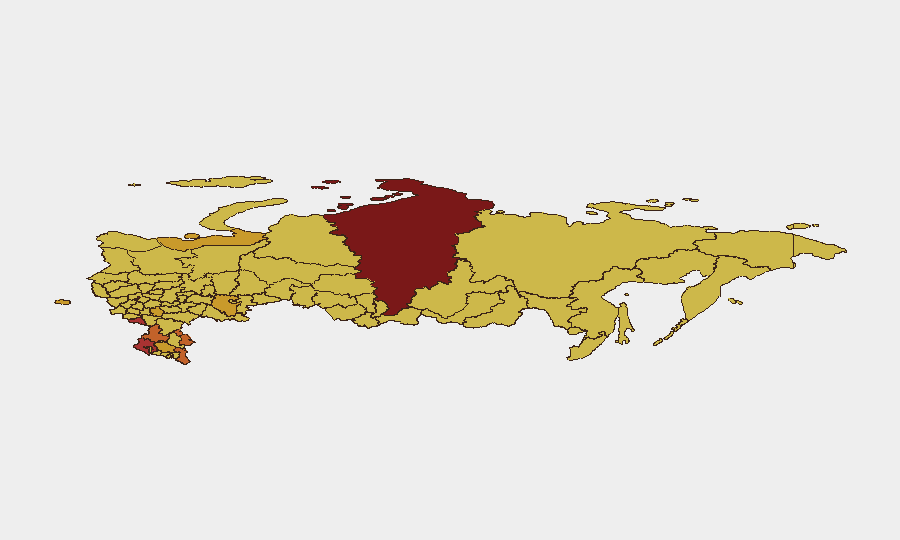
Krasnoyarsk Krai (score 100), Moscow (97.4), and Saint Petersburg (80) dominate the sub-national ranking, with southern conflict-adjacent regions—Belgorod, Krasnodar, Rostov—scoring 76–77. Krasnoyarsk's peak risk reflects its status as a major Arctic/Siberian strategic hub with nuclear and energy infrastructure; Moscow and Saint Petersburg concentrate political, financial, and diplomatic activity and remain targets of broader geopolitical pressure. Southern oblasts face compounded risk from proximity to active war, supply-chain disruption, military mobilization, and historical instability in the North Caucasus (Dagestan, Stavropol). Any corporate presence in these regions faces elevated exposure to military operations, supply-chain collapse, sanctions enforcement, and sudden policy change.
How GeoBit Would Assist
Teams with personnel or assets in Russia should employ Intel Sweep and multi-language OSINT (X, Telegram, Russian media) paired with AOI Monitoring & Early Warning on high-risk oblasts to detect operational changes, mobilization signals, or infrastructure damage in real time. Conflict & Military tracking (force structure, weapons capability, battle mapping) provides early warning of military posture shifts; GIS & Spatial Analysis and alternative route/network planning support contingency logistics and safe-area identification. Economic & Trade monitoring flags sanctions escalation and supply disruption risk.
7-Day Outlook
Military tempo in the Kiev sector and broader Donetsk theater is expected to remain elevated. Diplomatic friction with Serbia and Western states (Germany, ambassador-level) suggests Russia may be testing or hardening coalition positions; watch for secondary sanctions or trade restrictions targeting corporate operations. No near-term ceasefire or major policy shift is forecast; risk in Moscow, Saint Petersburg, and southern oblasts will remain at current levels or edge higher if military operations accelerate.
Highest-Risk Areas — Ranked
| # | State / Region | Risk |
|---|---|---|
| 1 | Krasnoyarsk Krai | 100 |
| 2 | Moscow | 97.4 |
| 3 | Saint Petersburg | 80 |
| 4 | Belgorod Oblast | 76.9 |
| 5 | Krasnodar Krai | 76.2 |
| 6 | Rostov Oblast | 75.8 |
| 7 | Astrakhan Oblast | 73.5 |
| 8 | Dagestan | 73 |
| 9 | Bashkortostan | 72.6 |
| 10 | Stavropol Krai | 72.4 |
| 11 | Nenets Autonomous Okrug | 71.5 |
| 12 | Tambov Oblast | 71.5 |
Sources
Previous Daily Briefs
A new Russia brief is written every day — each with its own risk map and downloadable CSV. Here's the last week; use the calendar to go further back.
📅 Browse every day by calendar →
Highlighted days have a brief. Tap a day for that day's map & analysis, or “csv” for that day's dataset ($5).