Situation Summary
Spain remains a stable, low-risk destination overall (rank #78 globally), but faces acute pressure from a mass migrant incursion at its Moroccan borders, particularly the Ceuta enclave, where authorities have reported 67 deaths and the processing of approximately 50,000 irregular crossings within 48 hours. Spanish security forces have successfully contained the crisis and prevented onward movement into mainland Europe, though the incident has triggered temporary border restrictions by Italy and France and elevated tension in the two Spanish exclaves. Beyond the border crisis, no significant new security incidents, terrorism events, or civil unrest have been documented across mainland Spain in the past 24–48 hours.
Key Developments
- Ceuta, 31 July–1 August: Spanish authorities confirmed 67 migrant deaths during the mass crossing attempt and reported processing of approximately 50,000 irregular entries, with 48,000+ returned to Morocco within 48 hours. Reinforced police, military, drones, divers, and vessels were deployed to restore order.
- Ceuta, 31 July–1 August: Spanish government declared the border under control and confirmed that zero migrants from the incursion proceeded to mainland Spain due to intensified checkpoints and containment protocols.
- Ceuta, 31 July–1 August: Local authorities imposed movement restrictions on approximately 80,000 residents, including store closures; authorities indicated stabilization beginning by 1 August, though thousands of migrants remained in the enclave pending processing and repatriation.
- Melilla, late July–1 August: Additional crossing attempts reported at Spain's second Moroccan enclave; security reinforced; Spanish government stated that irregular onward movement was contained and no persons crossed into mainland EU.
- Italy, 1 August: Italy enacted a one-month suspension of Schengen free movement with Spain, effective 1 August, imposing enhanced border controls on Spanish arrivals.
- France, 1 August: France tightened border controls with Spain and increased police presence, citing concerns over secondary migration flows from the Ceuta crisis.
- EU-level, 1 August: EU Commissioner Magnus Brunner confirmed that no migrants from the Ceuta incursion crossed into mainland European Union territory, validating Spanish containment effectiveness.
Highest-Risk Areas
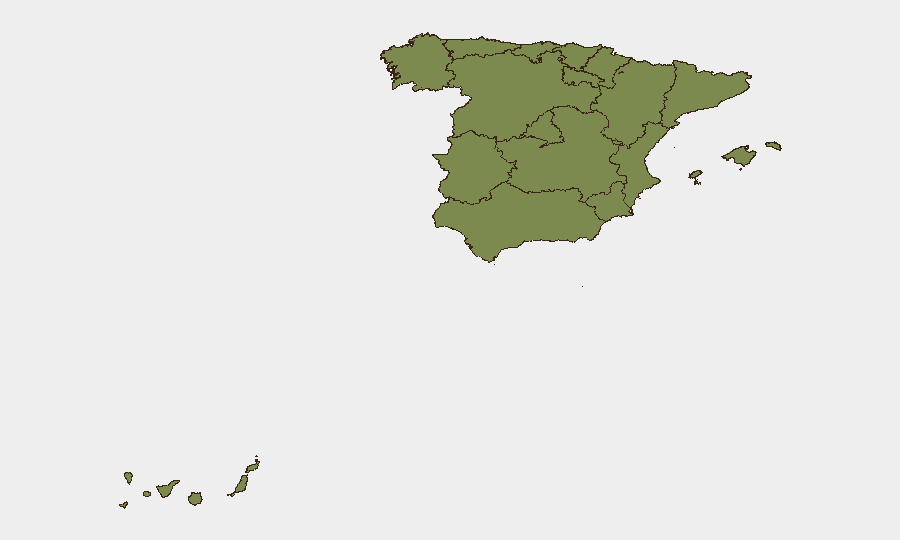
The Community of Madrid dominates Spain's risk profile with a composite score of 32—more than three times higher than Catalonia (10.4), the second-ranked region. This reflects Madrid's position as Spain's capital and largest metropolitan area, hosting government institutions, major transport hubs, corporate centers, and dense populations—all typical targets for petty crime, organized crime, and terrorism planning. Catalonia's secondary risk stems from longstanding independence movements and associated civil unrest; Andalusia, the Basque Country, and other northern/central regions face lower but persistent risks linked to organized crime, migrant trafficking, and localized political tensions. The southern border regions (Andalusia, Ceuta, Melilla) are inherently higher-risk due to irregular migration flows and smuggling networks, now intensified by the current Ceuta crisis.
How GeoBit Would Assist
Security teams can leverage Intel Sweep and global event feeds combined with multi-language OSINT (X, Telegram, YouTube) and sentiment analysis to monitor emerging migrant routes, smuggler networks, and secondary migration movements into mainland Spain and EU. AOI Monitoring with alerting on Ceuta, Melilla, and key transport corridors (Madrid airport, rail hubs, border crossings) provides real-time early warning of crowd activity, police response, or new crossing attempts. GIS and network analysis of migrant flows and routing patterns help anticipate which regions (Madrid, Barcelona, Valencia) may experience secondary strain and inform duty-of-care positioning for personnel and assets.
7-Day Outlook
The Ceuta crisis appears to be entering a stabilization and processing phase, with Spanish authorities reporting control restored and EU border reinforcements in place. Expect continued elevated vigilance at Spain's Moroccan borders and temporary Schengen restrictions (Italy, France) to persist for days to weeks. Mainland Spain's security posture is unlikely to deteriorate sharply, though secondary migration pressures on transport hubs and urban centers should be monitored.
Highest-Risk Areas — Ranked
| # | State / Region | Risk |
|---|---|---|
| 1 | Community of Madrid | 32 |
| 2 | Catalonia | 10.4 |
| 3 | Andalusia | 4.8 |
| 4 | Autonomous Community of the Basque Country | 4.2 |
| 5 | Cantabria | 3.3 |
| 6 | Castile and León | 3.1 |
| 7 | Navarre | 2.6 |
| 8 | Canary Islands | 2.4 |
| 9 | Castile-La Mancha | 2.3 |
| 10 | Valencian Community | 2.2 |
| 11 | Galicia | 2.2 |
| 12 | Balearic Islands | 2 |
Sources
Previous Daily Briefs
A new Spain brief is written every day — each with its own risk map and downloadable CSV. Here's the last week; use the calendar to go further back.
📅 Browse every day by calendar →
Highlighted days have a brief. Tap a day for that day's map & analysis, or “csv” for that day's dataset ($5).
Atlas — our AI intelligence desk — emails them this snapshot personally. Nothing else, no list.