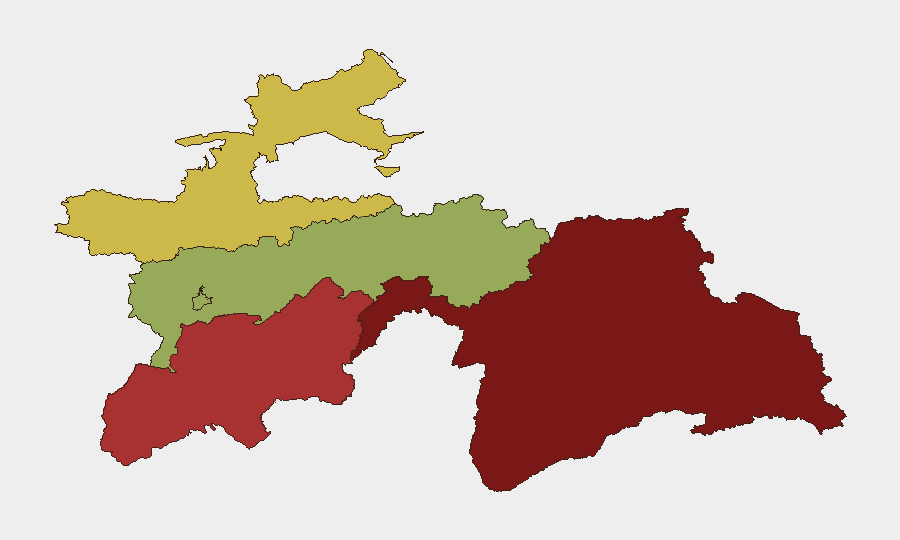
Situation Summary
Tajikistan remains a low-intensity security environment globally (#70 composite threat ranking) with negligible reported incidents in the last 24–48 hours. A cluster of criminal stabbings under investigation in three districts (Vahdat, Kubodiyon, Nurek) represents the most concrete recent development; however, these remain localized criminal matters without indication of organized violence, extremism, or state instability. The eastern mountainous regions (Gorno-Badakhshan, Khatlon) sustain the highest documented risk, driven by remote terrain, limited law-enforcement presence, and cross-border factors; Dushanbe and Republican Subordination districts remain comparatively lower-risk. Overall trajectory is stable absent new triggering events.
Key Developments
• Criminal stabbings under investigation — Vahdat, Kubodiyon, and Nurek districts, Tajikistan (reported 13–14 June 2026). Tajik news outlet Avesta reported multiple stabbing incidents are currently being investigated by law-enforcement authorities; no fatality counts, victim identities, or motive clarity disclosed in available reporting.
• No discrete security incidents reported in the preceding 24–48 hours beyond the above stabbing cluster; open-source reporting (local news in Russian/Tajik, international wires, social media) yields no independently corroborated, location-specific violent incidents, attacks, or state-level events within the current window.
Highest-Risk Areas
Gorno-Badakhshan (GBAO, risk 92) and Khatlon Region (risk 78) dominate the risk profile and drive national threat scores. GBAO's extreme remoteness, minimal state authority, difficult terrain, and proximity to Afghanistan and Kyrgyzstan's disputed Pamir border create persistent exposure to cross-border trafficking, irregular armed movement, and limited law-enforcement reach. Khatlon's risk stems from similar geographic isolation, historical inter-communal tensions, and porous borders; it remains the de facto highest-priority zone for duty-of-care monitoring. Sughd Region (risk 65) and the capital Dushanbe (risk 42) carry significantly lower composite scores, reflecting denser state presence and more stable urban governance, though assets in any region should remain subject to baseline security protocols.
How GeoBit Would Assist
Organizations with personnel or assets in Tajikistan should deploy AOI Monitoring & Early Warning on Gorno-Badakhshan and Khatlon to detect emerging incidents in real time; Intel Sweep and multi-language OSINT (Tajik, Russian sources, Telegram/local networks) to capture crime and security developments before mainstream reporting; and Risk & Threat Assessment tools to flag upticks in criminal violence or cross-border activity that might signal deteriorating conditions. GIS & Spatial Analysis and Routing & Network Analysis support secure travel planning and asset-location risk profiling within high-risk districts.
7-Day Outlook
No indicators suggest imminent escalation; the current stabbing cluster, if criminal and non-political, is unlikely to trigger broader security disruption. Monitoring should focus on whether incidents in Vahdat, Kubodiyon, and Nurek spread geographically or develop a collective motive (gang activity, extremism, communal violence). Baseline vigilance in GBAO and Khatlon remains essential given structural remoteness and border dynamics; any cross-border incident or significant law-enforcement operation would warrant immediate reassessment.
Highest-Risk Areas — Ranked
| # | State / Region | Risk |
|---|---|---|
| 1 | Gorno-Badakhshan Autonomous Region | 92 |
| 2 | Khatlon Region | 78 |
| 3 | Sughd Region | 65 |
| 4 | Districts of Republican Subordination | 58 |
| 5 | Dushanbe | 42 |
Sources
Previous Daily Briefs
A new Tajikistan brief is written every day — each with its own risk map and downloadable CSV. Here's the last week; use the calendar to go further back.
📅 Browse every day by calendar →
Highlighted days have a brief. Tap a day for that day's map & analysis, or “csv” for that day's dataset ($5).