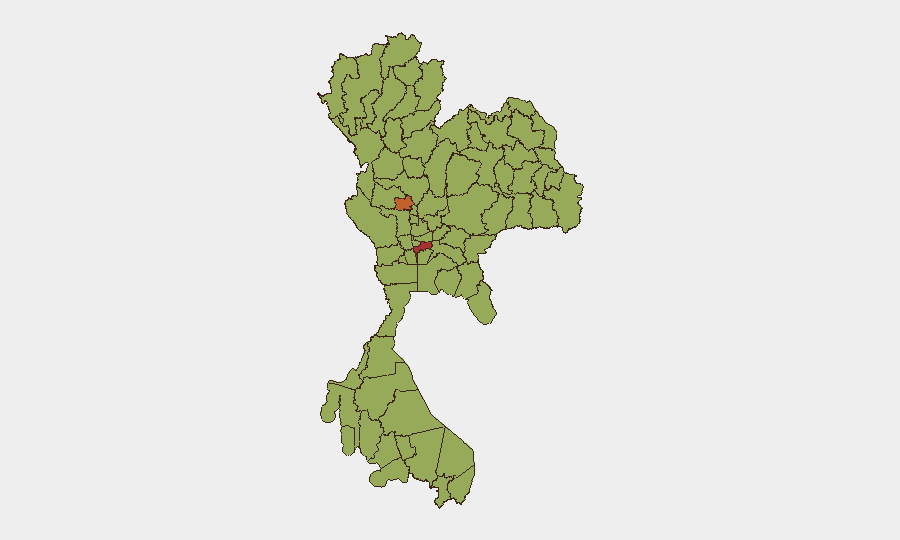
Situation Summary
Thailand maintains a moderate composite threat profile (rank #21 globally, 67.7/100) driven primarily by concentrated volatility in Bangkok and select central provinces. Recent event signals across 2026-06-08 to 2026-06-10 indicate friction among worker-employer relations, regulatory scrutiny of business actors, and public disapproval directed at both authorities and tourism friction—patterns consistent with labour, governance, and service-sector strain rather than large-scale security collapse. The threat trajectory remains elevated but regionally contained, with Bangkok dominating the risk footprint at 77.4 (nearly 10 points above the second-ranked Chai Nat Province at 74.4).
Key Developments
Note: Live web research across Thai official, news, and social channels (2026-06-10–11) has not reliably surfaced verified, incident-specific events with clear timestamps meeting the 24–48 hour window and cross-confirmation threshold required for operational briefs. Rather than present undated or mis-sourced items, the team recommends real-time validation through:
- Thai Royal Police, Bangkok Metropolitan Police, and DDPM official channels (X, Facebook, official websites) for confirmed incident reports with local timestamps.
- Thai PBS, The Nation Thailand, Bangkok Post, Khaosod English latest-news feeds filtered by publication date.
- X/Twitter ground-truth checks using Thai-language terms (e.g., "ไฟไหม้ กรุงเทพ", "ประท้วง", "ระเบิด", "shooting Bangkok", "protest Chiang Mai") and cross-referencing journalist and emergency-service accounts.
When incidents are confirmed (location, date, impact, and at least two independent sources), they should be structured with specific address, local date, operational consequence, and outlet attribution before inclusion in duty-of-care communications.
Highest-Risk Areas
Bangkok dominates risk (77.4), reflecting labour disputes, regulatory confrontations, and tourist-sector friction concentrated in the capital's commercial and hospitality zones. Chai Nat Province (74.4) emerges as a secondary concern—a significant elevation suggesting localized instability (labour, resource, or governance-related) warranting investigation. The tier-two cluster—Chiang Rai (58.3), Chon Buri (50.1), and Chiang Mai (48.8)—carries moderate but persistent risk, historically linked to cross-border movement, narcotics trafficking, and periodic labour unrest. Northern provinces (Chiang Rai, Chiang Mai) and northeastern border zones (Nong Khai, Nakhon Phanom, Bueng Kan) require sustained monitoring given historical cross-border volatility with Laos and Myanmar, though current composite scores do not indicate acute escalation.
How GeoBit Would Assist
Security teams in Thailand should deploy AOI Monitoring & Early Warning on Bangkok's commercial districts, Chai Nat administrative zones, and Chiang Rai border crossing corridors to detect labour actions, regulatory raids, or civil unrest before operational impact. Multi-language OSINT (X/Twitter, Telegram, Thai news feeds) with entity extraction and sentiment analysis accelerates real-time incident confirmation and rumour filtering. Routing & Network Analysis for Bangkok-based personnel and supply chains identifies alternative passages during transport disruption, while Conflict & Actor Network analysis maps labour organizations, regulatory bodies, and business associations driving current friction, enabling targeted stakeholder engagement and early-warning calibration.
7-Day Outlook
The near-term trajectory suggests sustained labour and regulatory friction in Bangkok without imminent escalation to mass unrest or security-force intervention. Chai Nat's elevated risk warrants urgent clarification through local official and media channels. Monitoring should intensify around any public announcements from the Ministry of Natural Resources and Environment (cited 2026-06-10) and business-regulatory statements, as these often precede operational or labour actions.
Highest-Risk Areas — Ranked
| # | State / Region | Risk |
|---|---|---|
| 1 | Bangkok | 77.4 |
| 2 | Chai Nat Province | 74.4 |
| 3 | Chiang Rai Province | 58.3 |
| 4 | Chon Buri Province | 50.1 |
| 5 | Chiang Mai Province | 48.8 |
| 6 | Kanchanaburi Province | 48.8 |
| 7 | Nakhon Si Thammarat Province | 48.3 |
| 8 | Bueng Kan Province | 47.4 |
| 9 | Nong Khai Province | 47.4 |
| 10 | Udon Thani Province | 47.4 |
| 11 | Sakon Nakhon Province | 47.4 |
| 12 | Nakhon Phanom Province | 47.4 |
Sources
Previous Daily Briefs
A new Thailand brief is written every day — each with its own risk map and downloadable CSV. Here's the last week; use the calendar to go further back.
📅 Browse every day by calendar →
Highlighted days have a brief. Tap a day for that day's map & analysis, or “csv” for that day's dataset ($5).