Situation Summary
Turkmenistan remains a low-threat operating environment with no corroborated security incidents, civil unrest, or acute instability reported in the last 24–48 hours. Routine diplomatic engagement (Iran, U.S.) and normal commodity-exchange activity proceeded without disruption. The security picture is stable, though sub-national risk concentration in the Balkan and Lebap regions warrants differentiated monitoring for corporate operations across the country.
Key Developments
- Ashgabat, 12 June 2026 – Turkmen foreign minister conducted bilateral meeting with Iran's deputy foreign minister; discussions covered energy cooperation and regional issues with no associated security incidents or protests reported.
- Ashgabat, mid-June 2026 – U.S. Under Secretary of State for Public Diplomacy engaged in routine diplomatic and commercial discussions on diversification of Turkmen natural-gas export routes; no demonstrations or instability linked to the visit.
- Turkmenistan, last week – State Commodity and Raw Materials Exchange reported 40 transactions and normal oil and gas infrastructure operation; no sabotage, security disruptions, or supply-chain incidents documented.
- Turkmenistan, ongoing – Domestic media narrative emphasizes agricultural sector expansion and food-security positioning; no concurrent reports of food-related unrest or supply disruption in the last 48 hours.
- Regional diplomatic participation, June 2026 – Turkmenistan engaged in multilateral forums on Afghanistan and C5+1 economic cooperation; no cross-border security incidents or internal unrest reported on Turkmen territory during this period.
Highest-Risk Areas
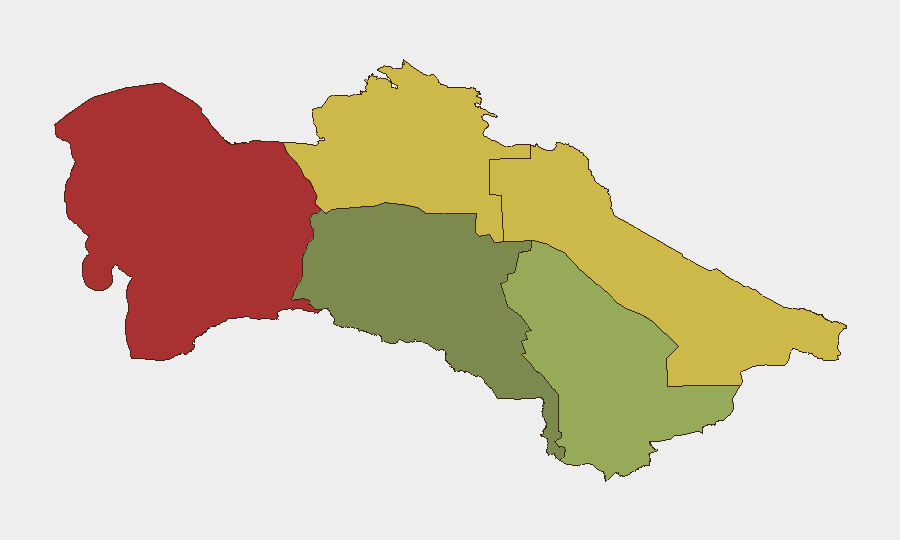
Balkan Region (risk score 78) and Lebap Region (risk score 68) account for the majority of sub-national threat concentration in Turkmenistan. Both regions border Afghanistan and Uzbekistan respectively, creating exposure to cross-border trafficking, smuggling, and potential militant transit. Dashoguz Region (risk 62) also borders Uzbekistan and Afghanistan, presenting similar vulnerabilities. By contrast, Ashgabat City (risk 18) and Ahal Region (risk 35) show significantly lower risk profiles. Organizations with personnel or assets in Balkan and Lebap should maintain heightened awareness and apply more-granular monitoring protocols than those in the capital or southern regions.
How GeoBit Would Assist
Security and risk teams operating in Turkmenistan should employ AOI (Area-of-Interest) Monitoring & Early Warning on the Balkan and Lebap regions to detect cross-border activity, trafficking patterns, or anomalous movement with persistent alerting. OSINT Fusion & Corroboration (combining X/Telegram monitoring, regional media, and entity extraction) compensates for Turkmenistan's tightly controlled information space and helps surface under-reported incidents. Routing & Network Analysis enables alternative route planning for personnel and supply chains, particularly around high-risk border zones, mitigating exposure to smuggling corridors and potential security checkpoints.
7-Day Outlook
No acute security deterioration is expected over the next seven days. Routine diplomatic and economic activity will likely continue without disruption. However, the persistent elevation of risk in border regions (Balkan, Lebap) means that organizations should maintain standing monitoring posture rather than assume benign conditions; even in low-threat environments, supply-chain delays, unofficial payments, and minor harassment at border checkpoints remain operational realities for international staff and logistics.
Highest-Risk Areas — Ranked
| # | State / Region | Risk |
|---|---|---|
| 1 | Balkan Region | 78 |
| 2 | Lebap Region | 68 |
| 3 | Dashoguz Region | 62 |
| 4 | Mary Region | 42 |
| 5 | Ahal Region | 35 |
| 6 | Ashgabat City | 18 |
Sources
Previous Daily Briefs
A new Turkmenistan brief is written every day — each with its own risk map and downloadable CSV. Here's the last week; use the calendar to go further back.
📅 Browse every day by calendar →
Highlighted days have a brief. Tap a day for that day's map & analysis, or “csv” for that day's dataset ($5).