Situation Summary
The UAE faces an elevated but contained security environment following coordinated Iranian missile and drone strikes across the broader Gulf region on 16–17 June 2026. Multiple hostile unmanned aerial vehicles (UAVs) targeted civilian and critical infrastructure sites in Abu Dhabi, Dubai, and the northern emirates corridor; UAE air defenses successfully intercepted all incursions, limiting casualties and property damage to minor levels. The federal government has condemned the attacks, reaffirmed security partnerships with affected regional states and the United States, and maintained normal operations across all seven emirates, with international travel advisories already being scaled back to reflect controlled risk.
Key Developments
- Abu Dhabi City, 17 June 2026: UAE air defenses intercepted multiple hostile UAVs targeting civilian and vital infrastructure; debris from interceptions caused minor injuries and light property damage with no major disruption to critical infrastructure.
- Dubai Emirate, 17 June 2026: Attempted UAV incursions detected and neutralized by integrated air-defense systems before reaching populated or strategic locations; no casualties reported.
- Northern Emirates corridor (Sharjah–Ajman area), 17 June 2026: Additional UAVs detected and intercepted over northern airspace as part of coordinated cross-Gulf strikes; authorities implemented localized, short-term airspace management measures while maintaining normal ground transport.
- Federal level, 17 June 2026: UAE Ministry of Foreign Affairs issued formal statement condemning Iranian attacks on Jordan, Kuwait, and Bahrain as "flagrant violations" of sovereignty and threats to regional security.
- Federal level / Defense coordination, 17 June 2026: UAE officials engaged in high-level security talks with the United States and regional partners on responses to Iranian activity, including Strait of Hormuz security and maritime coalition participation.
- International travel advisory, 17 June 2026: A major foreign government publicly scaled back Middle East travel warnings for the UAE (and Qatar, Bahrain, Kuwait, Israel), citing manageable risk despite ongoing tensions and recent UAV activity.
Highest-Risk Areas
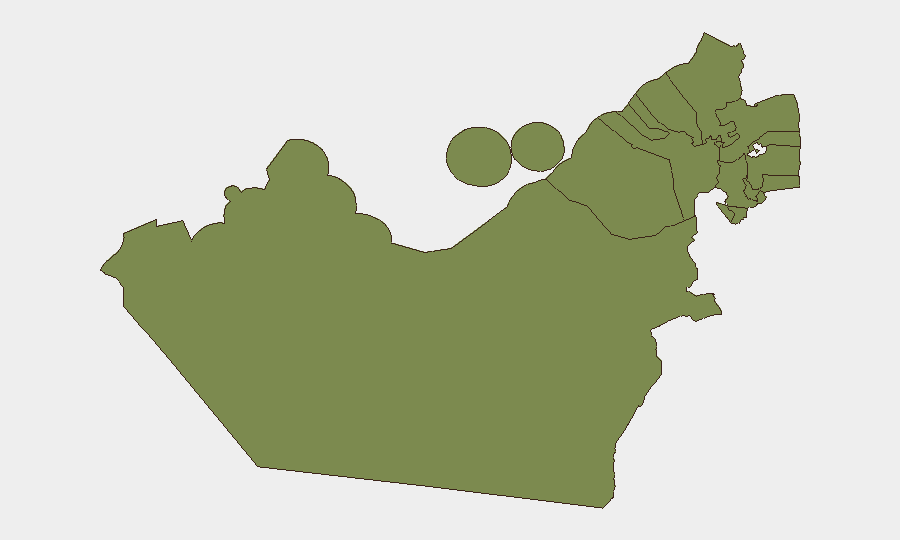
Dubai dominates the sub-national risk landscape with a composite score of 31.4—more than three times the rating for Abu Dhabi Emirate (10.0) and substantially higher than all northern emirates (each 1.4). This disparity reflects Dubai's role as a major international business, aviation, and maritime hub, making it the primary target for both direct strikes and collateral damage from regional military activity. Abu Dhabi's secondary ranking correlates with its status as the federal capital and seat of national defense infrastructure. The northern emirates carry minimal measured risk, reflecting their smaller scale and lower strategic value in current cross-Gulf hostilities.
How GeoBit Would Assist
Corporate security and duty-of-care teams in the UAE would employ AOI Monitoring & Early Warning to maintain persistent watch on high-risk zones (Dubai, Abu Dhabi) with real-time alerting tied to UAV launches, air-defense activations, or infrastructure incidents. Intel Sweep and multi-language OSINT capabilities (X/Twitter, Telegram, YouTube) would track official statements, military communications, and threat actor declarations to assess escalation intent and attack timing. Routing & Network Analysis would enable rapid alternative journey planning for personnel and supply chains should airspace closures or ground disruptions occur during follow-on strikes.
7-Day Outlook
The immediate risk remains elevated but declining as UAE air defenses demonstrate operational effectiveness and international partners reinforce security coordination. A second wave of Iranian strikes cannot be ruled out within 7–10 days if regional escalation cycles continue, but sustained interception success and the absence of major casualties suggest the UAE's resilience is constraining damage and maintaining business continuity. Monitoring of Iranian IRGC communications and Gulf state defense postures will be critical to detecting intent for renewed attacks.
Highest-Risk Areas — Ranked
| # | State / Region | Risk |
|---|---|---|
| 1 | Dubai | 31.4 |
| 2 | Abu Dhabi Emirate | 10 |
| 3 | Sharjah Emirate | 1.4 |
| 4 | Ajman Emirate | 1.4 |
| 5 | Ras al-Khaimah | 1.4 |
| 6 | Fujairah Emirate | 1.4 |
| 7 | Umm al-Quwain | 1.4 |
Sources
Previous Daily Briefs
A new United Arab Emirates brief is written every day — each with its own risk map and downloadable CSV. Here's the last week; use the calendar to go further back.
📅 Browse every day by calendar →
Highlighted days have a brief. Tap a day for that day's map & analysis, or “csv” for that day's dataset ($5).