Situation Summary
Uzbekistan remains a low-risk country globally (rank #164, composite score 3) with no credible, independently confirmed security incidents, civil unrest, major crime, or acute travel disruptions reported in the last 24–48 hours. Recent official activity reflects economic and diplomatic engagement—notably US–Uzbek investment cooperation, defence-system restructuring, and Taliban-government trade discussions—rather than instability. Risk remains concentrated in the Fergana Valley and eastern border regions, where historical militant activity and cross-border dynamics persist; the capital and western regions are substantially lower-risk.
Key Developments
- Tashkent, 15–16 June: US and Uzbek officials announced plans for a joint investment platform and dedicated special economic zone (SEZ) to deepen bilateral economic cooperation, signalling stable governance and investor confidence.
- Tashkent, mid-June: Uzbek defence authorities completed structural reorganization of military aviation and air-defence capabilities through creation of a new Air Force Combat Command; presented as modernization, not response to acute threat.
- Tashkent Region, mid-June: Provincial governor met Taliban Deputy Minister of Industry and Trade to discuss industrial and economic cooperation; no associated cross-border incident or unrest reported.
- Tashkent, 15–16 June: High-level Uzbek–Russian officials meeting reaffirmed energy security and investment cooperation; no linked protest or security disruption noted.
- No major incidents: Open-source monitoring across news, social media (X/Twitter, Telegram), and sector-specific feeds detected no protests, attacks, infrastructure sabotage, or travel-disrupting events in the last 48 hours.
Highest-Risk Areas
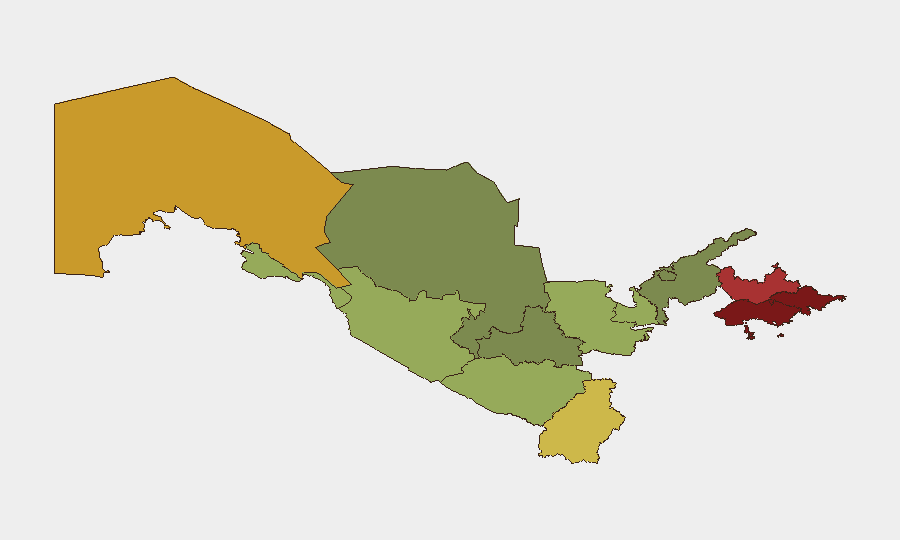
The Fergana Valley—comprising Andijan (rank 88), Fergana (82), and Namangan (78) regions—accounts for three of Uzbekistan's four highest-risk districts. This concentration reflects historical presence of militant networks, dense cross-border population flows with Tajikistan and Kyrgyzstan, and legacy extremist recruitment activity. Karakalpakstan (72) presents secondary concern due to remote geography, water-security stress, and limited state capacity in parts of the region. All other provinces, including Tashkent and Bukhara, score well below 50 and present minimal acute risk. Risk is largely structural (militant networks, border permeability) rather than event-driven at present.
How GeoBit Would Assist
Security and duty-of-care teams with Uzbek operations should use persistent Area-of-Interest (AOI) Monitoring & Early Warning on Fergana Valley districts to detect emerging protests, militant activity, or cross-border incidents in real time. Multi-language OSINT fusion (news, social media, Telegram channels, local radio) and sentiment analysis can identify early shifts in community mood or official posture before unrest escalates. For personnel in high-risk zones, Routing & Network Analysis capabilities enable identification of safer transit corridors and real-time alternative journey planning during localized instability.
7-Day Outlook
No acute triggers for escalation are visible in the near term. Ongoing defence restructuring, economic engagement, and regional dialogue suggest stability orientation. Monitoring should remain focused on Fergana Valley and eastern borders for any uptick in militant recruitment, cross-border incidents, or localized unrest; absence of current events does not eliminate structural risk in those zones.
Highest-Risk Areas — Ranked
| # | State / Region | Risk |
|---|---|---|
| 1 | Andijan Region | 88 |
| 2 | Fergana Region | 82 |
| 3 | Namangan Region | 78 |
| 4 | Republic of Karakalpakstan | 72 |
| 5 | Surxondaryo Region | 65 |
| 6 | Qashqadaryo Region | 58 |
| 7 | Sirdaryo Region | 55 |
| 8 | Jizzakh Region | 48 |
| 9 | Xorazm Region | 45 |
| 10 | Bukhara Region | 42 |
| 11 | Navoiy Region | 38 |
| 12 | Samarqand Region | 35 |
Sources
Previous Daily Briefs
A new Uzbekistan brief is written every day — each with its own risk map and downloadable CSV. Here's the last week; use the calendar to go further back.
📅 Browse every day by calendar →
Highlighted days have a brief. Tap a day for that day's map & analysis, or “csv” for that day's dataset ($5).