Situation Summary
Albania remains a moderate-risk jurisdiction (global rank #74) with political instability and mass civil unrest as the primary security drivers. A sustained protest movement against a Kushner-linked coastal resort has escalated significantly over the past 48 hours, triggering police clashes, arrests, and institutional scrutiny. The concurrent uncertainty over NATO summit hosting and EU monitoring of the project adds external political pressure and creates medium-term investment and operational risk.
Key Developments
- Mass protests in Tirana (June 29–30, 2026): Large crowds ("thousands") gathered in central Tirana, including Skanderbeg Square and government areas, for renewed "flamingo revolution" demonstrations against the Kushner-linked resort, chanting anti-corruption slogans and demanding PM Edi Rama's resignation.
- Protester–police clashes and arrests (evening June 29, 2026): Confrontational demonstrations in Tirana resulted in reported clashes between demonstrators and police, with documented detentions and injuries as the protest movement has escalated.
- Private security arrest and activist incident (late June 2026 reporting): A private security employee was arrested following investigation into the forcible removal of an activist from the resort site near the Narta Lagoon; video evidence circulated widely and has continued to inflame current protests.
- Special Prosecution Office opens corruption probe (June 29–30, 2026): Albania's Special Prosecution Office Against Corruption and Organized Crime announced a formal investigation into the resort project, adding legal and institutional dimensions to the unrest.
- NATO summit hosting in doubt (June 30, 2026): Reuters reporting indicates a draft NATO summit statement for next week omits a previously planned 2027 gathering in Albania, citing US concerns over Albania's defence spending and signaling political sensitivity around security commitments.
- EU accession monitoring of resort project (June 29–30, 2026): EU officials confirmed they are monitoring the development to ensure compliance with conditions tied to Albania's EU accession, raising medium-term political-stability and investment-risk concerns.
- Nationwide escalation beyond Tirana (June 29–30, 2026): Social media and mainstream coverage describe "the biggest protests yet," with mobilisation spreading across Albania and environmental/anti-corruption messaging intensifying.
Highest-Risk Areas
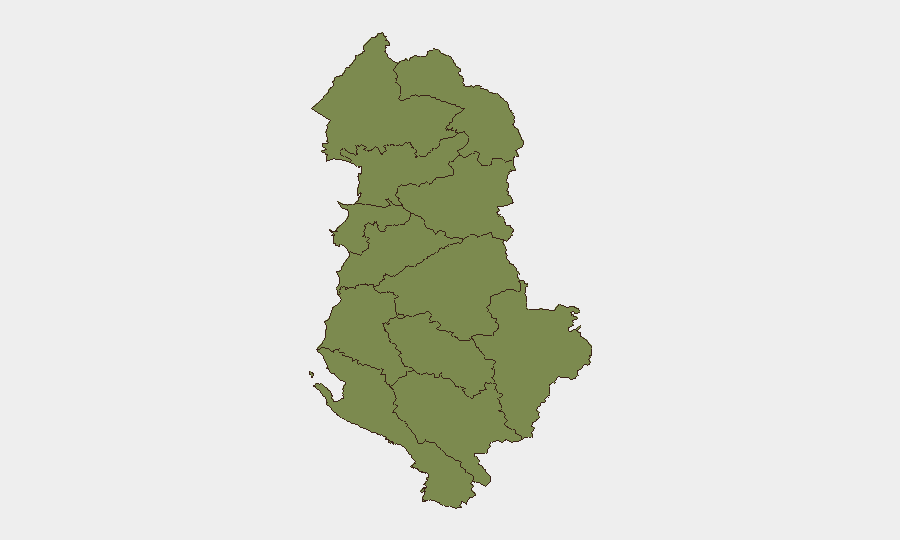
Elbasan County (composite risk 32) dominates Albania's sub-national threat profile by a significant margin, though reporting over the last 48 hours concentrates risk in Tirana County (risk 19.1), where resort protests, police operations, and government institutions are clustered. The Adriatic coastal zone near the Narta Lagoon and Sazan Island, within Vlorë County (risk 10.9), represents the secondary geographic flashpoint. Remaining counties present residual risk (scores 2–6.1) with no acute current developments; Elbasan's elevated baseline likely reflects organized-crime and trafficking activity unrelated to current headlines.
How GeoBit Would Assist
Security teams operating in or monitoring Albania should deploy Area-of-Interest Monitoring & Early Warning on Tirana (protest sites, government areas, resort location) and the Narta Lagoon coastal zone to track protest scale, police/military presence, and checkpoint movements in real time. OSINT fusion (X/Telegram, YouTube, multi-language search, sentiment analysis) combined with Entity & Network Analysis enables continuous tracking of protest organizers, legal/political actors, and cross-border coordination signals. GIS & Spatial Analysis and satellite/imagery review support route planning, facility security assessment, and operational continuity planning around high-risk areas.
7-Day Outlook
Protests are likely to persist through early July in central Tirana and possibly expand to secondary cities, with police response potentially escalating if confrontations intensify. The formal corruption investigation and EU monitoring may generate additional political volatility; NATO summit uncertainty adds diplomatic friction. Personnel and asset security teams should expect continued civil unrest, intermittent road closures, and heightened police/military visibility, particularly in Tirana, over the near term.
Highest-Risk Areas — Ranked
| # | State / Region | Risk |
|---|---|---|
| 1 | Elbasan County | 32 |
| 2 | Tirana County | 19.1 |
| 3 | Vlorë County | 10.9 |
| 4 | Fier County | 6.1 |
| 5 | Durrës County | 2 |
| 6 | Shkodër County | 2 |
| 7 | Kukës County | 2 |
| 8 | Lezhë County | 2 |
| 9 | Dibër County | 2 |
| 10 | Berat County | 2 |
| 11 | Korçë County | 2 |
| 12 | Gjirokastër County | 2 |
Sources
Previous Daily Briefs
A new Albania brief is written every day — each with its own risk map and downloadable CSV. Here's the last week; use the calendar to go further back.
📅 Browse every day by calendar →
Highlighted days have a brief. Tap a day for that day's map & analysis, or “csv” for that day's dataset ($5).