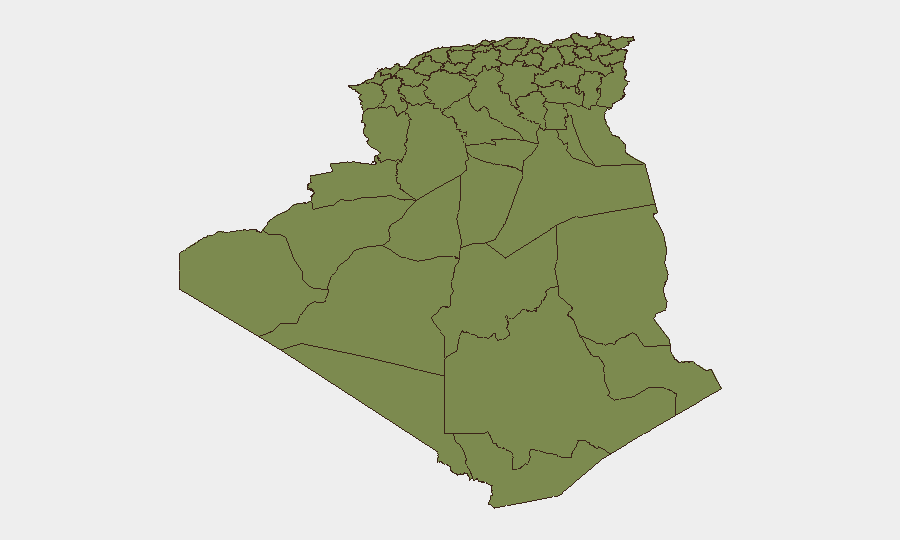
Situation Summary
Algeria's overall security posture remains stable relative to global benchmarks (rank #65, composite threat score 19), but persistent underlying risks in border regions, Saharan territories, and periodic civil unrest in urban centres warrant continued operational attention. Recent reporting (8–14 July) documented counter-terrorism operations, including dismantling of a MAK-linked cell in Tizi Ouzou and major narcotics seizures in Algiers, Tlemcen, and Ouargla. No multi-source-verified, location-specific incidents have been corroborated for the 16–18 July window; the absence of fresh tactical reporting reflects a data gap rather than an improvement in threat conditions.
Key Developments
Data Gap Alert: No incidents meeting the 24–48 hour criterion (16–18 July 2026), verified across multiple independent sources and with precise date/location, have surfaced in open-source OSINT or Algerian official channels. Reporting feeds show a gap between the last documented events (8–14 July) and today. Security teams should treat this as an analytical blind spot and rely on local in-country intelligence contacts and continuous monitoring of official Algerian sources (Ministry of Defence, DGSN, ANP) for emerging developments not yet reflected in aggregated global feeds.
Highest-Risk Areas
In Salah (risk 31.9) dominates the sub-national ranking by a wide margin, reflecting ongoing Saharan terrorism and smuggling activity linked to border permeability and sparse state presence. Mascara (15.1), in northwestern Algeria near the Moroccan border, ranks second and suggests sustained concern over cross-border insurgent movement and criminal networks. Algiers (7.2), while far lower in absolute risk, remains the principal urban centre where demonstrations, labour unrest, and street crime present periodic spikes, particularly following Friday prayers and in response to governance disputes. The sharp drop-off in risk scores below the top three regions indicates that threat concentration is geographic and predictable: southern Saharan regions and northwestern border zones drive national risk; major urban centres present localized, episodic hazards.
How GeoBit Would Assist
Security and duty-of-care teams with personnel or assets in Algeria should deploy Intel Sweep and multi-language OSINT fusion to close the reporting gap on In Salah, Mascara, and border regions, combining Algerian official releases, local media, X/Twitter, and Telegram monitoring to detect emerging incidents before they reach international newswires. AOI (Area-of-Interest) Monitoring & Early Warning on key facilities, travel routes, and city centres in Algiers and Mascara would provide persistent watch and alerting against demonstrations, roadblocks, or security incidents. Routing & Network Analysis can identify alternative transport and supply chains to mitigate exposure to known high-risk corridors in the south and near Morocco.
7-Day Outlook
No imminent escalation is signalled by available reporting, but the monitoring gap and underlying Saharan/border risks remain structural. Civil unrest and governance-related demonstrations may recur in urban areas in response to policy announcements or triggering events. Security teams should assume baseline threat persistence and maintain active local intelligence collection to detect any deterioration before it becomes visible in global feeds.
Highest-Risk Areas — Ranked
| # | State / Region | Risk |
|---|---|---|
| 1 | In Salah | 31.9 |
| 2 | Mascara | 15.1 |
| 3 | Algiers | 7.2 |
| 4 | Tinduf | 3.7 |
| 5 | Bordj Bou Arreridj | 2.8 |
| 6 | Bechar | 1.9 |
| 7 | Beni Abbes | 1.9 |
| 8 | Adrar | 1.9 |
| 9 | Bordj Badji Mokhtar | 1.9 |
| 10 | El Bayadh | 1.9 |
| 11 | Ghardaia | 1.9 |
| 12 | Saïda | 1.9 |
Sources
Previous Daily Briefs
A new Algeria brief is written every day — each with its own risk map and downloadable CSV. Here's the last week; use the calendar to go further back.
📅 Browse every day by calendar →
Highlighted days have a brief. Tap a day for that day's map & analysis, or “csv” for that day's dataset ($5).
Atlas — our AI intelligence desk — emails them this snapshot personally. Nothing else, no list.