Situation Summary
Azerbaijan maintains a composite threat score of 39, placing it in the lower-to-moderate range globally. The security environment is dominated by concentration of risk in Baku City (31.3), with all other tracked regions scoring substantially lower (1.3 each). Recent event signals from 19–20 June point to administrative and law-enforcement activity rather than acute destabilization, though the specific nature of these incidents remains unclear from available open sources.
Key Developments
GeoBit's web research was unable to identify verifiable, clearly dated security or unrest incidents in Azerbaijan during 20–21 June 2026. Available reporting from the last 24–48 hours does not contain confirmed accounts of armed clashes, terrorist attacks, major civil unrest, high-profile crime, sudden political instability, or infrastructure disruption tied to specific recent dates. Older regional background (e.g., Armenia–Azerbaijan border history, Iran–US regional dynamics) and development-focused news from Baku appear in search results but do not constitute current threat events.
If duty-of-care teams require specific incident details from the 19–20 June event signals flagged by GeoBit's platform (public statements, administrative sanctions, arrest/detention, and media-related statements), clarification of those incidents' underlying causes and geographic scope would require either direct escalation to GeoBit's Intel Sweep team or expansion of the time window beyond 48 hours.
Highest-Risk Areas
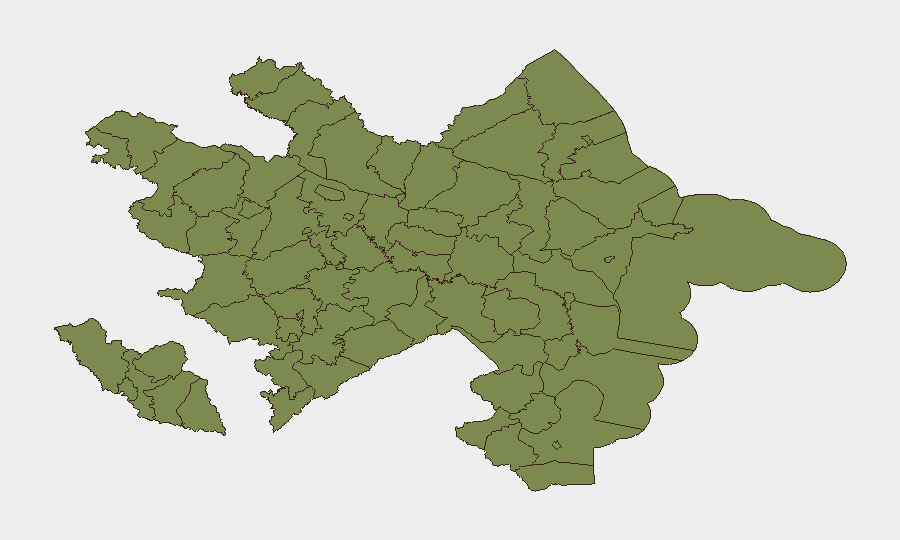
Baku City dominates the sub-national risk landscape with a composite score of 31.3—approximately 24 times higher than any other tracked region. All remaining high-risk areas (Sadarak, Qazakh, Sharur, Yevlakh, Kangarli, Nakhchivan, Aghstafa, Tovuz, Qakh, Shaki, Sheki) cluster at 1.3 each, indicating either recent incident concentration in the capital or structural differences in monitoring density. The concentration of risk in Baku reflects both its role as the national capital and largest urban center, and the likelihood that security events and law-enforcement activity are more densely reported there than in rural or peripheral districts.
How GeoBit Would Assist
Teams with personnel or assets in Azerbaijan should use AOI Monitoring & Early Warning to establish persistent watch over Baku City and key border districts (Sadarak, Qazakh, Sharur, Tovuz), with alerts configured for unrest, law-enforcement escalation, or infrastructure disruption. Intel Sweep and multi-language OSINT fusion (including X/Telegram monitoring and local-language news aggregation) can clarify the nature and location of the 19–20 June events currently flagged as administrative activity. Risk & Threat Assessment and GIS & Spatial Analysis together enable mapping of personnel movements and asset locations against sub-national risk scores, informing duty-of-care decisions on internal travel and site security posture.
7-Day Outlook
No acute escalation markers are visible in the next 7 days. The current composite threat score and event signals suggest localized administrative or law-enforcement activity rather than systemic instability. Continued monitoring of Baku and border regions is warranted as a precaution, particularly given historical volatility in the South Caucasus; however, immediate operational risk to corporate personnel appears moderate to low.
Highest-Risk Areas — Ranked
| # | State / Region | Risk |
|---|---|---|
| 1 | Baku City | 31.3 |
| 2 | Sadarak District | 1.3 |
| 3 | Qazakh District | 1.3 |
| 4 | Sharur District | 1.3 |
| 5 | Yevlakh District | 1.3 |
| 6 | Kangarli District | 1.3 |
| 7 | Nakhchivan Autonomous Republic | 1.3 |
| 8 | Aghstafa District | 1.3 |
| 9 | Tovuz District | 1.3 |
| 10 | Qakh District | 1.3 |
| 11 | Shaki | 1.3 |
| 12 | Sheki District | 1.3 |
Sources
Previous Daily Briefs
A new Azerbaijan brief is written every day — each with its own risk map and downloadable CSV. Here's the last week; use the calendar to go further back.
📅 Browse every day by calendar →
Highlighted days have a brief. Tap a day for that day's map & analysis, or “csv” for that day's dataset ($5).