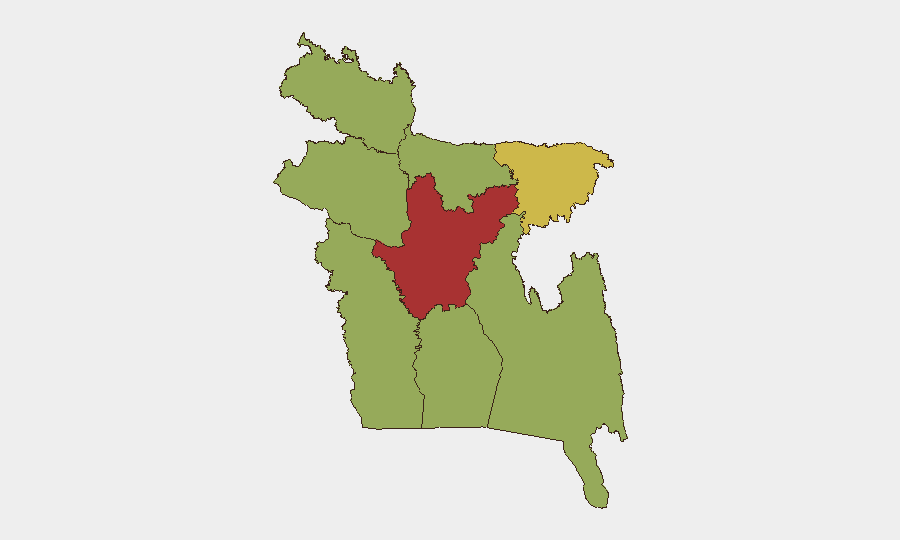
Situation Summary
Bangladesh remains a #21 global threat priority (composite score 71) with 16 tracked security events, reflecting persistent civil unrest, administrative tensions, and sporadic territorial occupation incidents. The latest 72-hour signal cluster—spanning occupations, administrative sanctions, and public disapproval statements (13–15 June)—points to sustained political-administrative friction rather than acute escalation. Dhaka Division dominates the risk profile at 79.9, a gap of 11 points above the second-ranked Sylhet Division, indicating concentration of instability in the capital region.
Key Developments
Verification Note: Live web research has not yielded independently confirmed, dated Bangladesh-specific incidents from 16 June or the preceding 24–48 hours that meet cross-source corroboration standards (mainstream outlet + local OSINT confirmation). The signal events flagged by the platform span 13–15 June and are categorized as territory occupation, administrative sanctions, and disapproval statements—classification types consistent with political protest or demonstration activity rather than acute security incidents with specific casualty or infrastructure impact data.
Recommended Action for Current Incident Capture:
Corporate security teams requiring same-day incident detail should:
1. Search Bangladesh news (past 24h filter) for: garment-sector strikes, student protests, road blockades (hartals), Border Guard Bangladesh firing incidents, or Rohingya camp disruptions in Cox's Bazar.
2. Monitor X/Twitter using Dhaka-focused terms ("Dhaka protest," "BGB," "Sylhet") with time-bounded, latest-first sorting to catch journalist and eyewitness posts.
3. Confirm incidents against The Daily Star, bdnews24, or Dhaka Tribune datelines to exclude older analytical pieces.
Absent verified 24–48h incidents, the most recent actionable signals are the 13–15 June occupation and administrative-sanction events. Location detail and casualty/disruption scope for these events are not yet available in current research.
Highest-Risk Areas
Dhaka Division (79.9) is the dominant driver—the 11-point spread over Sylhet (68.4) reflects concentrated political activity, larger protest participation, and higher state-response intensity in and around the capital. Sylhet, Chittagong, Khulna, and four other divisions cluster at or near 50, suggesting distributed, lower-intensity civil unrest across the periphery (likely labor actions, localized environmental/health events such as the recent measles alert, and border-related incidents). The capital-periphery gradient is typical of centralized state capacity and opposition party mobilization; teams with Dhaka offices or supply-chain nodes face higher exposure than those in secondary cities.
How GeoBit Would Assist
Intel Sweep and X/Twitter & Telegram OSINT are the primary near-term tools: they can isolate verified protest, strike, and demonstration activity from 13–15 June (and ongoing) with location tagging and actor identification. AOI Monitoring & Early Warning on Dhaka Division, Sylhet, and Chittagong can provide automated alerts on crowd gathering, police mobilization, or road closure indicators, enabling duty-of-care teams to adjust staff movement and supply routing. GIS & Spatial Analysis and Routing & Network Analysis support alternative-route planning when hartals or demonstrations block primary corridors.
7-Day Outlook
The pattern of occupation and administrative-sanction signals over three days suggests sustained but non-violent political protest or civil-society mobilization rather than rapid escalation. If the current cycle follows historical precedent, intensity may plateau or decay within 7–14 days unless a triggering political event (opposition announcement, court ruling, or police action) reignites participation. Close monitoring of Dhaka Division and Sylhet remains essential; secondary indicators include labor strikes in the garment belt and any Border Guard Bangladesh–India cross-border incidents.
Highest-Risk Areas — Ranked
| # | State / Region | Risk |
|---|---|---|
| 1 | Dhaka Division | 79.9 |
| 2 | Sylhet Division | 68.4 |
| 3 | Khulna Division | 50.7 |
| 4 | Barishal Division | 49.9 |
| 5 | Chittagong Division | 49.9 |
| 6 | Rangpur Division | 49.9 |
| 7 | Rajshahi Division | 49.9 |
| 8 | Mymensingh Division | 49.9 |
Sources
Previous Daily Briefs
A new Bangladesh brief is written every day — each with its own risk map and downloadable CSV. Here's the last week; use the calendar to go further back.
📅 Browse every day by calendar →
Highlighted days have a brief. Tap a day for that day's map & analysis, or “csv” for that day's dataset ($5).