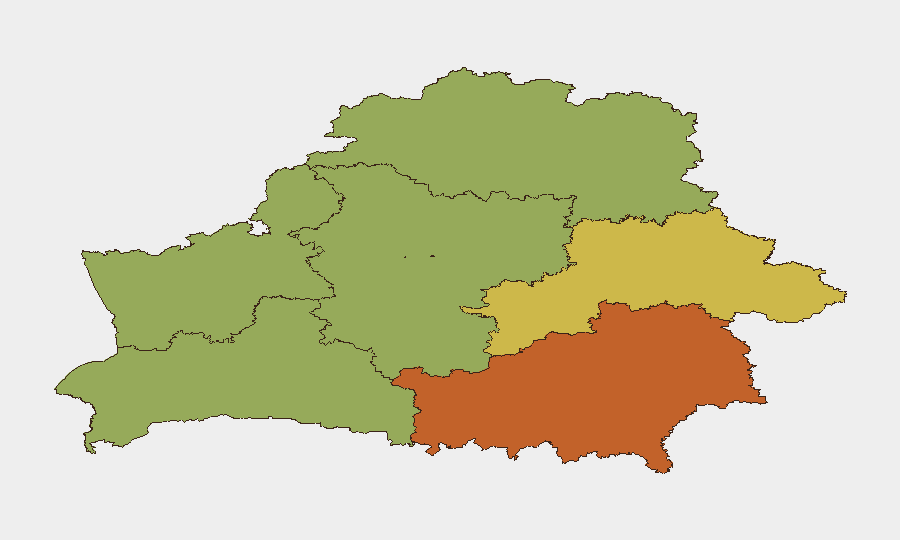
Situation Summary
Belarus remains a low-threat environment with no confirmed major civil unrest, conflict escalation, or infrastructure crises as of 22 July 2026. The security picture is dominated by administrative enforcement, border militarization tied to Ukraine, and petty crime (fraud, theft, bribery) rather than political violence or terrorism. Risk is concentrated in southern and eastern border regions and the capital; nationwide developments indicate tightening labor discipline in agriculture and expanded military positioning on the Ukrainian frontier.
Key Developments
- Southern Border (Ukraine–Belarus), 21 July 2026: President Lukashenko confirmed that special operations forces (Spetsnaz) have been dispersed along the entire southern border "for security" reasons, representing a formal reinforcement of military presence and signaling sustained concern over Ukrainian border dynamics.
- Nationwide (Agricultural Sector), 21 July 2026: Lukashenko announced that workers and officials who disrupt grain-harvesting operations or violate labor discipline will be forcibly conscripted into military service on the Ukrainian border after accelerated weapons training—a significant escalation linking internal labor enforcement to border militarization and raising human-rights and political-risk concerns.
- Nationwide (Interior Ministry), 21 July 2026: The Interior Ministry reported 46 identified crimes since the start of the harvesting season, primarily fuel and spare-parts theft plus bribery, indicating systemic economic crime affecting critical agricultural infrastructure.
- Russia–Belarus (Cyber Designation), 21 July 2026: Russia's Supreme Court designated the Belarusian hacktivist group "Cyberpartisans" and "Silent Crow" as extremist organizations, citing cyberattacks on Russian and Belarusian Railways' servers and IT infrastructure—elevating cyber-security and legal compliance risk for transport and digital systems operating in or connected to Belarus.
- Nationwide (Fraud), Mid-July 2026: The Interior Ministry recorded 34 telephone-fraud (vishing) cases in 24 hours and detained two cash couriers with over 30,000 Belarusian rubles, underscoring ongoing criminal-fraud exposure that typically outweighs physical-security threats for travelers and business operations.
Highest-Risk Areas
Homyel Region (risk 75) and Minsk (risk 68) dominate the sub-national ranking, followed by Mahilyow Region (risk 62). Homyel and Mahilyow's elevated scores reflect proximity to the Ukrainian border and the recent military reinforcement; Minsk's score reflects concentration of political administration, cyber-targeting potential, and urban crime. Southern and eastern regions are now primary focus areas for organizations with personnel or assets in Belarus; Minsk Region and Vitsebsk remain lower-risk but warrant standard corporate-security vigilance.
How GeoBit Would Assist
Security teams should deploy AOI Monitoring & Early Warning on Homyel Region, Mahilyow, and the southern border corridor to track military movements and labor-enforcement actions with persistent alerting. Parallel Cyber & Network Analysis of Belarusian Railways, financial infrastructure, and corporate IT systems would assess exposure to the newly designated hacktivist groups and inform hardening priorities. OSINT fusion and multi-language social/Telegram monitoring would provide early signals of labor unrest, civil discontent, or secondary enforcement actions before they escalate.
7-Day Outlook
Border militarization is likely to remain steady or increase moderately if Ukrainian military activity persists. Labor enforcement tied to agricultural output and border conscription may generate localized friction but is unlikely to trigger large-scale unrest over the next week. Fraud and petty crime will continue as the baseline security concern; cyber incidents targeting infrastructure remain possible given the designation of Cyberpartisans as extremist.
Highest-Risk Areas — Ranked
| # | State / Region | Risk |
|---|---|---|
| 1 | Homyel Region | 75 |
| 2 | Minsk | 68 |
| 3 | Mahilyow Region | 62 |
| 4 | Brest Region | 55 |
| 5 | Hrodna Region | 52 |
| 6 | Minsk Region | 48 |
| 7 | Vitsebsk Region | 45 |
Sources
Previous Daily Briefs
A new Belarus brief is written every day — each with its own risk map and downloadable CSV. Here's the last week; use the calendar to go further back.
📅 Browse every day by calendar →
Highlighted days have a brief. Tap a day for that day's map & analysis, or “csv” for that day's dataset ($5).
Atlas — our AI intelligence desk — emails them this snapshot personally. Nothing else, no list.