Situation Summary
Bolivia remains in a state of elevated political and social tension, with nationwide protests and blockades generating intermittent confrontations between security forces and demonstrators. President Luis Arce's administration faces sustained disapproval from peasant unions and other constituencies, accompanied by small-arms clashes among civilians and military/police deployments in key regions. The security picture is characterized by recurring cycles of demand, arrest, and investigation rather than large-scale armed conflict, but the frequency and geographic spread of events—concentrated in La Paz but extending into Cochabamba and Santa Cruz departments—indicate ongoing instability with no clear near-term resolution.
Key Developments
- 2026-06-13, La Paz area: Arrest of an attorney by Bolivian authorities; context suggests judicial/prosecutorial actions tied to protest-related or political detentions.
- 2026-06-13, nationwide: Demands issued by Bolivian groups toward authorities; signals indicate pressure campaigns by organized constituencies (peasant federations, labor unions) or civic bodies.
- 2026-06-13, military/institutional: Bolivian government investigating Armed Forces; suggests internal vetting or accountability proceedings, possibly linked to force deployments or conduct during recent operations.
- 2026-06-12, nationwide: Conventional military force deployment by Bolivia; consistent with government efforts to manage blockades or restore order on key highways and infrastructure.
- 2026-06-11, regional: Small-arms combat involving civilians reported; location and specific casualties unclear, but indicates armed engagement beyond state-security-force action.
- 2026-06-11, nationwide: Multiple public statements from government and president; reactive messaging in response to peasant disapproval and population mobilization signals.
- 2026-06-13, bilateral: Argentina investigation into Bolivia; reason not specified in available signals, but may relate to cross-border security, migration, or extradition matters.
*Note: Web research within the last 24–48 hours did not yield clearly timestamped, specific incident reports (location, casualty count, responsible parties) that could be cross-referenced with mainstream news or social media. The signals above derive from GeoBit's event-tracking feeds; on-the-ground corroboration via embassy security updates, local media monitoring, or direct contacts is strongly recommended.*
Highest-Risk Areas
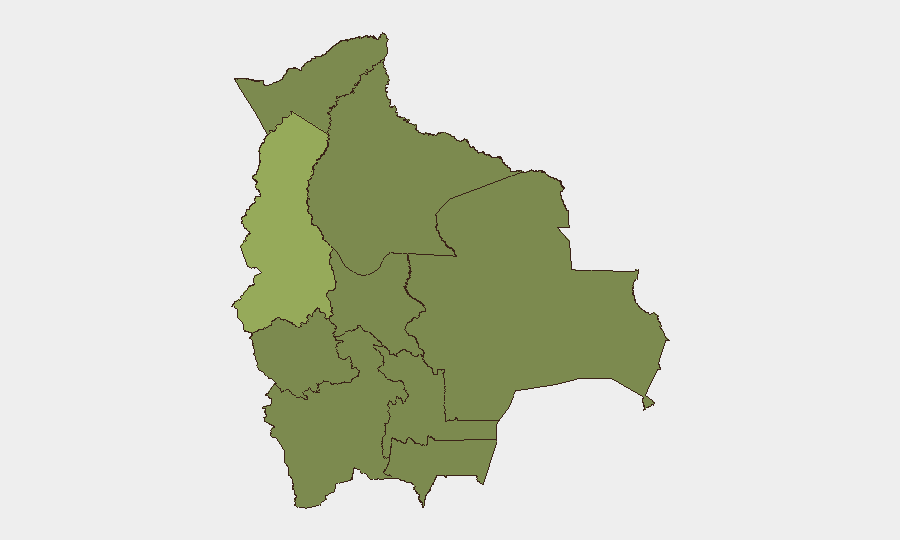
La Paz stands far above all other departments (risk score 53.9) and is the epicenter of political demand, detentions, and security-force activity. Cochabamba (34.8) follows as a secondary focus, likely reflecting peasant-union organizing and highway-blockade activity in the central Chapare region. All other departments—Santa Cruz, Potosí, Tarija, Pando, Beni, Oruro, and Chuquisaca—register similar moderate baseline risk (23.9), suggesting either distributed lower-intensity friction or data-collection limitations outside the capital and major urban centers. Corporate assets and personnel in La Paz face the highest encounter risk with demonstrations, blockades, and police/military presence; Cochabamba poses significant disruption risk to supply chains and staff movement between regions.
How GeoBit Would Assist
Security teams should deploy AOI Monitoring & Early Warning on La Paz, Cochabamba, and key highway corridors (San Julián, Chapare) to detect blockade resumption or force movements in real time. Network & Actor Analysis and multi-language OSINT (X/Twitter, Telegram, local media) will identify peasant-union and civic-group leadership, demand cycles, and protest scheduling. Routing & Network Analysis helps identify alternative supply and personnel routes around active blockades; combined with GIS & Spatial Analysis, this supports safe-zone mapping and incident-avoidance planning.
7-Day Outlook
Political and protest pressure is likely to sustain or escalate in the immediate week, driven by unmet peasant and labor demands and possible judicial actions against detained activists. Security-force deployments and civilian clashes will continue in a cyclical pattern—blockade, clearance, regrouping—particularly in La Paz and Cochabamba. Risk of major escalation (significant casualty incident, wider mutiny within armed forces, or capital-area civil unrest) remains present but not imminent; however, any unilateral government crackdown or high-profile arrest could trigger broader mobilization.
Highest-Risk Areas — Ranked
| # | State / Region | Risk |
|---|---|---|
| 1 | La Paz | 53.9 |
| 2 | Cochabamba | 34.8 |
| 3 | Potosí | 23.9 |
| 4 | Tarija | 23.9 |
| 5 | Pando | 23.9 |
| 6 | Beni | 23.9 |
| 7 | Oruro | 23.9 |
| 8 | Chuquisaca | 23.9 |
| 9 | Santa Cruz | 23.9 |
Sources
Previous Daily Briefs
A new Bolivia brief is written every day — each with its own risk map and downloadable CSV. Here's the last week; use the calendar to go further back.
📅 Browse every day by calendar →
Highlighted days have a brief. Tap a day for that day's map & analysis, or “csv” for that day's dataset ($5).