Situation Summary
Bosnia and Herzegovina remains a low-intensity, structurally fragile state with composite threat ranking of 4/100 globally (#169). The security environment is dominated by long-standing political and constitutional tensions rather than acute armed conflict or mass civil unrest. Governance vulnerabilities—particularly FATF grey-list status for anti-money laundering and terrorist-financing controls—and contested state sovereignty by Republika Srpska leadership create persistent baseline risk. No major security incidents were confirmed in the last 24–48 hours in open reporting.
Key Developments
- No discrete security incidents meeting corroboration standards were identified in Bosnia and Herzegovina in the last 24–48 hours (as of 29 June 2026). Available open-web reporting does not contain time-stamped, location-specific reports of attacks, arrests, protests, infrastructure failures, or crime events in that window.
- Political-stability analysis (29 June 2026, country-wide): Ongoing leadership challenges to state constitutional order and territorial integrity by Republika Srpska leadership and the SNSD party persist as structural friction points; no new escalation reported in the immediate reporting window.
- Governance baseline: Bosnia and Herzegovina remains under FATF increased monitoring (grey list), indicating sustained financial-crime and regulatory gaps that underpin wider governance risk.
- Regional event signals flagged by the platform include statements and tensions involving Iran, Kuwait, Bahrain, and Saudi Arabia (26–28 June), but these are *external* to Bosnia and Herzegovina and do not directly affect in-country security posture at present.
Highest-Risk Areas
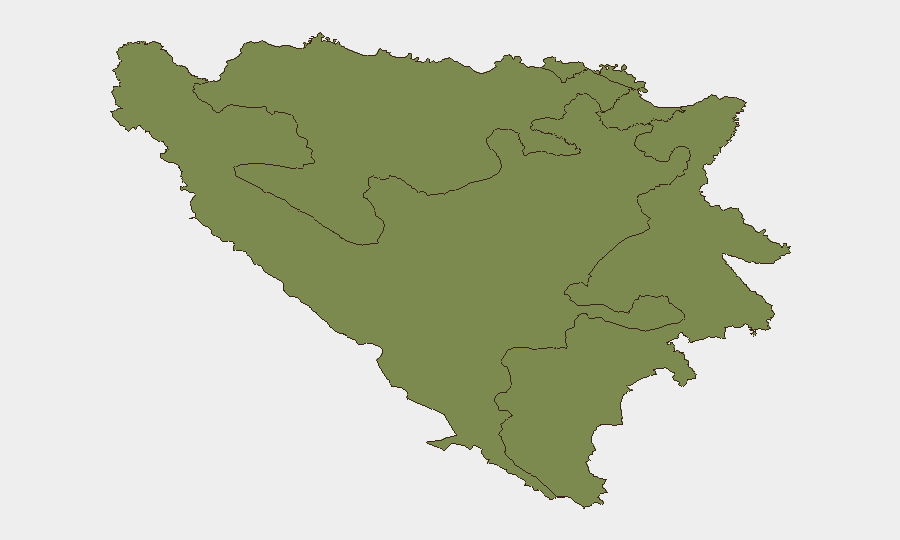
The Federation of Bosnia and Herzegovina dominates sub-national risk (31.4), reflecting concentration of political institutions, population, and economic activity in this entity, alongside historical inter-ethnic sensitivities and organized-crime presence. Republika Srpska (1.4) and Brčko District (1.4) carry significantly lower flagged risk, though RS remains the primary locus of sovereignty challenges to the state. The Federation's risk profile reflects vulnerability to both organized crime and political polarization; Republika Srpska's lower score does not indicate stability, but rather lower reporting density and less acute immediate triggering events.
How GeoBit Would Assist
Security teams with personnel or assets in Bosnia and Herzegovina should employ AOI Monitoring & Early Warning to track high-risk urban centers (Sarajevo, Mostar, Zenica) and border regions for emerging civil unrest, trafficking, or organized-crime activity. Network & Actor Analysis and multi-language OSINT (including Telegram, X, and local media) would provide early detection of political escalation, extremist recruitment, or financial-crime indicators. Conflict & Military and regime-stability assessment modules help distinguish structural political friction from acute destabilization risk.
7-Day Outlook
No imminent security deterioration is forecast. Baseline political tensions between Sarajevo and Banjaluka will likely continue; monitoring should focus on parliamentary calendar, SNSD public statements, and any external security incidents (regional conflict, sanctions) that could trigger domestic instability. Duty-of-care teams should maintain standard civil-unrest and crime alerting protocols; no shift to heightened alert posture is warranted at this time.
Highest-Risk Areas — Ranked
| # | State / Region | Risk |
|---|---|---|
| 1 | Federation of Bosnia and Herzegovina | 31.4 |
| 2 | Republika Srpska | 1.4 |
| 3 | Brčko District | 1.4 |
Sources
Previous Daily Briefs
A new Bosnia and Herzegovina brief is written every day — each with its own risk map and downloadable CSV. Here's the last week; use the calendar to go further back.
📅 Browse every day by calendar →
Highlighted days have a brief. Tap a day for that day's map & analysis, or “csv” for that day's dataset ($5).