Situation Summary
Botswana remains a stable, low-threat environment (global rank #170; composite threat score 4) with no recorded major security incidents in the past 24–48 hours. However, two concurrent risk vectors have emerged: (1) a documented pattern of Botswana citizens being trafficked into the Russia–Ukraine conflict via deceptive recruitment, triggering a formal government warning on 18 July 2026, and (2) ongoing urban crime trends in major cities and heightened civil-unrest risk for Batswana nationals in South Africa. The domestic security baseline remains sound; external and diaspora-linked risks are the primary concern.
Key Developments
- Gaborone (National) – 18 July 2026: Botswana's Ministry of International Relations issued a public warning of an *"alarming rise"* in citizens being lured or trafficked to Russia under false employment pretenses and then coerced into combat in Ukraine, marking an unusual diplomatic escalation and signaling elevated personal security risk for nationals engaging with foreign recruitment networks.
- Botswana nationals (Russia–Ukraine theatre) – 18 July 2026: Multiple outlets and social media reports confirmed a rapidly growing cohort of Botswana citizens deceived by recruitment schemes, transported to Russia, and reportedly forced into combat participation, underscoring conflict-exposure and duty-of-care risks for affected personnel.
- Gaborone (Diplomatic) – 18–19 July 2026: Botswana's public accusation of Russia over citizen trafficking and coerced military participation has generated regional and international media coverage, reflecting heightened political tension and a shift in official posture toward recruitment-linked foreign-national risk.
- South Africa (Cross-border) – Mid-July 2026: Botswana's government issued advisory guidance to its citizens in South Africa to avoid anti-immigration protests and remain vigilant, reinforcing travel and civil-unrest risk for Batswana in the neighboring country rather than domestically.
- Major Urban Centers (Gaborone, Francistown, Maun) – Recent period: Ongoing official travel guidance notes elevated crime (theft, robbery, armed attacks after dark) in major cities, consistent with crime-trend increases documented in recent years; no acute incident timestamp available.
Highest-Risk Areas
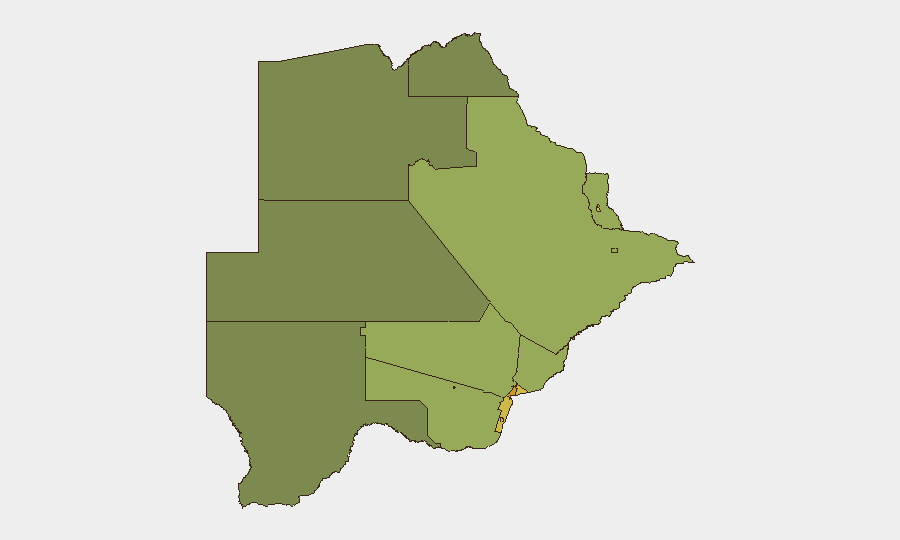
Gaborone (risk 72), South-East District (68), and Lobatse (65) carry the highest sub-national scores, reflecting concentration of crime, commercial activity, and population density in the capital and adjacent urban corridors. Francistown, Jwaneng, and Selebi Phikwe also register elevated risk (62, 61, 58 respectively), likely driven by mining operations, transient populations, and economic activity. Rural and northern districts (North-West, Central, North-East) score substantially lower (38–45), indicating that security risk is predominantly urban and economically driven rather than tied to regional instability.
How GeoBit Would Assist
Security teams managing personnel or assets in Botswana should deploy AOI Monitoring & Early Warning on high-risk urban centers (Gaborone, Francistown, Maun) to detect emerging crime patterns, protest activity, or civil-unrest signals in real time. Network & Actor Analysis and OSINT Fusion (X/Twitter, Telegram, web intelligence) would track recruitment network activity, trafficking indicators, and Russia–linked schemes targeting Botswana nationals, enabling rapid alerting to at-risk employees. Routing & Network Analysis supports alternative travel planning and avoidance of high-crime zones and protest areas, particularly for cross-border movement into South Africa.
7-Day Outlook
The Russia–Ukraine recruitment warning is likely to persist as a policy and media focus, with no immediate domestic security deterioration expected. Crime trends in urban centers will remain the primary operational risk for expatriates and mobile assets. Monitor diplomatic messaging and consular guidance updates for any escalation or new warnings affecting Botswana nationals abroad or travel corridors into South Africa.
Highest-Risk Areas — Ranked
| # | State / Region | Risk |
|---|---|---|
| 1 | Gaborone | 72 |
| 2 | South-East District | 68 |
| 3 | Lobatse | 65 |
| 4 | Francistown | 62 |
| 5 | Jwaneng | 61 |
| 6 | Selebi Phikwe | 58 |
| 7 | Southern District | 55 |
| 8 | Kgatleng District | 50 |
| 9 | Kweneng District | 48 |
| 10 | North-East District | 45 |
| 11 | Central District | 42 |
| 12 | North-West District | 38 |
Sources
Previous Daily Briefs
A new Botswana brief is written every day — each with its own risk map and downloadable CSV. Here's the last week; use the calendar to go further back.
📅 Browse every day by calendar →
Highlighted days have a brief. Tap a day for that day's map & analysis, or “csv” for that day's dataset ($5).
Atlas — our AI intelligence desk — emails them this snapshot personally. Nothing else, no list.