Situation Summary
Brazil's composite security threat level remains elevated at global rank #33 (score 79), driven primarily by large-scale organized-crime insurgency and structural gaps in state security capacity. A new Federal Court of Accounts audit has quantified the severity of the imbalance: criminal organizations now move approximately R$348 billion annually—2.4 times total government security spending—while federal investment in policing represents barely 1% of operational costs. Recent diplomatic tensions with the U.S. over cartel-designation policy and expanded federal investigations into financial-crime networks have added layers of political instability and protest potential to the underlying criminal-violence baseline.
Key Developments
- Brasília (Federal District) – 9 July 2026: Brazil's Foreign Ministry (Itamaraty) issued a public warning of heightened security risks and potential conflict following U.S. moves to classify major drug cartels as terrorist organizations, sparking domestic debate over possible military intervention and regional destabilization. Risk: elevated potential for anti-U.S. demonstrations and political friction.
- Brazil-wide – 9 July 2026: Federal Court of Accounts (TCU) released audit findings confirming organized crime annual revenue of R$348 billion—2.4× all government security spending. The report underscores severe structural funding and state-capacity deficits, particularly in poorer states.
- São Paulo (city) – 8–9 July 2026: Expansion of Smart Sampa surveillance network now comprises approximately 50,000 cameras with facial-recognition capability in central São Paulo and major urban zones. Media reporting includes tracking of arrests linked to the system ("prisonometer"), raising civil-liberties and protest-policing considerations.
- São Paulo – 9 July 2026: Federal Police launched operation targeting executive Thiago Miranda (Banco Master) and banker Daniel Vorcaro in connection with alleged irregular communications and financial dealings. Investigation marks escalation in federal anti-corruption and financial-crime enforcement.
- Brazil (cyber domain) – 8–9 July 2026: Market analysis highlighted rapid growth in cybersecurity sector driven by LGPD compliance, operational-resilience demands, and third-party risk assessment, with São Paulo reinforced as strategic hub. Reflects elevated cyber-crime and data-breach risk expectations.
- Brazil–U.S. relations – 9 July 2026: Domestic commentary amplified sovereignty concerns over U.S. counter-cartel initiatives and spillover risk, framed within broader struggle against criminal organizations already outspending the state. Risk: enhanced civil-unrest and political-instability potential in urban centres with high cartel/militia influence.
Highest-Risk Areas
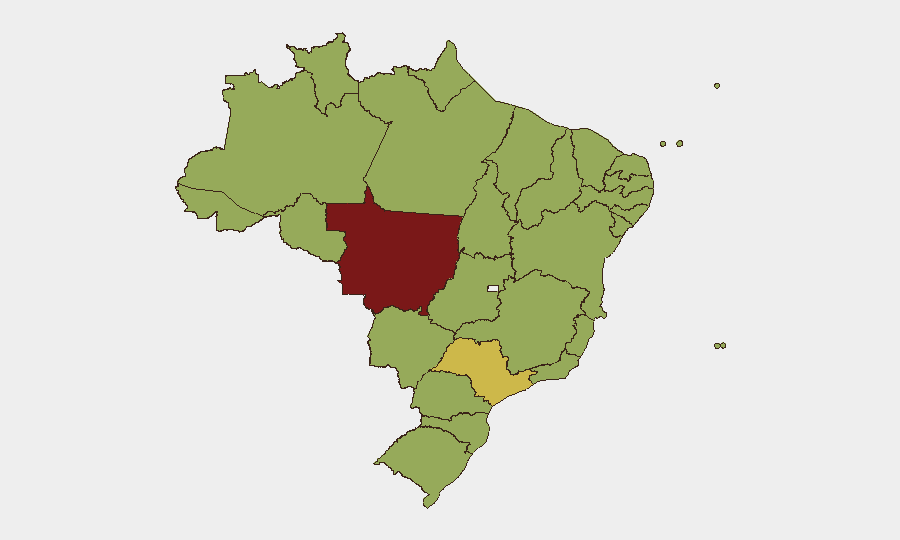
Mato Grosso (85.6) leads sub-national risk, driven by large-scale organized-crime logistics, border-trafficking corridors, and limited state capacity. São Paulo (68.5), despite major-city infrastructure and federal presence, faces compound risk from high cartel presence, financial-crime networks, and concentrated population density. Rio de Janeiro (58.8) and Minas Gerais (58) remain volatile due to militia activity, drug-trade competition, and state-security fragmentation. Northern states (Rondônia, Amazonas, Roraima, 55.6–56.0) face transnational trafficking and criminal-insurgency pressure across remote borders.
How GeoBit Would Assist
Security teams should deploy AOI Monitoring & Early Warning on high-risk states (Mato Grosso, São Paulo, Rio de Janeiro) to track protest activity, arrests, and cartel-related incidents in real time. OSINT fusion and sentiment analysis on X/Telegram/media feeds will capture escalation signals around U.S.–Brazil tensions and anti-U.S. demonstrations before they materialize. Network & Actor Analysis paired with cyber-domain search will help identify financial-crime exposure and data-breach vectors in São Paulo's banking sector.
7-Day Outlook
U.S.–Brazil diplomatic friction over cartel designations is likely to sustain moderate protest activity in Brasília and São Paulo over the next week, particularly if media coverage intensifies. Organized-crime violence in Mato Grosso and northern border regions will continue at baseline levels; no acute escalation is signalled, but structural instability remains high. Federal enforcement operations (financial crimes, anti-corruption) will continue, with potential for collateral disruption to business operations in São Paulo's financial district.
Highest-Risk Areas — Ranked
| # | State / Region | Risk |
|---|---|---|
| 1 | Mato Grosso | 85.6 |
| 2 | São Paulo | 68.5 |
| 3 | Rio de Janeiro | 58.8 |
| 4 | Minas Gerais | 58 |
| 5 | Pernambuco | 57.7 |
| 6 | Rio Grande do Sul | 57.4 |
| 7 | Santa Catarina | 57.2 |
| 8 | Bahia | 57.1 |
| 9 | Maranhão | 56.3 |
| 10 | Rondônia | 56 |
| 11 | Amazonas | 55.9 |
| 12 | Roraima | 55.7 |
Sources
Previous Daily Briefs
A new Brazil brief is written every day — each with its own risk map and downloadable CSV. Here's the last week; use the calendar to go further back.
📅 Browse every day by calendar →
Highlighted days have a brief. Tap a day for that day's map & analysis, or “csv” for that day's dataset ($5).
Atlas — our AI intelligence desk — emails them this snapshot personally. Nothing else, no list.