Situation Summary
China's security environment remains moderately elevated (composite threat score 74, rank #19 globally) driven primarily by political friction, regulatory enforcement, and isolated detention actions rather than acute physical disruption. The last 24–48 hours have seen steady tension centered on diplomatic/trade friction and targeted personnel actions, with no corroborated incidents of widespread unrest, infrastructure failure, or violence. Risk remains geographically concentrated in northwestern and coastal regions, with enforcement and compliance pressures dominating the threat landscape over immediate physical security concerns.
Key Developments
- Beijing – 13–14 June 2026 – Two arrest/detention events logged involving a scholar and citizen; part of an ongoing pattern of security scrutiny. Charges and full details remain unconfirmed in open reporting, but actions reflect elevated enforcement activity at the national level.
- Nationwide – 13–14 June 2026 – Chinese state outlets report Beijing has formally opposed the U.S. addition of 37 Chinese entities to national security trade restriction lists, framing the move as a threat to company interests. Public statements indicate heightened political friction in tech and trade sectors without reported street-level unrest.
- Beijing – 12–13 June 2026 – Cluster of regulatory signaling and administrative sanctions recorded, including trade/tech scrutiny actions. Diplomatic messaging and follow-on enforcement indicate sustained political tension at national institutions.
- Nationwide – 13–14 June 2026 – No time-stamped incidents of demonstrations, infrastructure disruption, or organized violence corroborated in open reporting or monitored channels over the prior 48 hours. Security posture remains elevated but operationally steady.
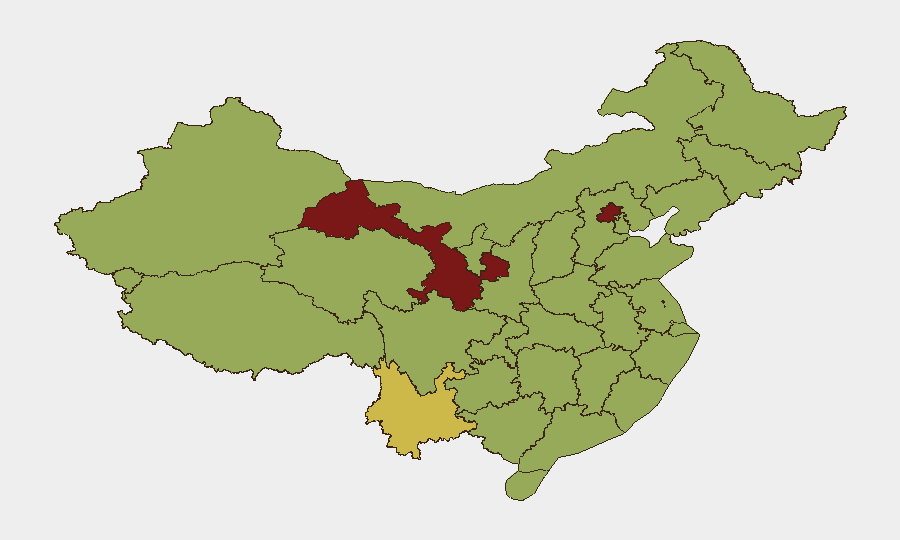
- Coastal/economic hubs (Shanghai, Jiangsu, Guangdong, Yunnan) – as of 14 June – Persistent moderate-to-elevated risk linked to trade exposure and cross-border movement scrutiny; no acute unrest reported in the measurement window.
- Northwestern regions (Gansu, Qinghai) – as of 14 June – Baseline risk remains highest nationally due to border sensitivity and structural vulnerabilities; no newly verified incidents in the last 48 hours.
Highest-Risk Areas
Gansu (81.9) and Beijing (81.5) drive the national risk ranking, with Gansu's elevation reflecting border sensitivity, ethnic/political tensions, and infrastructure vulnerability in China's northwest, while Beijing's score reflects concentration of regulatory authority and enforcement activity. Coastal economic centers—Yunnan (60.7), Shanghai (57.2), Jiangsu (54.5), and Guangdong (52.9)—face elevated risk from trade friction, cross-border regulatory scrutiny, and tech sector exposure following recent U.S. sanctions actions. These regions collectively account for the bulk of China's elevated composite score; risk is primarily regulatory and enforcement-driven rather than acute.
How GeoBit Would Assist
Security teams in China should employ Intel Sweep and multi-language OSINT (X/Twitter, Telegram, official state channels) for real-time detection of enforcement actions and diplomatic signaling; AOI Monitoring & Early Warning on Gansu, Beijing, and coastal hubs for rapid alert to unrest or infrastructure incidents; and Risk & Threat Assessment correlated with economic/trade monitoring to track enforcement and sanctions impact on personnel and supply chains. Network & Actor Analysis supports identification of detainees and investigation patterns, while Routing & Network Analysis aids in contingency planning for personnel in high-risk provinces.
7-Day Outlook
Regulatory and trade-related enforcement actions are likely to persist as Beijing responds to U.S. sanctions. No significant escalation in physical unrest or infrastructure disruption is forecast in the near term, but detention risk and compliance pressure—particularly in tech, trade, and academic sectors—will remain elevated. Operators should monitor for announcements in Shanghai, Beijing, and Gansu over the next 7 days, with focus on secondary regulatory actions rather than acute security crises.
Highest-Risk Areas — Ranked
| # | State / Region | Risk |
|---|---|---|
| 1 | Gansu | 81.9 |
| 2 | Beijing | 81.5 |
| 3 | Yunnan | 60.7 |
| 4 | Shanghai | 57.2 |
| 5 | Jiangsu | 54.5 |
| 6 | Chongqing | 54.2 |
| 7 | Heilongjiang | 54 |
| 8 | Guangdong Province | 52.9 |
| 9 | Qinghai | 52.8 |
| 10 | Jiangxi | 52.6 |
| 11 | Liaoning | 52.2 |
| 12 | Jilin | 52.2 |
Previous Daily Briefs
A new China brief is written every day — each with its own risk map and downloadable CSV. Here's the last week; use the calendar to go further back.
📅 Browse every day by calendar →
Highlighted days have a brief. Tap a day for that day's map & analysis, or “csv” for that day's dataset ($5).