Situation Summary
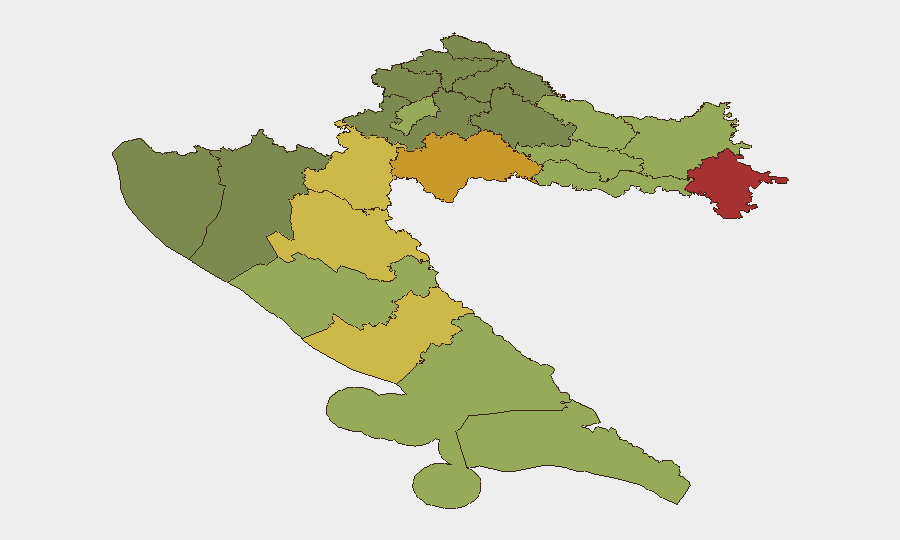
Croatia remains a stable, low-threat country ranked #125 globally with a composite threat score of 2.1. No major security incidents, civil unrest, or infrastructure failures have been documented in the last 24–48 hours; routine travel advisories remain current and recommend standard safety precautions. Risk is concentrated in former conflict zones and border regions in the northeast and inland Balkans, where legacy tensions, administrative disputes, and cross-border issues persist at elevated but manageable levels. The overall security trajectory is stable, with no indicators of near-term destabilization.
Key Developments
No verified major incidents in the last 24–48 hours. Open-source search and GeoBit's event feeds surface no discrete security, conflict, crime, political, or infrastructure events in Croatia meeting the last-48-hour threshold. The most recent dated item is:
- Country-wide advisory update (01 Jul 2026): Australia's Smartraveller confirmed Croatia travel advice remains current as of 01 July 2026, advising "exercise normal safety precautions" and noting no recent terrorist attacks. Border-crossing delays and general security vigilance remain advised but are routine operational factors, not acute incidents.
Older signals captured in GeoBit's event tracker (e.g., mayoral–commander dispute, tourism-related rejections, prosecutor action on 29 June) lack current verification and specific incident corroboration; they do not meet the requirement for concrete, time-stamped developments in the last 24–48 hours.
Highest-Risk Areas
Vukovar-Srijem, Sisak-Moslavina, and Karlovac counties in the northeast and inland Balkans drive the risk ranking, with composite scores of 78, 72, and 68 respectively. These regions share common drivers: proximity to Serbian and Bosnian borders, legacy tensions from the 1990s Balkans conflicts, ongoing property disputes and restitution issues, and sporadic administrative friction between local authorities and central government. Zadar, Šibenik-Knin, and Brod-Posavina counties remain elevated (55–62) due to border proximity and similar post-conflict societal dynamics. By contrast, Zagreb and major Adriatic tourism zones (Split-Dalmatia, Zadar) rank lower (48–50), reflecting stronger institutional capacity and international oversight. Risk is primarily structural and political rather than acute; violent crime and terrorism remain rare.
How GeoBit Would Assist
Security and risk teams operating in Croatia would benefit from AOI Monitoring & Early Warning on the highest-risk northeastern counties to detect emerging administrative disputes, cross-border incidents, or civil tensions before escalation. Multi-language OSINT and entity extraction (X/Twitter, Telegram, local news) would track local political actors, prosecutor actions, and official statements in real time, providing early signal of governance friction or unrest. GIS & Spatial Analysis combined with border & disputed-territory search capabilities would map specific routes, crossing points, and property-dispute flashpoints, enabling risk-informed duty-of-care decisions and alternative routing for personnel or supply movements.
7-Day Outlook
No acute threats are forecast for the next seven days. Routine administrative and political frictions in northeastern counties may generate local headlines but are unlikely to materialize into security incidents affecting corporate operations or expatriate personnel. Travel and business operations can proceed under standard precautions; security teams should maintain persistent monitoring of border regions and local administrative announcements but need not elevate alert posture.
Highest-Risk Areas — Ranked
| # | State / Region | Risk |
|---|---|---|
| 1 | Vukovar-Srijem County | 78 |
| 2 | Sisak-Moslavina County | 72 |
| 3 | Karlovac County | 68 |
| 4 | Lika-Senj County | 65 |
| 5 | Šibenik-Knin County | 62 |
| 6 | Brod-Posavina County | 58 |
| 7 | Zadar County | 55 |
| 8 | Osijek-Baranja County | 52 |
| 9 | City of Zagreb | 50 |
| 10 | Split-Dalmatia County | 48 |
| 11 | Požega-Slavonia County | 45 |
| 12 | Virovitica-Podravina County | 42 |
Sources
Previous Daily Briefs
A new Croatia brief is written every day — each with its own risk map and downloadable CSV. Here's the last week; use the calendar to go further back.
📅 Browse every day by calendar →
Highlighted days have a brief. Tap a day for that day's map & analysis, or “csv” for that day's dataset ($5).