Situation Summary
Estonia faces an uptick in multi-domain security pressure as of 1 September 2026, marked by concurrent airspace incursions and coordinated cyber activity targeting state infrastructure. The country remains #117 globally in composite threat score, but recent events signal intensifying Russian-aligned tactical probing along the eastern border and sustained hacktivist operations against government and financial systems. No physical casualties or permanent infrastructure damage have been reported, but the coordinated timing and scope of both incidents suggest deliberate pressure testing ahead of parliamentary activity.
Key Developments
- Southeastern Estonia airspace, 1 September 2026 (01:00–06:00 local) – Estonian Defence Forces issued air-raid alerts across six to eight counties after detecting multiple drones entering or approaching airspace along the eastern border. Turkish NATO fighter jets were scrambled to investigate. The alert was lifted at approximately 05:30 with no reported physical impact, debris recovery, or publicly confirmed drone origin.
- National cyber infrastructure, 1 September 2026 (night/early morning) – Pro-Russian hacktivist group NoName057(16) executed a coordinated DDoS campaign against at least seven Estonian government and financial systems, including the Riigikogu (Parliament) information portal, the Ministry of Finance authentication gateway, and banking e-ID platforms. Services experienced temporary unavailability; no data exfiltration or permanent damage confirmed. Attack timing preceded an extraordinary parliamentary session scheduled for 2 September.
- State cyberspace governance, implemented 31 August 2026 – Estonia began quarantining emails from .ru domains sent to state institutions, routing them centrally for enhanced security screening. The measure applies across the secure state cyberspace infrastructure and was announced by the Minister of Digital Affairs and Justice as a proactive cyber-risk mitigation step.
- Border operations context – Both the drone incursions and cyber campaign occurred in the same operational window, suggesting potential coordination or deliberate intensity escalation targeting state decision-making infrastructure ahead of parliamentary proceedings.
Highest-Risk Areas
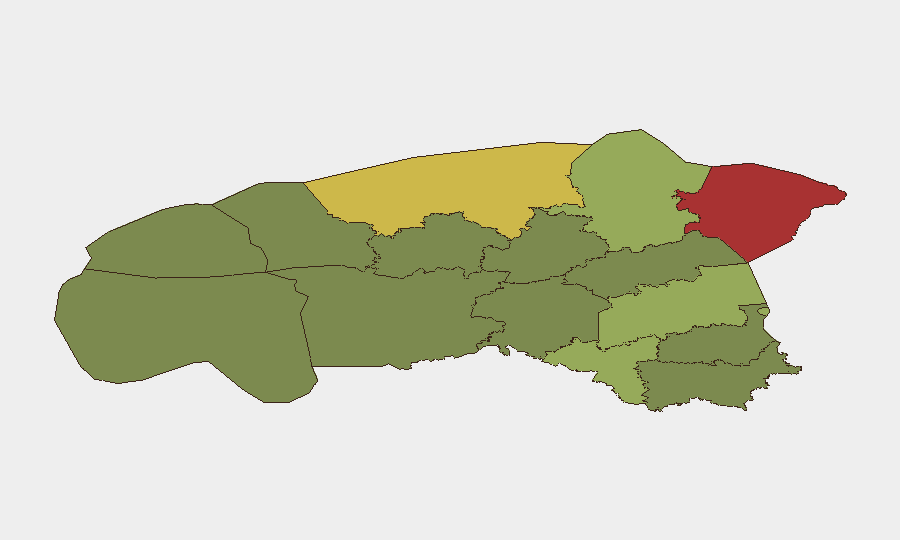
Ida-Viru County (risk 78) and Harju County (risk 68) dominate the sub-national ranking and are consistent with Estonia's geographic vulnerability: Ida-Viru borders Russia directly and has historically faced Russian-aligned espionage, sabotage, and hybrid threat concentration; Harju encompasses Tallinn and Estonia's critical national cyber and financial infrastructure, making it a priority target for DDoS and state-level cyber operations. Tartu, Valga, and Lääne-Viru counties (scores 58, 55, 52) extend the high-risk band across southeastern and eastern Estonia, forming a contiguous frontier exposure zone. All lower-ranked counties carry residual risk typical of peripheral regions.
How GeoBit Would Assist
Intel Sweep and multi-language OSINT workflows would enable continuous monitoring of NoName057(16) and related hacktivist forums, Telegram channels, and dark-web coordination signals to forecast DDoS timing and targets. AOI Monitoring & Early Warning with persistent satellite and SIGINT coverage of Ida-Viru and the eastern border would provide 6–24 hour advance notice of drone staging, launch patterns, and incursion attempts. Network & Actor Analysis applied to the hacktivist group's infrastructure and command nodes would support attribution precision and identify secondary targets for protective measures.
7-Day Outlook
The 1 September incidents suggest a sustained campaign of hybrid pressure—airspace testing combined with cyber disruption of state decision-making processes—likely to persist through the parliamentary session on 2 September and beyond. Organizations and critical infrastructure operators in Harju and Ida-Viru counties should maintain heightened vigilance on DDoS resilience, email hygiene (especially .ru-domain filtering), and border-area asset security. Further drone incursions or expanded cyber targeting of financial and energy infrastructure remain plausible within the near term.
Highest-Risk Areas — Ranked
| # | State / Region | Risk |
|---|---|---|
| 1 | Ida-Viru County | 78 |
| 2 | Harju County | 68 |
| 3 | Tartu County | 58 |
| 4 | Valga County | 55 |
| 5 | Lääne-Viru County | 52 |
| 6 | Pärnu County | 35 |
| 7 | Rapla County | 32 |
| 8 | Jõgeva County | 30 |
| 9 | Järva County | 28 |
| 10 | Viljandi County | 25 |
| 11 | Põlva County | 22 |
| 12 | Võru County | 18 |
Sources
Previous Daily Briefs
A new Estonia brief is written every day — each with its own risk map and downloadable CSV. Here's the last week; use the calendar to go further back.
- August 30, 2026
- August 27, 2026
- August 25, 2026
- August 23, 2026
- August 21, 2026
- August 19, 2026
- August 17, 2026
📅 Browse every day by calendar →
Highlighted days have a brief. Tap a day for that day's map & analysis, or “csv” for that day's dataset ($5).
Atlas — our AI intelligence desk — emails them this snapshot personally. Nothing else, no list.