Situation Summary
Eswatini faces a low-intensity, dispersed security environment with no acute incidents reported in the last 48 hours. The country's composite threat score remains at 2 globally, and open-source reporting shows no discrete security events within the current window. Structural vulnerabilities—including a five-place drop in the 2026 Global Peace Index ranking and ongoing detention-related human rights concerns—indicate a stable but fragile baseline rather than an escalating threat trajectory.
Key Developments
No discrete security, conflict, civil unrest, crime, or infrastructure incidents have been reliably identified in Eswatini within the last 24–48 hours based on available open-source reporting.
Background context (outside the 48h window):
- Matsapha (11 July): Discovery of a long-running stock-theft scheme involving E1.8 million in sweets, with five suspects arrested after checks spanning January–June 2026.
- Nationwide (8 July): Amnesty International documented continued detention of at least 30 migrants at Matsapha Correctional Complex under a third-country arrangement, reflecting ongoing detention and human-rights monitoring concerns.
- Ezulwini/KaDlovunga/Ntondozi (case filed Jan 2024–Jan 2026): Two former MTN Eswatini employees arrested for theft of airtime stock valued at over E10.2 million.
- Mbabane (end-June data): Central Bank reported public debt increased 2.2% to E42.1 billion, signaling macro-economic stress but not an acute security incident.
Highest-Risk Areas
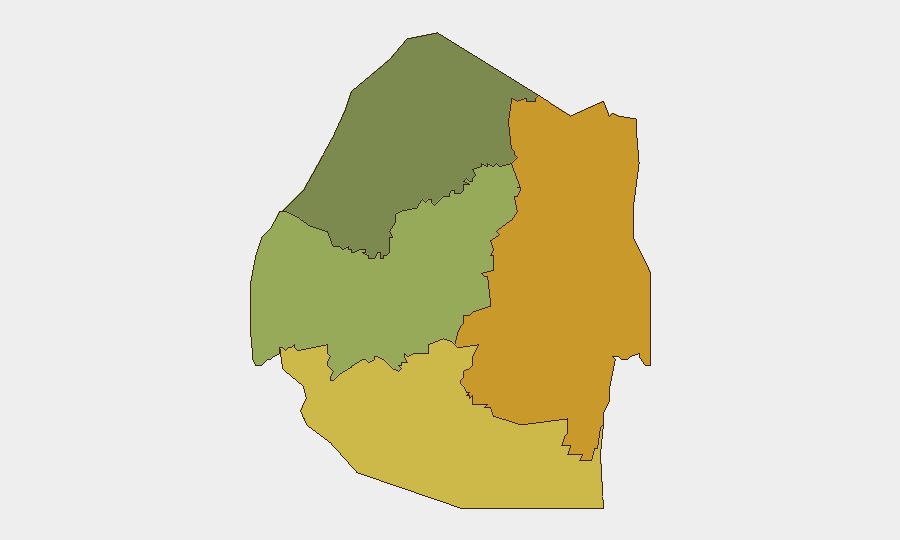
Lubombo (risk 72) and Shiselweni (risk 68) are the country's highest-risk regions, together accounting for the majority of sub-national threat exposure. Manzini Region (55) presents moderate risk, while Hhohho (35) remains the most secure. The drivers of Lubombo and Shiselweni risk are not specified in current open-source signals; GeoBit's sub-national risk ranking suggests persistent vulnerabilities in border security, trafficking, or transnational crime, but discrete events in these regions have not been reported in the last 48 hours. Corporate teams with operations in southern or eastern Eswatini should treat these regions as elevated-attention areas for supply-chain, staff movement, and asset-security planning.
How GeoBit Would Assist
Security teams should deploy AOI Monitoring & Early Warning on Lubombo and Shiselweni to capture emerging incidents in real-time and receive automated alerts before they affect operations. Intel Sweep and OSINT fusion (X/Twitter, Telegram, local news feeds, and multi-language search) will establish a daily baseline of criminal, political, and infrastructure activity across all regions, compensating for gaps in English-language reporting. Routing & Network Analysis can support duty-of-care planning by identifying safer movement corridors for personnel traveling between Mbabane, Manzini, and cross-border points, especially in high-risk zones.
7-Day Outlook
No escalation is expected in the near term; Eswatini's security environment remains characterized by baseline criminality, governance friction (ongoing police-sector disputes), and structural economic strain rather than acute conflict or civil unrest. Security teams should maintain standard protocols for cash-in-transit, detention-risk awareness (given migrant-detention activity), and staff safety in Lubombo and Shiselweni, but no operational lockdowns or evacuation triggers are warranted. Continued monitoring of detention practices and any political response to the recent Global Peace Index decline is advisable over the next 7–14 days.
Highest-Risk Areas — Ranked
| # | State / Region | Risk |
|---|---|---|
| 1 | Lubombo | 72 |
| 2 | Shiselweni | 68 |
| 3 | Manzini Region | 55 |
| 4 | Hhohho Region | 35 |
Sources
Previous Daily Briefs
A new Eswatini brief is written every day — each with its own risk map and downloadable CSV. Here's the last week; use the calendar to go further back.
📅 Browse every day by calendar →
Highlighted days have a brief. Tap a day for that day's map & analysis, or “csv” for that day's dataset ($5).
Atlas — our AI intelligence desk — emails them this snapshot personally. Nothing else, no list.