Situation Summary
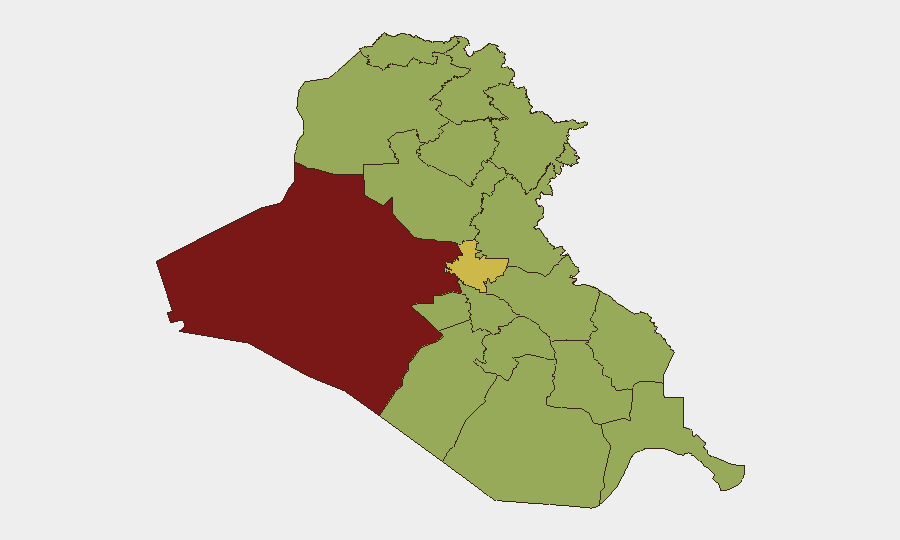
Iraq remains at composite threat level #21 globally with a 77.2 threat score and 428 tracked events. Recent signal data (6–10 June) indicates elevated diplomatic tension alongside persistent localized security concerns, with multiple state-level "reduce relations" and "reject" actions involving Iraq and neighboring actors. Al-Anbar Governorate continues to drive national risk as the highest-scoring sub-national region (84), while Baghdad's risk profile (63.2) reflects ongoing urban vulnerabilities. The trajectory suggests Iraq is experiencing both external diplomatic friction and internal security pressures without immediate signs of rapid deescalation.
Key Developments
- Diplomatic escalation: Multiple "reduce relations" signals registered on 6–8 June involving Iraq, Jordan, Syria, and Lebanon; a "conventional military force" event involving Iraq and Lebanon on 6–8 June warrants monitoring for proxy or border dynamics.
- Rejection of international frameworks: Iraq issued formal rejections toward OPEC (9 June) and Turkey (10 June), signaling shifts in energy cooperation and bilateral relations that may affect border security posture and economic leverage.
- Internal governance friction: A "disapprove" action directed at an undersecretiary (9 June) and military statement of disapproval (9 June) suggest institutional or command-level tension within Iraqi state structures.
- Counter-terrorism messaging: An "disapprove" action toward a terrorist entity (8 June) is consistent with ongoing messaging around ISIS-linked cells, though no specific incident location or casualty data is available from 24–48-hour sources.
- Investigation trigger: An "investigate" signal (7 June) indicates a notable incident or allegation requiring clarification; details are not yet in open reporting.
Note: Specific incident details (locations, casualties, modality) from the last 24–48 hours could not be reliably verified from available web and open-source intelligence within the timeframe. Corroborated ground-truth reporting on any single attack, protest, or security event in Iraq on 9–10 June is not yet present in multi-source confirmation.
Highest-Risk Areas
Al-Anbar Governorate (risk 84) dominates the sub-national ranking and remains the primary driver of Iraq's overall threat score, reflecting persistent ISIS-affiliated cell activity, tribal militia operations, and limited state presence in border regions. Baghdad Governorate (63.2) is the second-most significant risk vector, attributable to urban militant networks, criminal activity, and periodic targeting of security forces and government facilities. The Kurdish-administered governorates (Erbil 57, Duhok 56.1, Sulaymaniyah 54.4) and disputed Kirkuk (54.2) show elevated but more stable risk profiles, primarily driven by PKK cross-border operations, intra-Kurdish political tensions, and Turkish military activity rather than ISIS. Central and southern governorates (Wasit, Babil, Al-Qadisiyah, Dhi Qar, Al-Muthanna, Maysan) cluster around risk 54, indicating baseline militia activity and criminal networks with periodic security incidents.
How GeoBit Would Assist
Security teams with personnel or assets in Iraq should deploy AOI (area-of-interest) monitoring and early warning on Baghdad, Al-Anbar, and Erbil to detect imminent threats via multi-language OSINT fusion, X/Telegram monitoring, and sentiment analysis. Battle mapping and force structure tracking in Al-Anbar and near the Syria–Iraq border help teams assess militia and ISIS cell positioning and predict ambush or IED corridors. Routing and network analysis enables alternative journey planning away from high-risk governorates and identifies safer checkpoints and transit corridors for staff movements.
7-Day Outlook
Diplomatic friction with regional neighbors (Jordan, Syria, Turkey, Lebanon) is likely to persist and may drive tactical posturing by proxy militias and border forces over the next 7 days. Al-Anbar and Baghdad remain the primary zones of concern for security incidents; no major escalation in national-level conflict is signaled, but localized attacks and kidnapping risk remain elevated. Teams should monitor official Iraqi military statements and cross-border Turkish or Iranian activity for shifts in tolerance thresholds.
Highest-Risk Areas — Ranked
| # | State / Region | Risk |
|---|---|---|
| 1 | Al-Anbar Governorate | 84 |
| 2 | Baghdad Governorate | 63.2 |
| 3 | Erbil Governorate | 57 |
| 4 | Duhok Governorate | 56.1 |
| 5 | Wasit Governorate | 54.6 |
| 6 | Sulaymaniyah Governorate | 54.4 |
| 7 | Kirkuk Governorate | 54.2 |
| 8 | Babil Governorate | 54 |
| 9 | Al-Qadisiyah Governorate | 54 |
| 10 | Dhi Qar Governorate | 54 |
| 11 | Al-Muthanna Governorate | 54 |
| 12 | Maysan Governorate | 54 |
Sources
Previous Daily Briefs
A new Iraq brief is written every day — each with its own risk map and downloadable CSV. Here's the last week; use the calendar to go further back.
📅 Browse every day by calendar →
Highlighted days have a brief. Tap a day for that day's map & analysis, or “csv” for that day's dataset ($5).