Situation Summary
Latvia maintains a composite threat score of 3 with no tracked major security incidents in the past 24–48 hours. The security environment is dominated by persistent hybrid-threat activity along the eastern border—primarily irregular migration flows and aggressive incursion attempts from Belarus—rather than acute civil unrest or infrastructure disruption. Cyber and information operations remain an elevated structural risk, with no significant active incidents against critical systems currently reported.
Key Developments
- Belarus–Latvia border, past 24 hours: Latvian armed forces documented at least five illegal crossing attempts from Belarus, with migrants displaying aggressive behavior toward soldiers before withdrawing following warning shots. Activity characterized as part of ongoing hybrid-warfare provocation using irregular migration as a pressure vector on the NATO/EU perimeter.
- Eastern border smuggling operations, past 24 hours: State Border Guard detained one carrier transporting illegally crossed persons in Krāslava Municipality; separately, three additional carriers were apprehended in the border region during the same 24-hour window, indicating continued small-scale irregular-migration and human-smuggling networks.
- Cyber and information-operations posture, ongoing: Latvia's Constitution Protection Bureau reiterates that Russian sabotage and preparation for cyber-attacks against industrial control systems remain under sustained monitoring, though no significant incidents endangering critical infrastructure have materialized to date.
- NATO hybrid-threat messaging, recent: Latvian representatives at NATO forums have publicly emphasized hybrid threats—cyber, information, and border pressure—as core elements of Russia's operational doctrine, signaling that Riga views these vectors as the primary near-term security challenge rather than conventional military escalation.
Highest-Risk Areas
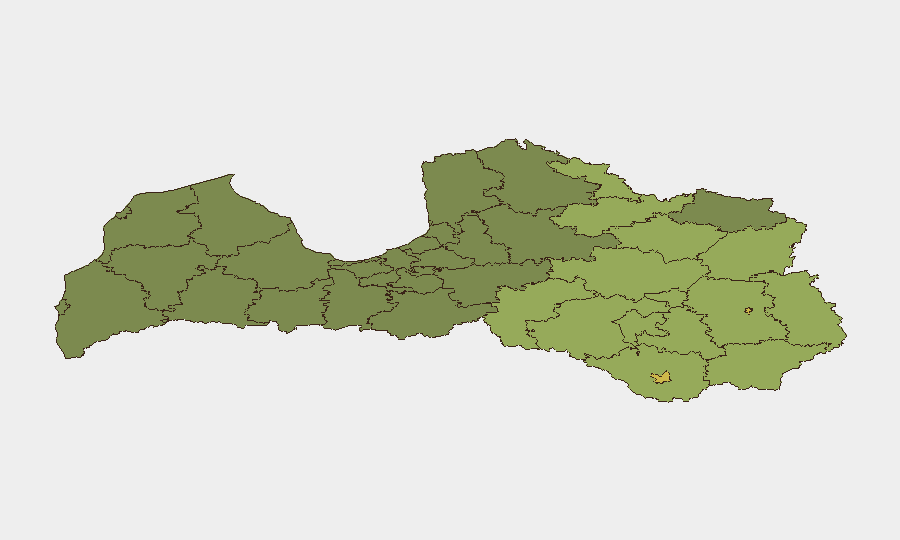
Eastern border regions—Rēzekne (risk 68), Daugavpils (65), and the surrounding municipal districts (Rēzeknes novads, Ludzas novads, Balvu novads)—drive the composite risk ranking. These areas face direct exposure to irregular migration flows, smuggling networks, and hybrid-provocation activity originating from Belarus and Russia. Risk is driven not by active violence or civil unrest, but by persistent low-intensity border pressure, inadequate infrastructure resilience in economically marginal regions, and proximity to Russian and Belarusian operational zones. Duty-of-care teams with assets or personnel in these municipalities should treat irregular border activity and logistics-network disruption as primary planning factors.
How GeoBit Would Assist
Security teams monitoring Latvia would deploy AOI Monitoring & Early Warning on critical border crossings and eastern municipalities to detect spikes in irregular-migration incidents or incursion patterns with minimal latency. Intel Sweep and OSINT fusion (multi-language search, Telegram/social-media monitoring, official government feeds) would provide real-time corroboration of border incidents and cyber-threat posturing, enabling rapid situational updates independent of formal diplomatic channels. Network & Actor Analysis applied to smuggling cells and hybrid-threat proxies would support longer-term pattern detection and route disruption planning for supply-chain and personnel-movement teams.
7-Day Outlook
Border incidents and irregular-migration pressure are expected to continue at current operational tempo; seasonal summer migration flows typically peak through August. Cyber-threat preparation by Russian actors remains elevated but episodic, with no imminent infrastructure attack indicators apparent. Overall Latvia threat trajectory remains stable but persistent, with no acute escalation expected absent major regional geopolitical shifts.
Highest-Risk Areas — Ranked
| # | State / Region | Risk |
|---|---|---|
| 1 | Rēzekne | 68 |
| 2 | Daugavpils | 65 |
| 3 | Rēzeknes novads | 58 |
| 4 | Ludzas novads | 55 |
| 5 | Balvu novads | 52 |
| 6 | Preiļu novads | 50 |
| 7 | Krāslavas novads | 48 |
| 8 | Jēkabpils novads | 47 |
| 9 | Augšdaugavas novads | 46 |
| 10 | Aizkraukles novads | 45 |
| 11 | Varakļānu novads | 44 |
| 12 | Līvānu novads | 43 |
Sources
Previous Daily Briefs
A new Latvia brief is written every day — each with its own risk map and downloadable CSV. Here's the last week; use the calendar to go further back.
📅 Browse every day by calendar →
Highlighted days have a brief. Tap a day for that day's map & analysis, or “csv” for that day's dataset ($5).
Atlas — our AI intelligence desk — emails them this snapshot personally. Nothing else, no list.