Situation Summary
Moldova remains a low-to-moderate threat environment globally (rank #89, composite score 11), but faces acute cross-border military spillover from the Russia–Ukraine conflict and deteriorating bilateral relations with Russia. A major corruption case at state air-traffic authority MoldATSA, involving senior staff and high-level political sensitivity, has triggered 25 simultaneous searches and three detention orders as of July 23. Governance instability, drone incursions, and diplomatic friction with Moscow create a compound risk profile for international operations and travel.
Key Developments
- Chișinău, MoldATSA headquarters (July 23): Anti-corruption prosecutors and the National Anticorruption Center executed 25 simultaneous searches and detained three senior company employees for 72 hours on suspicion of abuse of office and corruption in management, signaling elevated institutional vulnerability and governance risk.
- Chișinău (July 23): President Maia Sandu publicly acknowledged the corruption investigation involved her cousin but stated this was "not an excuse," underlining political sensitivity and potential reputational or operational complications for international partners engaging state institutions.
- Copanca, Căușeni district (July 22, preceding 24-hour window): A Russian Shahed drone carrying approximately 40 kg of explosives crashed after being employed in strikes on Ukraine's Odesa region, confirming active cross-border weaponry spillover and gaps in Moldova's air-defense capacity.
- Moldovan airspace (confirmed July 23, cumulative since February 2022): Authorities reported 34 total incidents of drones and ballistic missiles entering or transiting Moldovan airspace, and announced a €120 million EU-backed package for new air-defense detection and interception systems to counter ongoing spillover.
- Chișinău–Moscow diplomatic relations (incidents reported July 21–22): Russia's Foreign Ministry summoned the Moldovan ambassador after alleging Moldovan police used force and threats against Russian embassy staff, and reported separate document checks and delays affecting embassy personnel—escalating short-term diplomatic friction and security-incident risk.
- Chișinău, Russian Center for Science and Culture (recent days, confirmed July 23): The Russian House announced termination of operations "due to the decision of the Moldovan government," signaling further deterioration in bilateral relations and potential for organized protest or counter-activity.
- Countrywide (July 22–23, 24-hour period): Moldovan police blocked at least 152 attempted telephone and fraud schemes, reflecting sustained organized crime activity and elevated financial-crime risk for residents and international personnel.
- Ministry of Foreign Affairs advisory (updated this week): Moldova's MFA recommended citizens refrain from travel to Russia and Belarus, formalizing elevated travel-security risk assessment.
Highest-Risk Areas
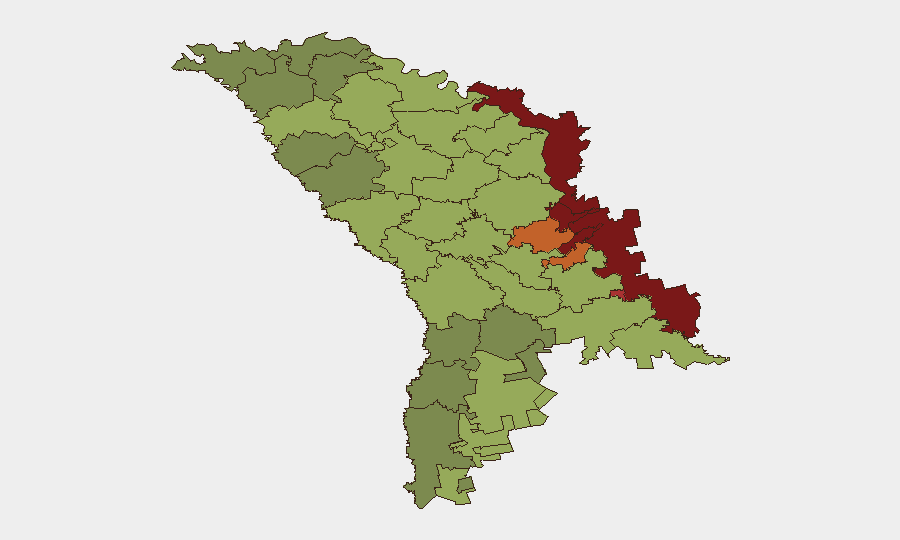
The Left Bank of the Dniester (risk 85) and Dubăsari (82) dominate Moldova's sub-national threat hierarchy, reflecting proximity to Russian forces, contested sovereignty, and limited state control. Bender (79) and Criuleni (75) follow, both near the Ukrainian border or Russian-aligned entities, where cross-border military spillover and smuggling networks pose acute risks. Chișinău (49) ranks 12th but warrants close operational attention given the concentration of state institutions, diplomatic missions, and international commercial presence; governance instability and corruption cases add institutional unpredictability for duty-of-care teams.
How GeoBit Would Assist
Organizations with personnel or assets in Moldova should deploy AOI Monitoring & Early Warning on Chișinău (governance and diplomatic incidents), border districts (drone/military spillover), and the Left Bank (conflict escalation). Conflict & Military tracking and satellite imagery analysis enable real-time awareness of cross-border weapons activity and airspace incidents. Entity & Network Analysis can track corruption investigations and institutional changes affecting contract performance, licenses, or security clearances for state-sector engagement.
7-Day Outlook
Diplomatic friction with Russia is likely to persist, with potential for further incident claims and embassy-related disruptions. The MoldATSA investigation will sustain governance-uncertainty messaging and may trigger secondary oversight actions affecting state-sector operations. Cross-border drone incursions will continue absent major changes in the Ukraine conflict; no near-term de-escalation is forecast.
Highest-Risk Areas — Ranked
| # | State / Region | Risk |
|---|---|---|
| 1 | Administrative-Territorial Units of the Left Bank of the Dniester | 85 |
| 2 | Dubăsari | 82 |
| 3 | Bender | 79 |
| 4 | Criuleni | 75 |
| 5 | Rezina | 58 |
| 6 | Taraclia | 55 |
| 7 | Gagauzia | 54 |
| 8 | Căușeni | 53 |
| 9 | Soroca | 52 |
| 10 | Ștefan Vodă | 51 |
| 11 | Orhei | 50 |
| 12 | Chișinău | 49 |
Sources
Previous Daily Briefs
A new Moldova brief is written every day — each with its own risk map and downloadable CSV. Here's the last week; use the calendar to go further back.
📅 Browse every day by calendar →
Highlighted days have a brief. Tap a day for that day's map & analysis, or “csv” for that day's dataset ($5).
Atlas — our AI intelligence desk — emails them this snapshot personally. Nothing else, no list.