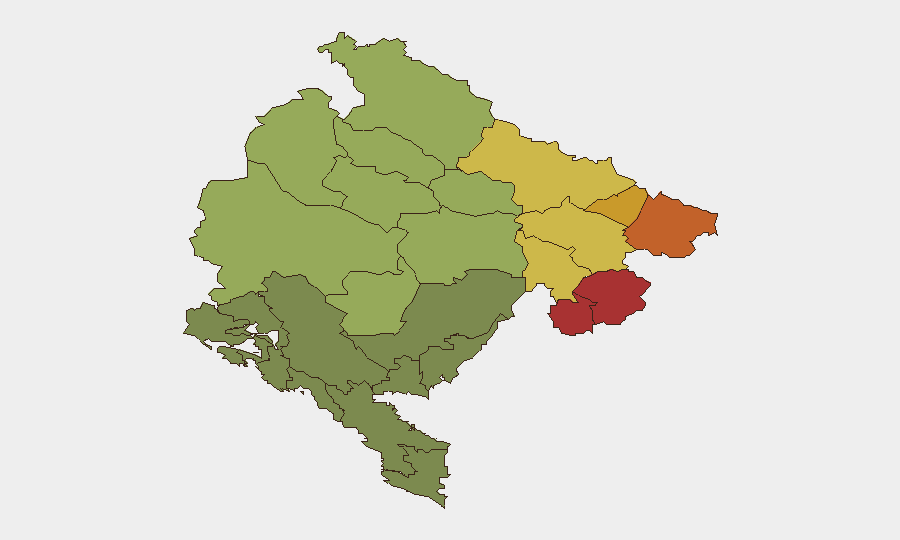
Situation Summary
Montenegro remains a low-risk destination globally (rank #157) with no confirmed security incidents reported in the last 24–48 hours. The overall composite threat environment is stable, with recent event signals largely tied to diplomatic and political activity rather than civil unrest, conflict, or crime. However, significant sub-national variance exists, with the northern municipalities—particularly Plav, Gusinje, and Rožaje—presenting elevated risk profiles that warrant continued monitoring by organizations with personnel or assets in those regions.
Key Developments
No verifiable security, conflict, civil-unrest, crime, political-instability, infrastructure, or travel-risk incidents were confirmed in Montenegro during the last 24–48 hours based on available open-source intelligence.
Recent event signals flagged by the platform (7–10 July) relate to diplomatic and political statements rather than ground-level security events:
- 7–10 July (diplomatic context): Public statements and political discussions between corporate, government, and international actors; no direct threat to personnel or assets identified.
Highest-Risk Areas
Northern municipalities dominate the sub-national risk landscape, with Plav (78), Gusinje (76), and Rožaje (74) presenting the highest composite scores. These mountainous border regions share proximity to Kosovo and Serbia, historically linked to transnational organized crime, arms trafficking, and smuggling networks. Bijelo Polje, Berane, and Plužine follow with moderate-to-elevated risk (65, 62, 58), reflecting similar cross-border dynamics. Central and southern municipalities (Kolašin, Žabljak, Šavnik) show lower risk profiles but remain subject to seasonal and event-driven fluctuations. Organizations operating in or transiting through the north should apply heightened due diligence.
How GeoBit Would Assist
Security teams should employ AOI Monitoring & Early Warning on Plav, Gusinje, and Rožaje municipalities to detect emerging civil unrest, crime spikes, or border-related incidents in near-real time. Parallel deployment of OSINT Fusion & Corroboration (X/Twitter, Telegram, local media) and multi-language search will surface local sentiment and incident reporting ahead of mainstream international coverage. For personnel movement and supply-chain routing, Routing & Network Analysis capabilities enable identification of safer corridors around known trafficking and conflict zones, while GIS & Spatial Analysis supports asset placement and evacuation planning for high-risk northern areas.
7-Day Outlook
No acute security escalation is forecast for Montenegro in the next seven days. Diplomatic and political engagement continues at the national level without indication of destabilization. Sub-national risks in northern municipalities remain chronic and structural rather than acute; monitoring cadence should remain consistent, with heightened sensitivity to any cross-border incidents or organized-crime activity in the Plav–Gusinje–Rožaje corridor.
Report Date: 12 July 2026
Threat Rank: #157 globally | Composite Score: 5
Next Review: 13 July 2026
Highest-Risk Areas — Ranked
| # | State / Region | Risk |
|---|---|---|
| 1 | Plav Municipality | 78 |
| 2 | Gusinje Municipality | 76 |
| 3 | Rožaje Municipality | 74 |
| 4 | Petnjica Municipality | 72 |
| 5 | Andrijevica Municipality | 68 |
| 6 | Bijelo Polje Municipality | 65 |
| 7 | Berane Municipality | 62 |
| 8 | Plužine Municipality | 58 |
| 9 | Pljevlja Municipality | 55 |
| 10 | Šavnik Municipality | 52 |
| 11 | Žabljak Municipality | 50 |
| 12 | Kolašin Municipality | 48 |
Sources
Previous Daily Briefs
A new Montenegro brief is written every day — each with its own risk map and downloadable CSV. Here's the last week; use the calendar to go further back.
📅 Browse every day by calendar →
Highlighted days have a brief. Tap a day for that day's map & analysis, or “csv” for that day's dataset ($5).
Atlas — our AI intelligence desk — emails them this snapshot personally. Nothing else, no list.