Situation Summary
The Netherlands faces a mixed but elevated near-term security environment marked by heightened counterterrorism operations, organised-crime enforcement, and civil-order incidents. Three teenagers were arrested in a coordinated national terrorism investigation on 28–29 July, and Amsterdam has implemented enhanced security for WorldPride events (Canal Parade) under terrorism threat level 4. Concurrent incidents—a hostage situation, motorway blockade with 270 arrests, port cocaine seizure (3,867 kg), and ongoing narcotics enforcement—indicate distributed pressure across law enforcement with no single dominant driver, but cumulative operational tempo is rising.
Key Developments
- Amsterdam, North Holland – 29–30 July: Authorities announced heightened security for WorldPride Canal Parade, citing national terrorism threat level 4 and concerns following the Berlin Pride attack; specific measures withheld but both visible and covert deployments confirmed.
- Alkmaar, Eindhoven, Rotterdam – 28–29 July: Dutch police arrested three teenagers (aged 16–19) in coordinated overnight operations as part of a national terrorism investigation; magistrate appearance scheduled, details not yet disclosed by prosecutors.
- Rotterdam Port, South Holland – 29–30 July: Dutch customs intercepted a large narcotics consignment (3,867 kg cocaine) concealed in a wood-shipment container during routine inspection at critical infrastructure.
- Utrecht area, A12 motorway – 30 July: Police disrupted a large-scale civil-unrest incident, making approximately 270 arrests to clear a motorway blockade; classified as protest-related action.
- Ede, Gelderland – 30 July: A hostage situation at nightclub Café Petticoat ended after several hours when a balaclava-masked suspect previously known to police surrendered; multiple staff and patrons threatened with knives; police stated no indication of terrorist motive.
- Moerdijk industrial area, North Brabant – 29 July: Port police arrested a 39-year-old Dordrecht resident for facilitating cocaine imports linked to supermarket seizures in Sint-Oedenrode, Den Bosch, and Panningen.
- Venlo, Limburg – 31 July (early morning): Two arrests made in an ongoing narcotics investigation per real-time police feeds; part of broader drug-enforcement pattern.
- Driebergen, Utrecht province – 31 July (early morning): Police conducted interventions related to online radicalisation of youth; framed as preventative counter-radicalisation activity, indicating active extremism monitoring.
Highest-Risk Areas
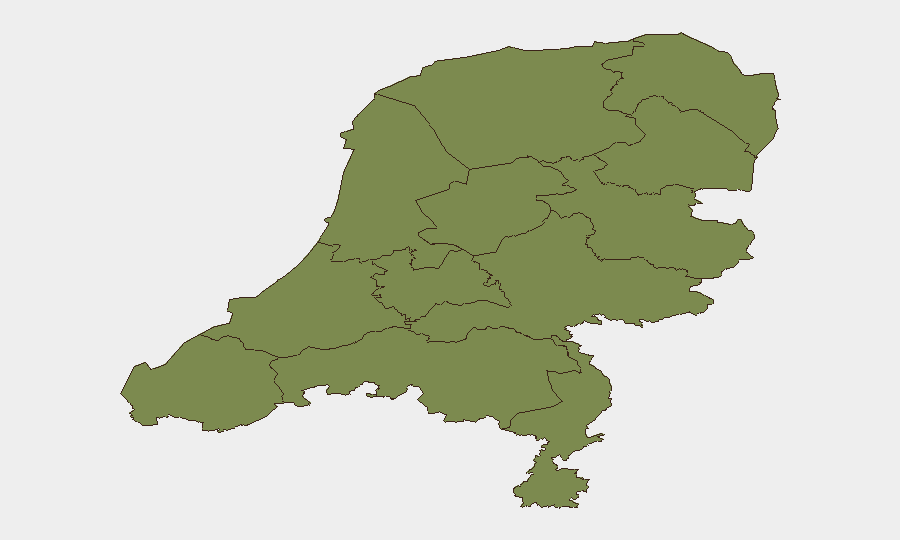
North Holland (risk 31.3) dominates the sub-national ranking, driven by Amsterdam's concentration of critical infrastructure, international visibility, and current heightened terrorism posture around WorldPride. All other provinces cluster significantly lower (1.3–1.9), suggesting risk is highly localised to the capital and its immediate hinterland rather than distributed across the country. The sharp differential reflects Amsterdam's role as a terrorism-surveillance priority and major transport/event hub, while organised-crime activity (cocaine, narcotics) spans South Holland (Rotterdam port) and North Brabant (industrial areas) but does not elevate those regions to comparable threat scores in the composite index.
How GeoBit Would Assist
Teams with personnel or assets in Netherlands would benefit from AOI Monitoring & Early Warning focused on North Holland and Amsterdam to track security-operation tempo and WorldPride developments in real time. Intel Sweep (global event feeds, X/Twitter & Telegram OSINT, multi-language search) would provide continuous situational awareness on emerging extremism narratives and protest coordination; Network & Actor Analysis would support tracking of narcotics and organised-crime cells across port and industrial zones. Risk & Threat Assessment and Early Warning capabilities would flag emerging radicalisation or protest escalation before they reach operational severity.
7-Day Outlook
No immediate spike in threat is forecast, but operational intensity will remain elevated through WorldPride (early August) and will sustain heightened policing around terrorism and organised crime. Civil unrest (motorway blockade) and narcotics enforcement suggest dispersed friction points rather than a single trajectory; however, any arrest outcome in the teenage terrorism case or further international incident could accelerate sentiment and security posture changes within 72–96 hours.
Highest-Risk Areas — Ranked
| # | State / Region | Risk |
|---|---|---|
| 1 | North Holland | 31.3 |
| 2 | South Holland | 1.9 |
| 3 | Flevoland | 1.3 |
| 4 | Zeeland | 1.3 |
| 5 | Utrecht | 1.3 |
| 6 | North Brabant | 1.3 |
| 7 | Frisia | 1.3 |
| 8 | Groningen | 1.3 |
| 9 | Drenthe | 1.3 |
| 10 | Gelderland | 1.3 |
| 11 | Overijssel | 1.3 |
| 12 | Limburg | 1.3 |
Sources
Previous Daily Briefs
A new Netherlands brief is written every day — each with its own risk map and downloadable CSV. Here's the last week; use the calendar to go further back.
📅 Browse every day by calendar →
Highlighted days have a brief. Tap a day for that day's map & analysis, or “csv” for that day's dataset ($5).
Atlas — our AI intelligence desk — emails them this snapshot personally. Nothing else, no list.