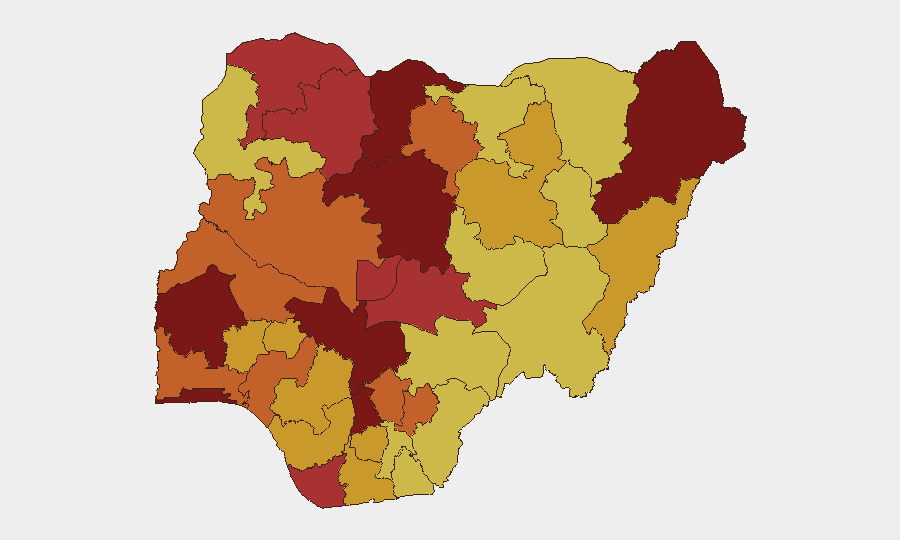
Situation Summary
Nigeria remains at acute risk (global rank #5, composite score 100) driven primarily by sustained insurgency, banditry, and kidnap-for-ransom activity across multiple northern and central states. The past 48 hours have seen a major counter-insurgency hostage rescue in Borno, armed clashes in Kogi, and a nationwide civil-society mobilization demanding security accountability, creating concurrent operational and protest-related disruption vectors. Elevated kidnapping tempo and security-force engagement across 11+ documented incidents in a single 24-hour cycle underscore sustained pressure on supply chains, personnel mobility, and institutional security nationwide.
Key Developments
- Mandara Mountains, Southern Borno State (June 13–14): Nigerian security forces conducted a major hostage-rescue operation freeing approximately 360 Boko Haram abductees; at least two children were reported deceased in captivity prior to rescue. This marks one of the most significant counter-insurgency operations in recent days and underscores both ongoing militant detention activity and military engagement intensity in Borno State (risk rank #1).
- EndBadGovernance Movement Strike Call, Abuja/Nationwide (June 13–14): Civil-society coalitions announced a 48-hour nationwide strike and protest action demanding security reforms, abductee release, and investigation of security spending. Organizers mobilized labour unions and regional chapters over the subsequent 24–48 hours, signaling potential commercial disruption and travel impediment if action proceeds as announced.
- Armed-Bandit Clash, Kogi State (June 13–14): Security forces clashed with armed bandits resulting in four confirmed deaths, confirming sustained armed-group activity and elevated bystander/transit risk along affected routes in Kogi State (risk rank #6).
- Attempted Abduction Interdiction, Plateau State (June 13–14): Military sources reported prevention of a pastor and spouse's abduction, confirming religious and community leaders remain targeted by armed groups despite active security interdiction.
- Student-Community Security Ultimatum, Ogun State (June 13–14): The National Association of Nigerian Students issued a 48-hour ultimatum to Ogun State authorities following multiple robbery attacks on student communities, warning of escalation and signaling tertiary-institution-focused disruption risk.
- Unconfirmed Cyber Data-Exfiltration Campaign (June 13): A cyber-intelligence alert attributed to threat actor "infernaliis" reported attacks on FinTech sector (Mustard.ng), health-sciences education (MCCHST Funtua, Katsina State), and federal education institutions (FGGC Owerri, Imo State). Incidents are explicitly labeled unconfirmed; treat as indicative cyber-risk requiring verification.
- Sustained Multi-State Kidnap & Armed Activity (June 11–14): National trackers documented 11+ confirmed security incidents within a single 24-hour period across multiple states, reflecting elevated operational tempo in kidnap-for-ransom and armed-group activity.
Highest-Risk Areas
Borno State (risk 100) remains the primary driver of national threat due to sustained Boko Haram/Islamic State West Africa insurgency; the Mandara Mountains hostage rescue underscores ongoing abduction and detention infrastructure. Kaduna (90.4) and Lagos (89.2) follow, driven by banditry, kidnap-for-ransom activity, and high-population-density crime vectors. Kogi State's recent armed clashes and the northern corridor states (Katsina, Sokoto, Zamfara) continue to experience bandit-led insecurity and cross-border spillover from Niger; federal institutions and civil-society mobilization in FCT (77.2) introduce concurrent protest and disruption risk.
How GeoBit Would Assist
Security teams would deploy AOI Monitoring & Early Warning on high-risk states (Borno, Kaduna, Lagos, Kogi) with persistent alerting on incident tempo, Routing & Network Analysis to generate real-time alternative travel/supply-chain paths avoiding active conflict zones, and Network & Actor Analysis to track kidnap-for-ransom and bandit-group composition and targeting patterns. Intel Sweep and multi-language OSINT (including Telegram/X monitoring) would provide early signals of protest escalation, cyber campaigns, and security-force operations.
7-Day Outlook
The 48-hour EndBadGovernance strike creates an immediate (June 15–16) window for nationwide commercial and transport disruption, overlapping with sustained insurgent and bandit activity in the north and center. If the strike materializes, coordination between protest mobilization and criminal/militant opportunism could amplify personnel risk and supply-chain disruption. Continued military counter-insurgency operations in Borno may prevent near-term tactical escalation but will not reduce underlying abduction infrastructure or regional instability drivers over the next week.
Highest-Risk Areas — Ranked
| # | State / Region | Risk |
|---|---|---|
| 1 | Borno State | 100 |
| 2 | Kaduna State | 90.4 |
| 3 | Lagos State | 89.2 |
| 4 | Oyo State | 84.1 |
| 5 | Katsina State | 82.5 |
| 6 | Kogi State | 80.5 |
| 7 | Anambra State | 80.1 |
| 8 | Zamfara State | 78.2 |
| 9 | Bayelsa State | 77.6 |
| 10 | Federal Capital Territory | 77.2 |
| 11 | Nasarawa State | 76.5 |
| 12 | Sokoto State | 76.1 |
Sources
Previous Daily Briefs
A new Nigeria brief is written every day — each with its own risk map and downloadable CSV. Here's the last week; use the calendar to go further back.
📅 Browse every day by calendar →
Highlighted days have a brief. Tap a day for that day's map & analysis, or “csv” for that day's dataset ($5).