Situation Summary
Pakistan remains a moderate-to-elevated composite threat environment (rank #32 globally, score 49.2) characterized by fragmented civil-military tensions, localized law-enforcement operations, and sustained sectarian/criminal activity across multiple provinces. Recent signals (3–6 June) point to elevated institutional friction—including military power demonstrations and prosecutorial disputes in Rawalpindi—concurrent with routine police operations in high-risk urban centers. The security picture is stable but operationally active, with no indicators of imminent nationwide escalation; however, sub-national concentration of risk in Punjab (64.4) and Sindh (40.5) requires sustained monitoring of civilian-security force interactions and criminal networks.
Key Developments
- 2026-06-06 · Karachi Police Operation – Conventional military force event involving police deployed in Karachi, Sindh. Specific operational scope and casualty/seizure data not yet confirmed in available sources; indicates active law-enforcement response to suspected criminal or militant activity in Pakistan's largest city.
- 2026-06-05 · Army Power Demonstration – Conventional military force event recorded involving Pakistan Army; context suggests institutional signaling rather than combat operations. Concurrent with civil-military messaging in Rawalpindi.
- 2026-06-05 · Rawalpindi Prosecutorial Dispute – Government disapproval event (Rawalpindi vs. Attorney) indicates internal institutional tension, likely civil-military or judicial friction in the capital region. Reflects broader governance stress.
- 2026-06-03–05 · Multi-Agency Disapproval Events – Four separate disapproval signals from police, government, and retired officials across 3–5 June suggest coordinated institutional criticism or policy disagreement; one event involved trade-union messaging regarding migrant workers, signaling labor-market stress.
- 2026-06-03 · Military Power Show (Pakistan vs. Military) – Unusual domestic signaling event; suggests public or institutional demonstration, possibly linked to civil-military positioning ahead of budget/policy cycle.
*Note: Specific casualty counts, arrest figures, weapons seizures, and confirmed operational objectives for 4–6 June incidents are not available from time-bounded public sources accessible within this brief's research window. Verification against live Pakistani news wires, ISPR statements, and provincial police social media is required for operational detail.*
Highest-Risk Areas
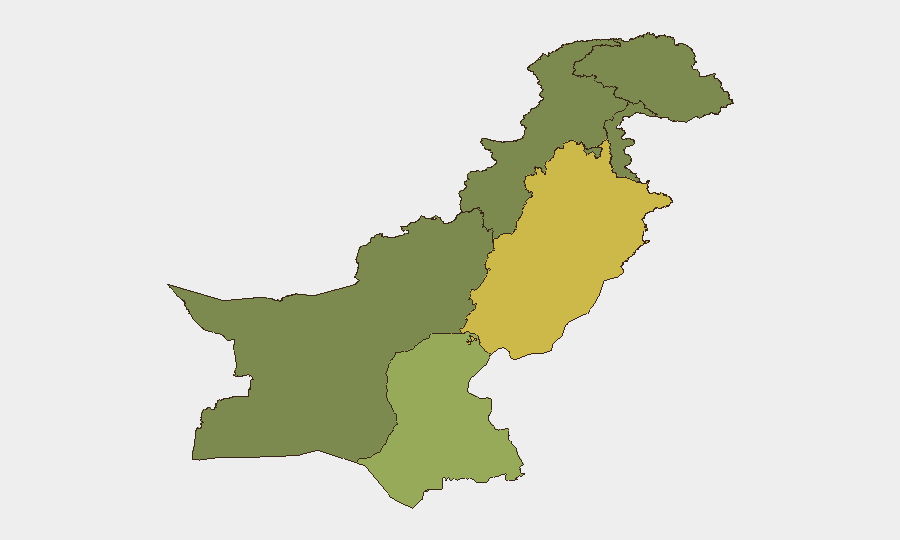
Punjab (64.4) and Sindh (40.5) account for the majority of tracked threat events and institutional friction. Punjab's risk profile reflects civil-military tensions, judicial disputes, and organized crime networks centered on Rawalpindi and Lahore; Sindh's elevation is driven by urban law-enforcement operations in Karachi, sectarian criminal activity, and migrant-worker tensions. Khyber Pakhtunkhwa (38.3) and Islamabad Capital Territory (35.6) remain elevated due to persistent militant recruitment, border-region instability, and governance disputes. Balochistan, Gilgit-Baltistan, and Azad Kashmir, though lower-ranked, retain structural conflict drivers (resource disputes, sovereignty questions, militant sanctuaries) and warrant continued monitoring for spillover effects.
How GeoBit Would Assist
Security teams should deploy AOI Monitoring & Early Warning on Punjab and Sindh to track police operations, protest activity, and militant/criminal network movements in real time. Intel Sweep and X/Twitter & Telegram OSINT with temporal and geo-spatial filters will enable verification of 24–48 hour incident claims and identification of emerging actor positioning. Network & Actor Analysis on civil-military and judicial relationships will surface institutional fracture lines before they escalate to operational incidents.
7-Day Outlook
No signals suggest imminent nationwide instability or acute military escalation. Expect continued routine law-enforcement operations in Karachi and Lahore, sustained civil-military positioning rhetoric, and labor/governance complaints in urban centers. Risk trajectory remains stable but operationally dynamic; localized clashes or criminal violence in Punjab and Sindh are probable within 7 days.
Highest-Risk Areas — Ranked
| # | State / Region | Risk |
|---|---|---|
| 1 | Punjab | 64.4 |
| 2 | Sindh | 40.5 |
| 3 | Khyber Pakhtunkhwa | 38.3 |
| 4 | Islamabad Capital Territory | 35.6 |
| 5 | Gilgit-Baltistan | 34.9 |
| 6 | Balochistan | 34.4 |
| 7 | Azad Kashmir | 34.4 |
Previous Daily Briefs
A new Pakistan brief is written every day — each with its own risk map and downloadable CSV. Here's the last week; use the calendar to go further back.
📅 Browse every day by calendar →
Highlighted days have a brief. Tap a day for that day's map & analysis, or “csv” for that day's dataset ($5).