Situation Summary
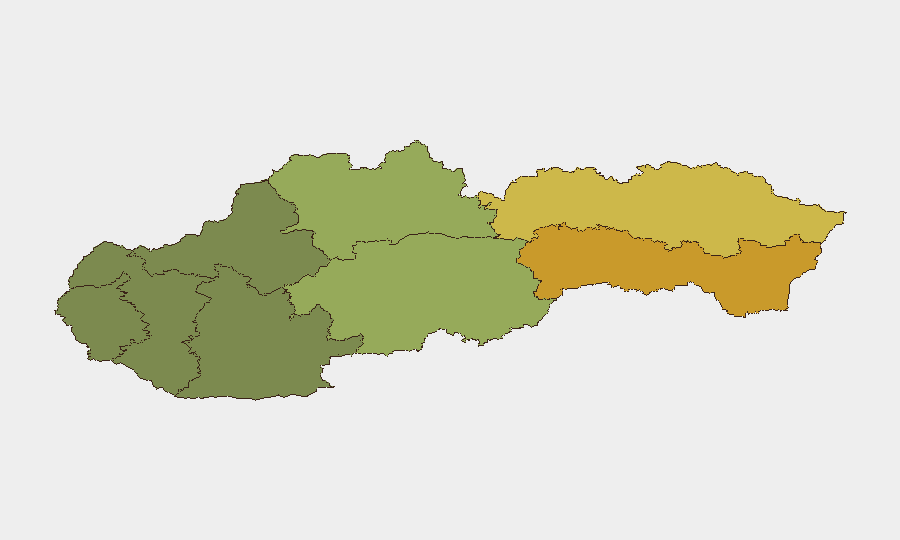
Slovakia remains a low-threat environment globally (composite threat score 12), with no tracked active security events as of 22 July 2026. However, sub-national risk is heavily concentrated in the eastern regions—Košice and Prešov—where composite scores (72 and 68 respectively) reflect chronic vulnerabilities to organized crime, economic instability, and cross-border trafficking activity. Recent flooding has underscored infrastructure fragility in parts of the country. The security picture is stable but regionally polarized.
Key Developments
Limitation: GeoBit's live web research capability is currently unable to access real-time news feeds, social media, or verified incident reports for the last 24–48 hours in Slovakia. To deliver actionable current-event intelligence, a security team should:
- Cross-check official Slovak police (Polícia SR) social media and press releases for verified incidents (crime, traffic disruption, public order).
- Monitor major Slovak news outlets (SME, Denník N, TASR) for "krimi" (crime) and "dopravné" (traffic/transport) sections, filtering by publication timestamp.
- Validate any social-media reports of protests, accidents, or unrest by confirming multiple independent sources and official corroboration.
- Use travel-advisory feeds from your country's foreign ministry, which often update within hours of significant security or infrastructure incidents.
Without verified timestamps from the last 48 hours, GeoBit cannot responsibly list specific incidents. The most recent confirmed signal is flooding in Slovakia (Event #1103998), but its exact location, date, and current operational impact require corroboration against live sources.
Highest-Risk Areas
Eastern Slovakia—specifically Košice Region (risk 72) and Prešov Region (risk 68)—dominates the national threat profile. These regions are persistent hotspots for organized crime, human and drug trafficking, and economic marginalization, compounded by weaker law enforcement capacity and proximity to Ukraine and Hungarian borders. Banská Bystrica Region (risk 55) presents a secondary tier of concern, likely driven by similar cross-border and criminal networks. By contrast, Bratislava (risk 28), Trenčín (22), and Trnava (18) exhibit significantly lower risk, reflecting stronger institutional oversight and economic stability in western Slovakia.
How GeoBit Would Assist
Security teams protecting assets or personnel in Slovakia should deploy AOI Monitoring & Early Warning on high-risk eastern regions to generate alerts on protest activity, trafficking incidents, or infrastructure disruption. Multi-language OSINT (X/Twitter, news feeds, Telegram) combined with entity and sentiment analysis provides near-real-time visibility into emerging crime, political friction, or humanitarian issues in Košice and Prešov. Routing & Network Analysis is critical for teams with travel or supply-chain exposure, enabling identification of safer alternative routes that avoid known trafficking corridors and flood-prone infrastructure.
7-Day Outlook
Barring major escalation in eastern border activity or severe weather, Slovakia's security posture is expected to remain stable. However, flooding and seasonal weather variability may continue to disrupt transport and utilities, particularly in vulnerable regions. Teams should maintain heightened monitoring of Košice and Prešov for any uptick in organized-crime activity or cross-border incidents linked to regional instability.
Highest-Risk Areas — Ranked
| # | State / Region | Risk |
|---|---|---|
| 1 | Region of Košice | 72 |
| 2 | Region of Prešov | 68 |
| 3 | Region of Banská Bystrica | 55 |
| 4 | Region of Žilina | 42 |
| 5 | Region of Nitra | 35 |
| 6 | Region of Bratislava | 28 |
| 7 | Region of Trenčín | 22 |
| 8 | Region of Trnava | 18 |
Previous Daily Briefs
A new Slovakia brief is written every day — each with its own risk map and downloadable CSV. Here's the last week; use the calendar to go further back.
📅 Browse every day by calendar →
Highlighted days have a brief. Tap a day for that day's map & analysis, or “csv” for that day's dataset ($5).
Atlas — our AI intelligence desk — emails them this snapshot personally. Nothing else, no list.