Situation Summary
Sweden maintains a composite threat score of 6 globally (rank #130), reflecting low-intensity event activity and manageable security baseline across most regions. However, sub-national risk concentration is acute: Jämtland County scores 31.5—approximately 17× the risk of Stockholm County—indicating significant localized volatility. Recent event signals (2026-07-10 to 2026-07-12) span institutional friction (university–police disagreement, senate–government tension, business–government demands) and administrative detention, but open-source verification of concrete security incidents in the last 24–48 hours remains limited.
Key Developments
- Policy Implementation (Sweden-wide, 2026-07-01 onward): Sweden's new deportation and "good behaviour" law—expanded grounds for removing foreign nationals without criminal conviction—remains a focus of institutional and social-media discussion, though no verified unrest directly tied to enforcement has been corroborated in the 24–48h window.
- Institutional Statements (dates 2026-07-10 to 2026-07-11): Public statements from judicial, mayoral, executive, and parliamentary figures, alongside reported disapproval from university and prison sectors, suggest ongoing policy disagreement but do not yet constitute operational security events. These warrant monitoring for escalation trajectory.
- Demand Signal (2026-07-11, location not yet specified): A "demand" categorization between business and government entities has been flagged but remains unverified in open sources; further clarification on sector, geography, and nature is required.
- Administrative Action (2026-07-11, Sweden-wide): An arrest or detention within the administration category was recorded; detail and location classification are pending confirmation.
- Media Reference to Aerial Weapons (2026-07-12): A media signal mentioning aerial weapons has been logged but lacks verified incident confirmation, location detail, or corroboration; this requires urgent real-time validation.
Open-Source Note: No travel warnings, infrastructure disruptions, or confirmed crime/unrest incidents affecting corporate or expatriate populations have been independently verified in Swedish news, official police announcements, or multi-source feeds for this 24–48h period.
Highest-Risk Areas
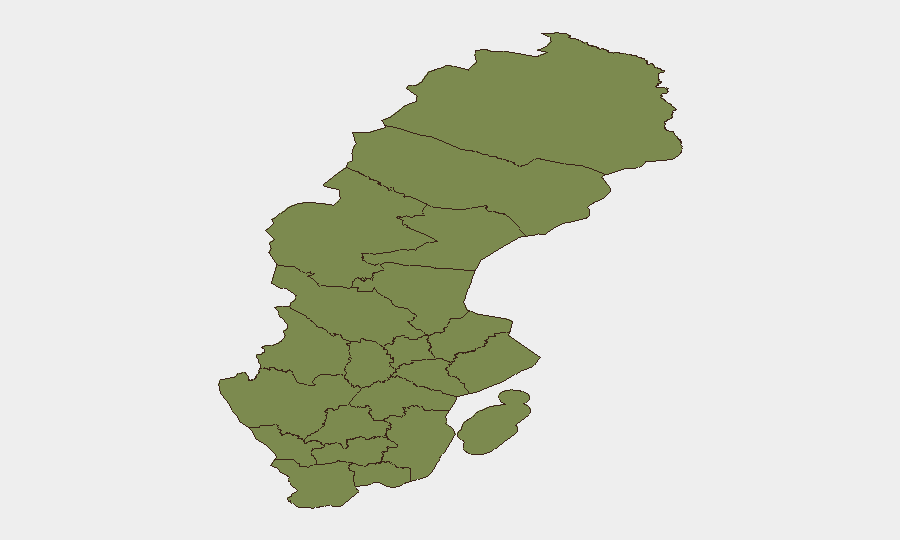
Jämtland County's risk score of 31.5 is a significant outlier and warrants dedicated attention; the drivers remain to be granularly assessed but may reflect border proximity, resource-extraction activity, or localized political tension. All other tracked counties cluster at 1.5–1.9, indicating that institutional and minor-crime signals are widely distributed rather than geographically concentrated. Stockholm County's score of 1.9 suggests that capital-region event activity (political statements, administrative friction) does not currently translate to material operational risk for corporate presence. Organizations with personnel or assets in Jämtland should request granular AOI monitoring; Stockholm-based teams should maintain routine vigilance on institutional/policy developments.
How GeoBit Would Assist
A security team should deploy AOI Monitoring & Early Warning on Jämtland County and Stockholm to flag real-time incident escalation; layer this with Intel Sweep (news, social-media, and local authority feeds) in Swedish and English to catch policy implementation friction, arrests, or protest formation ahead of mainstream coverage. Network & Actor Analysis would map the institutional players (judicial, parliamentary, business sectors) named in the event signals to predict which policy domains pose duty-of-care risk (labor, immigration, energy, tech). Real-time Telegram and X/Twitter OSINT tuned to Swedish law-enforcement, municipal government, and business-federation channels will provide earlier warning than traditional news cycles.
7-Day Outlook
Institutional disagreement over the new deportation law and business–government demands will likely continue as parliamentary recess ends (if applicable) and enforcement patterns emerge. Jämtland's outlier risk score should stabilize or escalate within 7–14 days as clarity emerges; no major escalation to civil disorder or violence is signaled at present. Organizations should confirm 72-hour check-in protocols for personnel in Jämtland and ensure travel-plan flexibility for Stockholm-region staff pending clarification of the "aerial weapons" media signal.
Highest-Risk Areas — Ranked
| # | State / Region | Risk |
|---|---|---|
| 1 | Jämtland County | 31.5 |
| 2 | Stockholm County | 1.9 |
| 3 | Skåne County | 1.7 |
| 4 | Norrbotten County | 1.5 |
| 5 | Västerbotten County | 1.5 |
| 6 | Västernorrland County | 1.5 |
| 7 | Dalarna County | 1.5 |
| 8 | Gävleborg County | 1.5 |
| 9 | Blekinge County | 1.5 |
| 10 | Västra Götaland County | 1.5 |
| 11 | Halland County | 1.5 |
| 12 | Värmland County | 1.5 |
Sources
Previous Daily Briefs
A new Sweden brief is written every day — each with its own risk map and downloadable CSV. Here's the last week; use the calendar to go further back.
📅 Browse every day by calendar →
Highlighted days have a brief. Tap a day for that day's map & analysis, or “csv” for that day's dataset ($5).
Atlas — our AI intelligence desk — emails them this snapshot personally. Nothing else, no list.