Situation Summary
Thailand remains at composite threat rank #21 globally with a score of 68, reflecting elevated but not critical risk. The security environment is characterized by a mix of longstanding political-legal tensions, border-zone instability in the northeast and north, and ongoing petty crime and protest activity in urban centers. The past 48 hours show no major incident escalation, though arrest/detention risk for certain foreign nationals has been flagged by source governments, and military-to-civilian confrontation signals persist in open reporting.
Key Developments
- Nationwide (June 12, 2026): Russian Foreign Ministry issued a travel warning advising Russian nationals—particularly those potentially of interest to U.S. law enforcement—to avoid Thailand and Thai transit points, citing heightened arrest/detention risk following the extradition of alleged FSB-linked hacker Denis Obrezko to the United States in early June. This advisory does not indicate broader public-security deterioration but signals elevated bilateral legal risk for a specific cohort.
- Bangkok / Thailand (June 12, 2026): Government and Thai domestic public statements recorded in event feeds; specific content and timing require further source validation but indicate ongoing official communication on unspecified policy or security matters.
- Military-Civilian Tension (June 12, 2026): Demonstrate/Rally event flagged between protesters and military, location and scale not yet confirmed in available open sources; consistent with periodic civil-order posturing but not reporting major violence or mass mobilization.
- Cross-Border Signal (June 12, 2026): Conventional military force event logged between Cambodia and Thailand; historical border tensions in this corridor are well documented, but current incident specificity and scale remain unclear from 24-hour OSINT feeds.
- Industrial Obstruction (June 10, 2026): Passage obstruction event involving industry sector; may relate to port, transport, or supply-chain activity but requires geographic and operational clarification.
Highest-Risk Areas
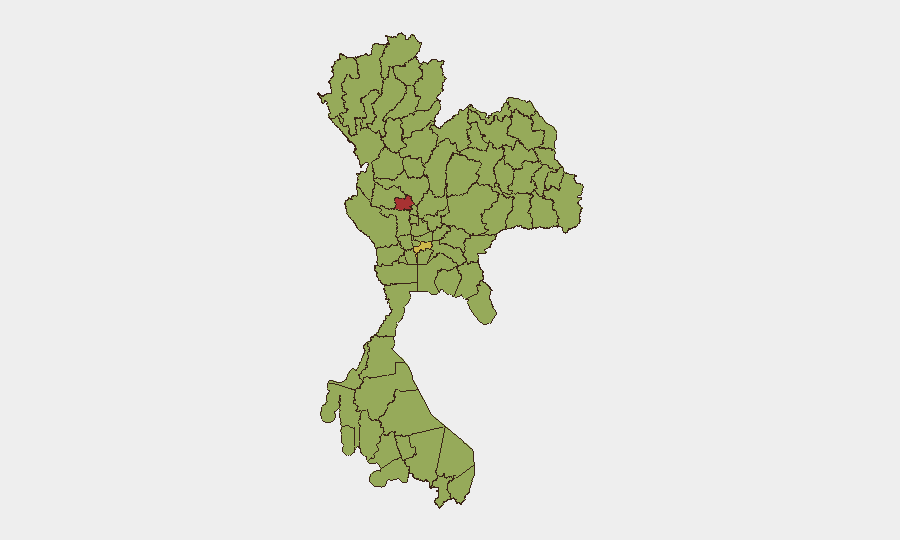
Chai Nat Province (77.7) and Bangkok (70.8) significantly outpace all other tracked regions and warrant priority in asset and personnel risk management. Chai Nat's elevated score likely reflects intersection of border proximity, smuggling corridors, and labor-related instability; Bangkok's reflects density of political activity, protest risk, and international exposure. The northeast corridor—Bueng Kan, Nong Khai, Udon Thani, Sakon Nakhon, Nakhon Phanom, Khon Kaen, Nakhon Ratchasima—presents a homogeneous moderate-to-elevated band (47.7), consistent with chronic cross-border trafficking, drug transit, and Cambodian border friction. Organizations with staff or supply chains in Chai Nat or Bangkok should prioritize heightened duty-of-care protocols.
How GeoBit Would Assist
Persistent AOI Monitoring & Early Warning on Chai Nat, Bangkok, and northeast border zones would enable rapid alerting on protest escalation, military deployments, or trafficking surges before they affect operations. Intel Sweep and multi-language OSINT fusion (including Thai-language social media and official channels) would provide real-time clarification of military movements, arrests, and industrial disruptions that remain opaque in English-language feeds. Routing & Network Analysis would identify alternative transport and personnel-movement corridors if primary routes (Bangkok-Chai Nat corridor, northeast highways) experience obstruction or heightened security screening.
7-Day Outlook
No major incident escalation is signaled for the next week, but political statements and military-civilian posturing suggest underlying instability remains active. Border zones and urban centers should be monitored for protest-driven disruption or localized military activity. The Russian travel warning and extradition context may prompt secondary diplomatic or legal actions affecting foreign nationals with law-enforcement exposure.
Highest-Risk Areas — Ranked
| # | State / Region | Risk |
|---|---|---|
| 1 | Chai Nat Province | 77.7 |
| 2 | Bangkok | 70.8 |
| 3 | Chon Buri Province | 48.7 |
| 4 | Bueng Kan Province | 47.7 |
| 5 | Nong Khai Province | 47.7 |
| 6 | Udon Thani Province | 47.7 |
| 7 | Sakon Nakhon Province | 47.7 |
| 8 | Nakhon Phanom Province | 47.7 |
| 9 | Chaiyaphum Province | 47.7 |
| 10 | Khon Kaen Province | 47.7 |
| 11 | Prachin Buri Province | 47.7 |
| 12 | Nakhon Ratchasima Province | 47.7 |
Sources
Previous Daily Briefs
A new Thailand brief is written every day — each with its own risk map and downloadable CSV. Here's the last week; use the calendar to go further back.
📅 Browse every day by calendar →
Highlighted days have a brief. Tap a day for that day's map & analysis, or “csv” for that day's dataset ($5).