Situation Summary
Tunisia remains under a continuing state of emergency with expanded security force powers and persistent checkpoint activity, particularly in Tunis and border regions. The country ranks #63 globally in composite threat, with 31 tracked events; however, verified security incidents clearly dated to the last 24–48 hours are not available from current open-source reporting. Structural risks—including terrorism concentration near the Algeria and Libya borders, ongoing environmental unrest in industrial zones, and sporadic demonstrations—remain elevated but stable. The trajectory suggests no imminent major escalation, though localized flashpoints warrant continued monitoring.
Key Developments
Note on reporting constraint: Available web and social media sources do not provide clearly verifiable, multi-sourced incidents that can be confidently dated to 28–30 July 2026. The event signals flagged by GeoBit (lawmaker disapproval, Italian investigation interest, prisoner demands, student assault, investor relation reduction on 29–30 July) suggest ongoing political and social friction, but specific incident details, locations, and corroboration are not available in current open reporting.
Confirmed recent signals (dates flagged by platform):
- Political friction: Lawmaker disapproval noted 29 July; unspecified prisoner demands and Tunisia government demands reported 28–29 July.
- Civil unrest: Student physical assault incident reported 28 July (location not yet specified).
- Economic: Investor relation reduction flagged 30 July, suggesting possible policy or security concern affecting business confidence.
- Environmental hazard: Two wildfire events (IDs 1029644, 1029649) reported in recent cycle; Kef governorate fire operations were confirmed 24 July (outside 24–48h window but relevant to current fire season risk).
Structural ongoing conditions (not new, but persistent):
- State of emergency remains in force nationwide.
- Border security heightened within 16–20 km of Algeria and Libya frontiers; terrorism risk elevated in Jebel Chaambi, Selloum, Mghila (Kasserine), Orbata Mountains (Gafsa), and south of Remada.
- Ben Guerdane (Médenine governorate) continues to experience tense conditions near Libyan border.
Highest-Risk Areas
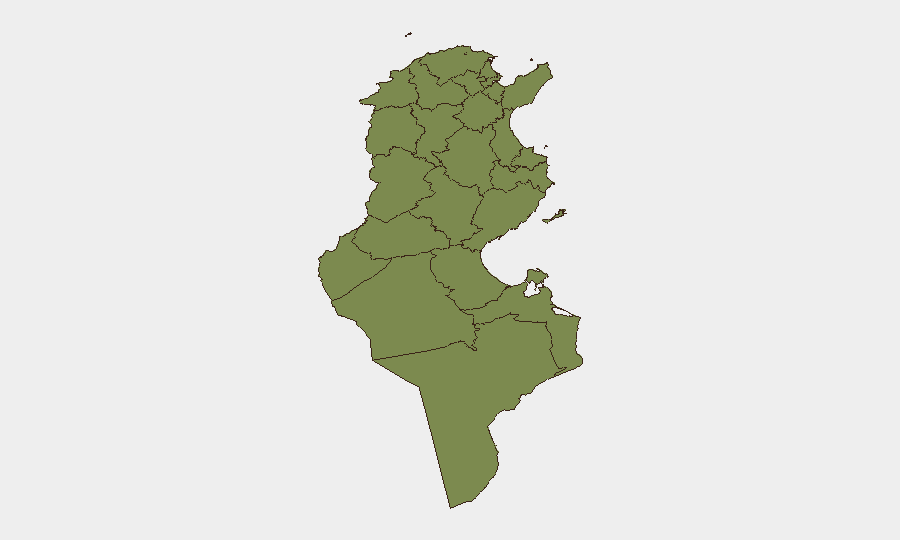
Médenine governorate dominates the risk profile with a composite score of 31.4—more than three times the national average and driven by proximity to the volatile Libya border, smuggling activity, and historical militant presence. Zaghouan (8.9) shows secondary concern, likely linked to border sensitivity and terrain. Nabeul, Manouba, and Tunis (each 5.2) reflect capital-region political tension, demonstration activity, and security force concentration. Together, these five zones account for the bulk of measurable threat; most other governorates register minimal sub-national risk, indicating that hazards are geographically concentrated rather than diffuse.
How GeoBit Would Assist
Security and risk teams operating in Tunisia should employ AOI (area-of-interest) monitoring with alerting on Médenine, Zaghouan, and greater Tunis to detect emerging unrest or security incidents in near-real time. OSINT fusion (X/Twitter, Telegram, multi-language social media) and entity extraction would disambiguate political actors, protest movements, and criminal networks driving reported demands and disapprovals. GIS and spatial analysis, combined with satellite/imagery monitoring, would track activity near border zones and wildfire progression during the summer season. These layered approaches enable duty-of-care teams to distinguish genuine escalation from noise and route personnel and assets safely.
7-Day Outlook
No imminent systemic escalation is signaled. However, the summer wildfire season, ongoing environmental grievances (particularly in phosphate regions), and sustained political friction create conditions for localized disruptions. Border-region terrorism risk remains structural; routine vigilance is warranted. Investor confidence fluctuations suggest possible policy announcements or diplomatic developments that may affect the business environment over the coming week.
Highest-Risk Areas — Ranked
| # | State / Region | Risk |
|---|---|---|
| 1 | Médenine | 31.4 |
| 2 | Zaghouan Governorate | 8.9 |
| 3 | Nabeul | 5.2 |
| 4 | Manouba | 5.2 |
| 5 | Tunis | 5.2 |
| 6 | Tataouine | 1.4 |
| 7 | Monastir | 1.4 |
| 8 | Sfax | 1.4 |
| 9 | Mahdia | 1.4 |
| 10 | Jendouba | 1.4 |
| 11 | Béja | 1.4 |
| 12 | Bizerte | 1.4 |
Sources
Previous Daily Briefs
A new Tunisia brief is written every day — each with its own risk map and downloadable CSV. Here's the last week; use the calendar to go further back.
📅 Browse every day by calendar →
Highlighted days have a brief. Tap a day for that day's map & analysis, or “csv” for that day's dataset ($5).
Atlas — our AI intelligence desk — emails them this snapshot personally. Nothing else, no list.