Situation Summary
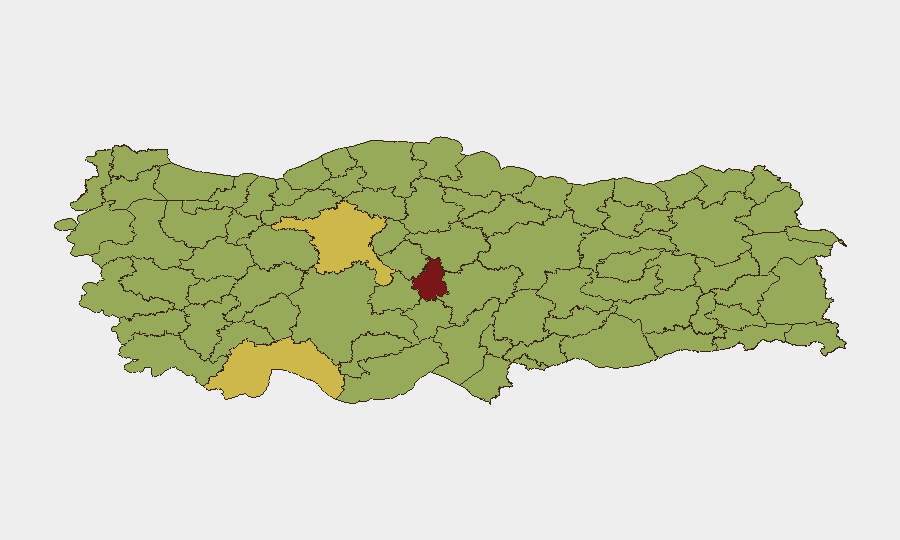
Turkey remains a composite-threat environment (rank #23 globally, score 74) with elevated diplomatic and rhetorical tensions in the past 48 hours—most notably involving public statements, disapprovals, and threats directed at international actors and domestic administration. The event signal cluster from 15–16 June indicates concurrent tensions with the US, Iran, the international community, and internal governance actors, suggesting a multi-vector pressure environment rather than a single-source crisis. Regional risk concentration in Nevşehir (81.5), Ankara (66.9), and Antalya (62.7) remains the primary sub-national concern. No corroborated major incidents (attacks, mass unrest, infrastructure damage) have been independently confirmed in the past 24–48 hours from available open sources.
Key Developments
- 15–16 June, Multiple locations (National scope): Turkish government issued public statements and rejections of positions; disapproved actions toward US and Iran; threatened response(s) toward international community. Specific operational details and locations not yet corroborated in open sources; recommend OSINT fusion and multi-language monitoring for clarification.
- 16 June, National scope: Hyundai Motor Company and Turkey exchanged disapprovals and public statements, suggesting commercial or labour-relations friction; no operational disruption to manufacturing or supply chains confirmed.
- 15 June, Ankara: Turkish administration and central government entities were cited in disapproval signals, consistent with ongoing governance friction; nature and scope not independently detailed.
Data Caveat: GeoBit event signals (REJECT, DISAPPROVE, THREATEN, PUBLIC STATEMENT categories) indicate *sentiment and actor positioning* but do not yet correlate to ground-level incidents, security breaches, or localized disturbances in the past 48 hours. Corroborated incident detail (location, casualty, infrastructure impact) remains limited in available open-source feeds. Duty-of-care teams should not treat signal volume alone as an indicator of imminent operational threat without downstream verification.
Highest-Risk Areas
Nevşehir (81.5) stands significantly above peer regions and warrants focused monitoring; Ankara (66.9) reflects both political/administrative activity and baseline security factors. Antalya (62.7) combines tourism-sector exposure with regional instability vectors. The secondary tier—Kocaeli, Erzurum, Gaziantep, Istanbul, Bolu, Izmir, and Muğla—clusters around 51–54, indicating broadly distributed moderate risk rather than geographic concentration. This distribution suggests that no single region is acutely critical at present, but that Istanbul, Ankara, and major transport/tourism hubs require standard corporate-presence due diligence (personnel vetting, facility hardening, travel routing).
How GeoBit Would Assist
Security teams should activate Intel Sweep (multi-language, entity extraction, OSINT fusion) to disaggregate the latest diplomatic and commercial signals into confirmed incidents vs. rhetorical positioning. AOI Monitoring & Early Warning on Nevşehir, Ankara, and Antalya with persistent alerting thresholds would flag ground-level escalation (protests, roadblocks, security operations) before they affect corporate operations. Network & Actor Analysis applied to Turkish government, Hyundai, and opposition figures would reveal intent and coordination patterns behind the current statement cluster.
7-Day Outlook
Diplomatic and commercial friction is likely to persist or cycle for 5–7 days before either resolution or dormancy. No indicators suggest imminent major security incidents (bombings, mass civil unrest, armed confrontation) in major cities, but rhetorical escalation can shift rapidly. Maintain standard alert posture; escalate only if ground-level incident reporting (protests, road closures, security operations) emerges in the top three risk regions.
Highest-Risk Areas — Ranked
| # | State / Region | Risk |
|---|---|---|
| 1 | Nevşehir | 81.5 |
| 2 | Ankara | 66.9 |
| 3 | Antalya | 62.7 |
| 4 | Kocaeli | 54.1 |
| 5 | Erzurum | 53.2 |
| 6 | Gaziantep | 52.4 |
| 7 | Istanbul | 52.4 |
| 8 | Bolu | 52.4 |
| 9 | Izmir | 52.4 |
| 10 | Muğla | 52.4 |
| 11 | Kars | 51.5 |
| 12 | Yozgat | 51.5 |
Sources
Previous Daily Briefs
A new Turkey brief is written every day — each with its own risk map and downloadable CSV. Here's the last week; use the calendar to go further back.
📅 Browse every day by calendar →
Highlighted days have a brief. Tap a day for that day's map & analysis, or “csv” for that day's dataset ($5).