Situation Summary
Uruguay maintains a low global threat ranking (#184) with a composite threat score of 2, reflecting its position as one of South America's most stable nations. The country has recorded 85 tracked security events, with recent activity dominated by political statements and isolated incidents rather than systemic threats. Current trajectory indicates stability, though regional concentration of risk—particularly in Durazno—warrants localized attention from organizations with personnel or assets in that department.
Key Developments
- Miami, United States — 16 June 2026 — Uruguay's national football team underwent intensive security screening (sniffer dogs, metal detectors, baggage searches) upon arrival ahead of World Cup competition, following an overnight transit disruption in Mexico. This reflects external security protocols rather than domestic Uruguay risk, though it highlights elevated scrutiny of Uruguayan movements internationally.
- Durazno Department — Status ongoing — Durazno remains the country's highest-risk sub-national area (composite score 31.4), substantially exceeding all other departments. The nature of this elevated risk requires further intelligence clarification, as publicly available reporting does not detail the specific drivers.
- National level — 16–18 June 2026 — Multiple public statements from government officials, deputies, and politicians have been recorded, alongside at least one investigative action by national authorities. Content and implications of these statements remain unclear from available open sources.
- Montevideo Department — Status ongoing — The capital registers moderate localized risk (4.7), consistent with typical urban crime and protest activity in a metropolitan center of ~1.3 million residents.
- Artigas Department — Status ongoing — Northern border department (Artigas) shows elevated risk comparable to Montevideo (4.7), potentially reflecting cross-border movement, contraband, or organized crime dynamics typical of frontier regions.
Note: No confirmed domestic security incidents (criminality, protest, infrastructure disruption, or civil unrest) were identified within Uruguay's borders during the last 24–48 hours. Recent event signals reference political statements and administrative actions rather than active threats.
Highest-Risk Areas
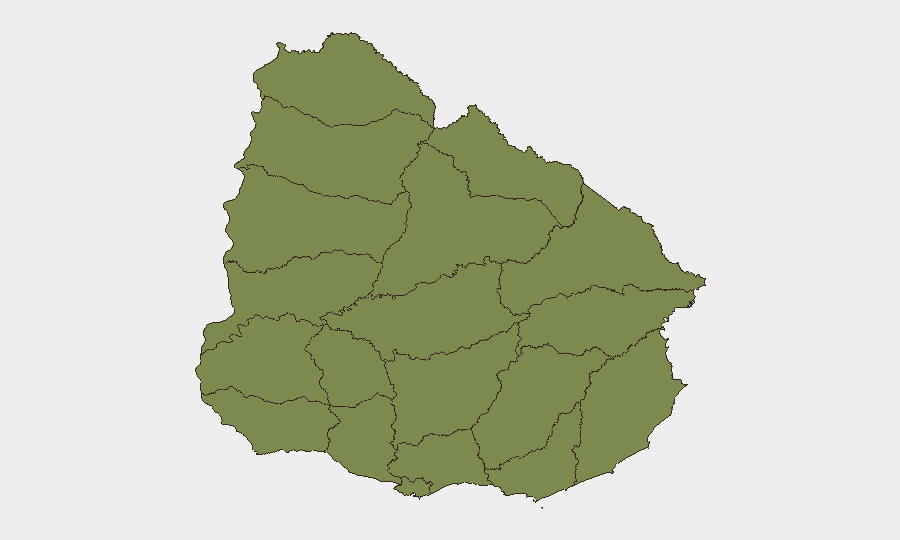
Durazno's risk score (31.4) is nearly seven times higher than any other department and merits immediate investigation by organizations with operations there. The northern and western border departments—Artigas, Salto, Paysandú, and Rivera—show elevated baseline risk consistent with cross-border smuggling corridors and informal economic activity. Montevideo's moderate score (4.7) reflects standard urban crime and occasional protest activity typical of capital cities in the region. All other departments report low, uniform risk (1.4), suggesting risk is geographically concentrated rather than dispersed.
How GeoBit Would Assist
Organizations with personnel or assets in Durazno should employ AOI Monitoring & Early Warning (persistent watch with alerting on that department) and Intel Sweep (multi-language OSINT and event-feed analysis) to identify emerging threat drivers. Network & Actor Analysis and Routing & Network Analysis would support security teams in understanding local power structures and planning safe movement. Real-time Election Monitoring and Radio SIGINT capabilities would provide early warning of civil unrest or political escalation.
7-Day Outlook
No significant escalation in national-level threat is anticipated. Durazno's elevated risk profile should be treated as a standing concern requiring continuous monitoring rather than an acute spike. Political statements at the national level should be tracked for rhetoric that could signal shifting stability, particularly around any scheduled events or international engagement.
Highest-Risk Areas — Ranked
| # | State / Region | Risk |
|---|---|---|
| 1 | Durazno | 31.4 |
| 2 | Artigas | 4.7 |
| 3 | Montevideo | 4.7 |
| 4 | Salto | 1.4 |
| 5 | Paysandú | 1.4 |
| 6 | Rivera | 1.4 |
| 7 | Tacuarembó | 1.4 |
| 8 | Soriano | 1.4 |
| 9 | Colonia | 1.4 |
| 10 | Río Negro | 1.4 |
| 11 | Flores | 1.4 |
| 12 | San José | 1.4 |
Previous Daily Briefs
A new Uruguay brief is written every day — each with its own risk map and downloadable CSV. Here's the last week; use the calendar to go further back.
📅 Browse every day by calendar →
Highlighted days have a brief. Tap a day for that day's map & analysis, or “csv” for that day's dataset ($5).