Situation Summary
Vietnam remains a stable, low-threat operating environment (rank #134 globally; composite score 6.0) with concentrated risk in specific provinces, particularly Huế and Ho Chi Minh City. Recent activity reflects routine governance, military-to-military coordination, and localized incidents rather than systemic instability. The security posture is characterized by standard institutional strengthening and hazard management, with no indication of broader deterioration in the near term.
Key Developments
- Da Nang International Airport – UAV intrusions (26 June). A police report disclosed 597 unauthorized unmanned flights in airport control zones over recent months, including 458 in prohibited airspace and 227 penetrating the innermost restricted area. Six serious incidents involved drones in approach corridors; one event saw three simultaneous UAVs disrupt dozens of flights. Authorities are pursuing criminal prosecution under aviation-security and counter-terrorism statutes.
- Ho Chi Minh City – cafe fire fatality (26 June). A street-front cafe fire killed one person with additional injuries; fire authorities indicated electrical short circuit as the probable cause. Criminal-technical police are investigating potential fire-safety violations.
- Hanoi – inter-agency defense coordination accord (25 June). The National Assembly Chairman witnessed signing of new coordination regulations among the NA Committee for National Defence, Security & Foreign Affairs, Defence Ministry, Public Security Ministry, and Foreign Affairs Ministry, aimed at tightening institutional alignment on security and external-relations policy.
- National – environmental lawyer release (24 June). Dang Dinh Bach, an environmental lawyer, was released after completing a five-year sentence for tax evasion. Human-rights groups characterize his case as politically motivated due to coal-policy activism, signaling continued sensitivity around civic activism in contentious policy domains.
- Quang Tri – US–Vietnam EOD training (26 June). U.S. and Vietnamese military engineers conducted Explosive Ordnance Disposal familiarization training under Pacific Friendship 2026, exchanging detection and clearance techniques for unexploded ordnance as part of ongoing post-conflict hazard reduction.
- National – cyber malware circulation (26 June). A weekly cyber-intelligence report highlighted ongoing distribution of VBV Stealer malware targeting Windows environments. Southeast Asia, including Vietnam, is identified as a region where threat actors are harvesting credentials and financial data, raising fraud and cyber-crime risk.
- Khanh Hoa Province – public-order incident volume (late June). Provincial authorities received 1,364 public reports of security, traffic, and construction incidents in the first half of 2026, used to prioritize local police and agency responses.
Highest-Risk Areas
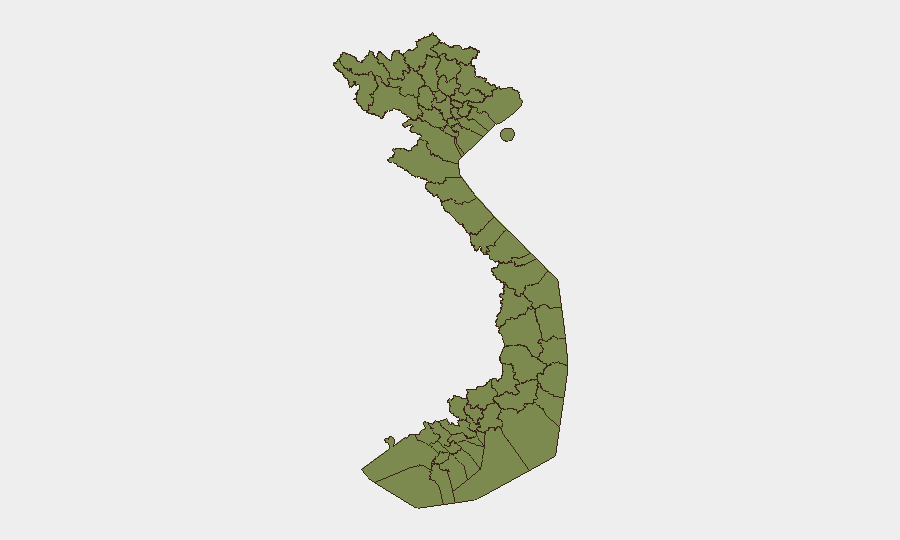
Huế dominates the sub-national risk profile (score 33.9), significantly outpacing all other regions; Ho Chi Minh City follows at 19.9, and Tuyên Quang at 13.8. All remaining provinces and the capital fall below 6.0. The concentration in Huế and HCMC reflects historical incident density and operational complexity in those urban centers; northern border provinces (Lai Châu, Lào Cai, Hà Giang, Cao Bằng, Điện Biên) remain low-risk despite geographic proximity to Laos and China. No sub-national area shows acute escalation signals.
How GeoBit Would Assist
GeoBit's AOI Monitoring & Early Warning capability would track Huế and HCMC for emerging threats, with automated alerting on aviation incidents, civil unrest, or crime clusters. OSINT fusion and multi-language search across Vietnamese official media, social platforms, and sector-specific feeds would surface policy shifts, labor disputes, or regulatory changes affecting corporate operations. GIS & Spatial Analysis would support supply-chain routing and asset-location risk modeling, especially around Da Nang's airport disruption zone.
7-Day Outlook
No imminent security shocks are indicated. The UAV intrusions at Da Nang and institutional coordination moves point to normal law-enforcement and administrative operations. Cyber-malware activity will persist at ambient levels; summer heat and monsoon conditions may increase fire and weather-related incidents. Corporate teams should maintain standard duty-of-care postures; no emergency mobilization is warranted.
Highest-Risk Areas — Ranked
| # | State / Region | Risk |
|---|---|---|
| 1 | Huế | 33.9 |
| 2 | Ho Chi Minh City | 19.9 |
| 3 | Tuyên Quang Province | 13.8 |
| 4 | Tiền Giang Province | 5.8 |
| 5 | Hà Nội | 5.8 |
| 6 | Khánh Hòa Province | 5.8 |
| 7 | Lai Châu Province | 3.8 |
| 8 | Lào Cai Province | 3.8 |
| 9 | Hà Giang Province | 3.8 |
| 10 | Cao Bằng Province | 3.8 |
| 11 | Bắc Kạn Province | 3.8 |
| 12 | Điện Biên Province | 3.8 |
Sources
Previous Daily Briefs
A new Vietnam brief is written every day — each with its own risk map and downloadable CSV. Here's the last week; use the calendar to go further back.
📅 Browse every day by calendar →
Highlighted days have a brief. Tap a day for that day's map & analysis, or “csv” for that day's dataset ($5).