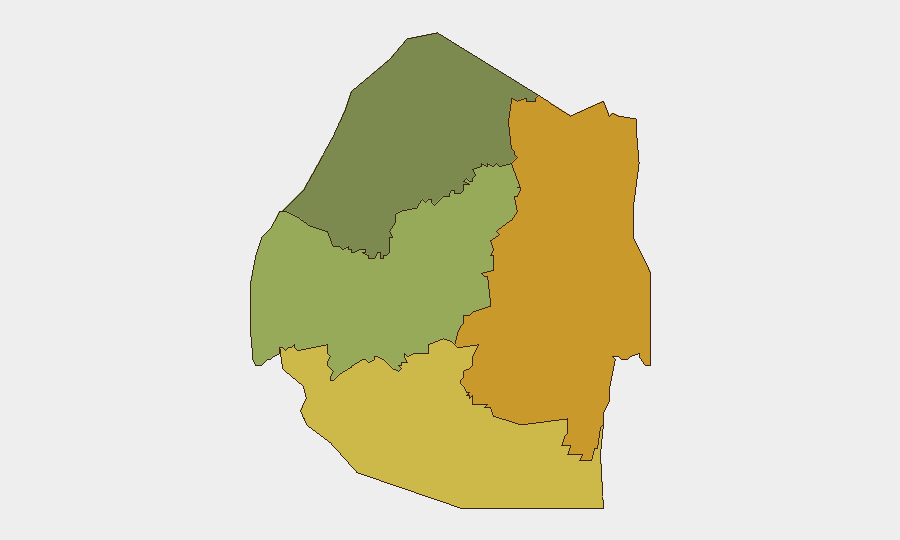
Situation Summary
Eswatini remains a low-threat environment globally (ranked #152) with no confirmed security incidents reported during the October 14–20 period. The country's composite threat score of 9 reflects endemic governance and infrastructure challenges rather than acute violence or civil unrest. Regional risk concentration in Lubombo and Shiselweni (scores 72 and 68, respectively) suggests persistent vulnerabilities tied to border proximity, service delivery gaps, and socioeconomic strain, but these have not generated reportable incidents in the current week.
Key Developments
No discrete security events (crime, civil unrest, political violence, infrastructure failure, or accident) were confirmed in Eswatini between October 14 and October 20, 2026.
Recent policy signals—rather than operational incidents—merit brief note for strategic context:
- October 14, policy announcement (Mbabane): Government identified unreliable electricity, transport, and public infrastructure as priority development concerns during World Bank and IMF engagement; no new outage or infrastructure failure was documented.
- October 14, policy warning (Taipei/Mbabane): King Mswati III announced intention to expand strategic fuel reserves from 60 to 90 days in response to potential international supply disruptions; framed as precautionary, not responsive to current shortage.
- October 14, climate advisory (Mbabane): African Union climate expert issued preparedness warning regarding El Niño-related drought risk; no active drought conditions or impact were reported.
These developments reflect forward-looking government and international concern about resilience (energy, logistics, water security) rather than active crises requiring immediate response.
Highest-Risk Areas
Lubombo region (score 72) and Shiselweni region (score 68) drive the national risk profile and warrant prioritized monitoring. Both regions lie in the country's southeastern and southern periphery, with greater exposure to cross-border dynamics, informal economic activity, and more limited state presence and service coverage than central and northern areas. Manzini Region (score 55) represents a secondary concentration tied to its density and role as a commercial hub; Hhohho Region (score 35) is substantially lower-risk. The risk gradient suggests that southern and eastern border zones face compounded vulnerabilities—economic precarity, informal settlement, limited infrastructure—that may constrain response capacity and visibility, even absent current incident reports.
How GeoBit Would Assist
Security and risk teams operating in or responsible for Eswatini should deploy Area-of-Interest (AOI) Monitoring & Early Warning focused on Lubombo and Shiselweni to detect emerging incidents (civil unrest, criminal activity, infrastructure failure) before they escalate or disrupt operations. OSINT Fusion & Corroboration (X/Twitter, Telegram, local media, radio SIGINT) across multiple languages and platforms would provide real-time visibility into informal reporting and ground sentiment, particularly in border and rural zones where formal press coverage is sparse. Routing & Network Analysis supports alternative journey planning for personnel and asset movement, accounting for infrastructure vulnerability and regional risk variation.
7-Day Outlook
No acute deterioration is anticipated in the near term. The risk environment remains characterized by chronic institutional and infrastructure constraints rather than acute political, security, or conflict triggers. Continued monitoring of regional border dynamics (Lubombo, Shiselweni) and infrastructure reliability (particularly electricity and transport) is warranted as baseline precaution; seasonal El Niño-related drought risk should be tracked through early 2027.
Highest-Risk Areas — Ranked
| # | State / Region | Risk |
|---|---|---|
| 1 | Lubombo | 72 |
| 2 | Shiselweni | 68 |
| 3 | Manzini Region | 55 |
| 4 | Hhohho Region | 35 |
Sources
Previous Weekly Briefs
A new Eswatini brief is written every Monday, covering the week — each with its own risk map and downloadable CSV. Use the calendar to go further back.
- October 13, 2026
- October 6, 2026
- September 29, 2026
- September 22, 2026
- September 15, 2026
- September 8, 2026
- September 1, 2026
📅 Browse past briefs by calendar →
Highlighted days have a brief. Tap a day for that day's map & analysis, or “csv” for that day's dataset ($5).
Atlas — our AI intelligence desk — emails them this snapshot personally. Nothing else, no list.