Situation Summary
Slovakia remains a low-threat environment globally (#121, composite score 2.1) but faces elevated near-term administrative and cyber risk following the largest ransomware attack in the country's history against the national land-registry system. The UGKK cyberattack has created cascading disruption to property services, municipal administration, and mortgage processing nationwide, while ongoing attribution disputes and public cyber hygiene deficits are compounding exposure to secondary attacks and disinformation. Political sensitivities around alleged foreign involvement are increasing information-operations risk and complicating response transparency.
Key Developments
- Bratislava & nationwide – historic ransomware attack on UGKK cadastral system. The Office of Geodesy, Cartography and Cadastre remains severely disrupted, paralyzing land-registry services, parking-permit issuance, and real-estate transactions across Slovakia. Recovery timeline and full service restoration remain unclear.
- Nationwide – active investigation with geopolitical attribution tension. Interior Ministry and OCCK are investigating suspected Ukrainian involvement, with senior officials drawing comparisons to attacks on Russia. Public attribution claims are heightening political sensitivity and risk of competing threat narratives.
- Nationwide – cascading administrative and commercial impact. Municipal services dependent on UGKK data, mortgage lenders, property conveyancing, and land-title verification remain severely constrained. This disruption will likely persist for weeks to months.
- Nationwide – structural cyber-hygiene vulnerabilities. A 2025 Slovak National Cyber Security Centre survey found 66% of the public reuse passwords, 60% lack multi-factor authentication, and 57% are unfamiliar with ransomware concepts—creating a permissive environment for follow-on phishing, credential theft, and social engineering.
- Nationwide – elevated disinformation and influence-operation risk. The same survey indicates 40% of citizens do not verify social-media information or verify only occasionally, suggesting high susceptibility to false narratives around the cyberattack, foreign involvement, and government response.
- Nationwide – hostile media environment. U.S. State Department human rights reporting documents dozens of incidents targeting journalists in 2023 (threats, stalking, harassment), hampering independent investigation and reporting on the cyberattack and state cyber-defense posture.
Highest-Risk Areas
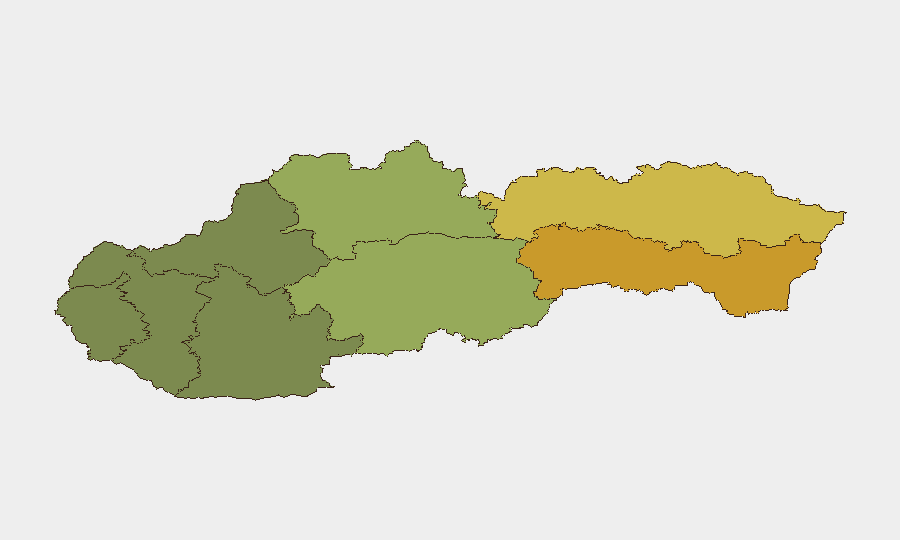
The Banská Bystrica region registers a composite risk score of 31.5—substantially higher than all other Slovak regions (each at 1.5)—but current available intelligence does not specify discrete threat drivers within that region. The elevated ranking warrants targeted monitoring but should not be interpreted as evidence of imminent violence or instability. All regions remain low-risk in absolute terms. The national-level cyber-infrastructure outage and disinformation environment represent the primary near-term threat vectors across Slovakia, concentrated in Bratislava (seat of national administration) and affecting all municipalities and businesses dependent on land-registry services.
How GeoBit Would Assist
Security teams operating in Slovakia should employ Intel Sweep and multi-language OSINT to monitor official statements, media reporting, and social platforms for attribution claims, disinformation, and secondary cyber incidents. AOI Monitoring & Early Warning on Bratislava municipal and national cyber-agency infrastructure can detect recovery progress and emerging attacks. Network & Actor Analysis and Telegram/X OSINT are essential for tracking threat-actor claims, ransomware-gang communications, and coordinated influence campaigns that could amplify geopolitical tensions or trigger secondary operational disruptions.
7-Day Outlook
Recovery of UGKK services will likely remain incomplete through mid-June, sustaining administrative friction for property-dependent operations. Attribution disputes and domestic political fallout will continue shaping official messaging, creating ambiguity around actual threat actors and defensive priorities. Heightened cyber-hygiene deficits and disinformation susceptibility increase risk of follow-on attacks and social disruption, warranting continuous monitoring of threat-actor communications and public-narrative shifts.
Highest-Risk Areas — Ranked
| # | State / Region | Risk |
|---|---|---|
| 1 | Region of Banská Bystrica | 31.5 |
| 2 | Region of Košice | 1.5 |
| 3 | Region of Žilina | 1.5 |
| 4 | Region of Bratislava | 1.5 |
| 5 | Region of Trnava | 1.5 |
| 6 | Region of Trenčín | 1.5 |
| 7 | Region of Nitra | 1.5 |
| 8 | Region of Prešov | 1.5 |