Situation Summary
Armenia faces elevated internal security pressure driven by a combination of acute criminal violence, detention-related health crises among opposition figures, and unresolved sovereignty disputes over transit corridors. Yerevan accounts for the overwhelming majority of measurable risk (31.3 vs. 1.3 across all other provinces), reflecting concentrated urban instability centered on the capital. The security environment remains volatile but contained; no systemic institutional collapse or mass mobilization is evident, though protest activity and border tensions create potential flashpoints for rapid escalation.
Key Developments
- Central Yerevan (20–22 July) – Armed shooting and grenade attack resulted in one fatality, one hospitalization, and one suspect detained. Investigation ongoing; indicates elevated urban violence and potential organized-crime involvement.
- Yerevan, Justice Ministry (21 July) – Ministry formally challenged the legality of a proposed U.S.–Azerbaijan transit corridor ("Trump Route" / TRIPP) through Armenian territory, citing violation of domestic law. Signals escalating political friction over sovereignty and transit arrangements with external powers.
- Yerevan detention facility (20–24 July) – Andranik Tevanyan, detained opposition leader of the pro-Russian *Mother Armenia* party and defendant in a treason case, experienced sudden health deterioration during medical examination. Assessment flags this as a credible flashpoint for opposition mobilization and street protests.
- Yerevan government and embassy areas (ongoing, last 24–48h) – Persistent protest activity documented around government buildings and diplomatic zones; advisories note common demonstrations with potential for rapid escalation and movement disruption.
- Armenia–Azerbaijan border (ongoing, last 24–48h) – Continued elevated tension with active checkpoint controls and risk of sudden closures. Cross-border travel and logistics remain vulnerable to rapid deterioration.
- National Assembly and Prosecutor General (24–25 July) – Multiple public statements and disapprovals issued by parliament, state officials, and the Prosecutor General, indicating internal institutional friction and public dissatisfaction; domestic audience fragmentation.
Highest-Risk Areas
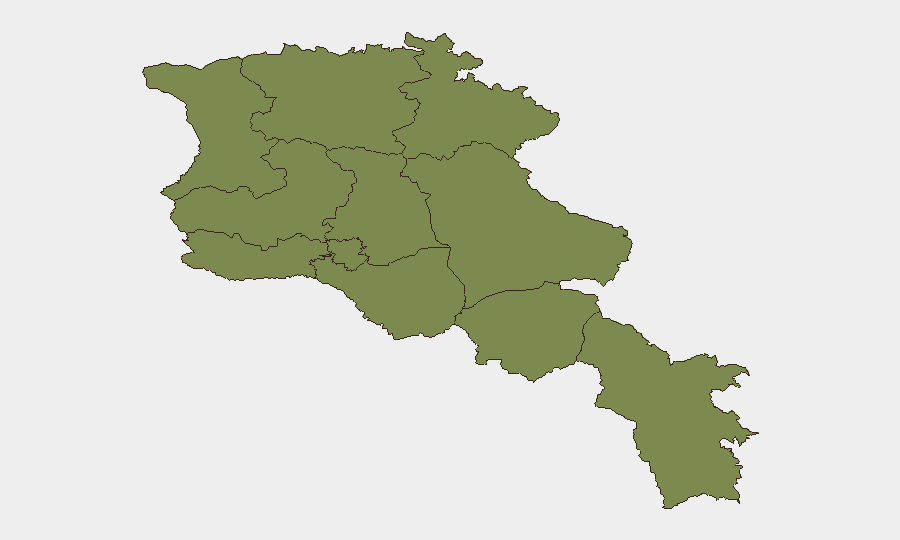
Yerevan dominates the risk landscape by a factor of 24× relative to all other provinces. The capital's elevated score reflects concentration of government institutions, opposition activity, detention facilities, international presence, and recent armed criminal violence. All ten provincial zones register nearly identical baseline risk (1.3), indicating that security volatility is largely urban and capital-centric rather than dispersed regionally. Border provinces (Tavush, Syunik, Gegharkunik) maintain low recorded scores despite proximity to Azerbaijan, suggesting either effective border management or underreporting; however, recent border-tension signals warrant continued monitoring of these zones.
How GeoBit Would Assist
Security teams operating in Armenia should deploy AOI Monitoring & Early Warning on Yerevan's government and embassy districts, detention facilities, and key protest-assembly sites to enable real-time alerting on crowd movement and demonstrations. Network & Actor Analysis combined with multi-language OSINT and Telegram/social-media intelligence would track opposition coordination, health-crisis narratives, and detained-figure mobilization risk. Border & Disputed-Territory Search with persistent satellite and imagery monitoring would provide early warning of checkpoint closures and cross-border logistics disruption along Armenia–Azerbaijan crossing points.
7-Day Outlook
Opposition health crises and ongoing detention cases are likely to sustain protest pressure over the next week, with highest risk in central Yerevan around government and judicial buildings. Border tensions remain chronic but manageable absent external military escalation; however, transit-corridor disputes may intensify rhetorical friction without immediate operational impact. No indicators suggest imminent large-scale civil unrest or regime instability; risk trajectory remains elevated but stable.
Highest-Risk Areas — Ranked
| # | State / Region | Risk |
|---|---|---|
| 1 | Yerevan | 31.3 |
| 2 | Lori Province | 1.3 |
| 3 | Tavush Province | 1.3 |
| 4 | Kotayk Province | 1.3 |
| 5 | Ararat Province | 1.3 |
| 6 | Gegharkunik Province | 1.3 |
| 7 | Vayots Dzor Province | 1.3 |
| 8 | Syunik Province | 1.3 |
| 9 | Shirak Province | 1.3 |
| 10 | Aragatsotn Province | 1.3 |
| 11 | Armavir Province | 1.3 |
Sources
Previous Daily Briefs
A new Armenia brief is written every day — each with its own risk map and downloadable CSV. Here's the last week; use the calendar to go further back.
📅 Browse every day by calendar →
Highlighted days have a brief. Tap a day for that day's map & analysis, or “csv” for that day's dataset ($5).
Atlas — our AI intelligence desk — emails them this snapshot personally. Nothing else, no list.