Situation Summary
Belarus remains stable at the domestic level with no reported civil unrest, large-scale protests, or significant infrastructure disruptions in the past 48 hours. Border-security tensions with Latvia dominate current reporting, driven by a documented surge in migrant-crossing attempts originating from Belarus. Military and cyber cooperation with China is underway in Minsk, while the Belarusian Defence Ministry has publicly affirmed no signs of external military aggression or Ukrainian border threats as of 22 July.
Key Developments
- Latvia–Belarus border (near Latvian frontier), 22 July – Latvian forces used tear gas and fired a warning shot to halt at least five migrants crossing from Belarus; the group allegedly threw logs at soldiers. This reflects ongoing hybrid-migration pressure linked directly to Belarus as the departure point.
- Minsk (Defence Ministry), 22 July – Defence Minister Viktor Khrenin stated the military–political situation around Belarus is "stable," citing minimal NATO exercises and low flight activity; no signs of Ukrainian aggressive preparations along the southern border were identified.
- Minsk (Chinese–Belarusian military cooperation), 22–25 July – A Chinese People's Liberation Army Information Support Force delegation is meeting Belarusian Armed Forces communications and information-computing units to discuss cybersecurity systems, command-and-control resilience, and cyberattack countermeasures.
- Latvia–Belarus border region (Latvia reporting), 21–22 July – Latvia's prime minister reported a doubling in migrant-crossing attempts from Belarus in recent days, explicitly linking the surge to a Russia–Belarus hybrid campaign targeting the EU's eastern border.
- No major domestic incidents reported, 23–24 July – Open-source reporting confirms an absence of verified civil unrest, political violence, or large-scale disruption inside Belarus itself during the past 48 hours.
Highest-Risk Areas
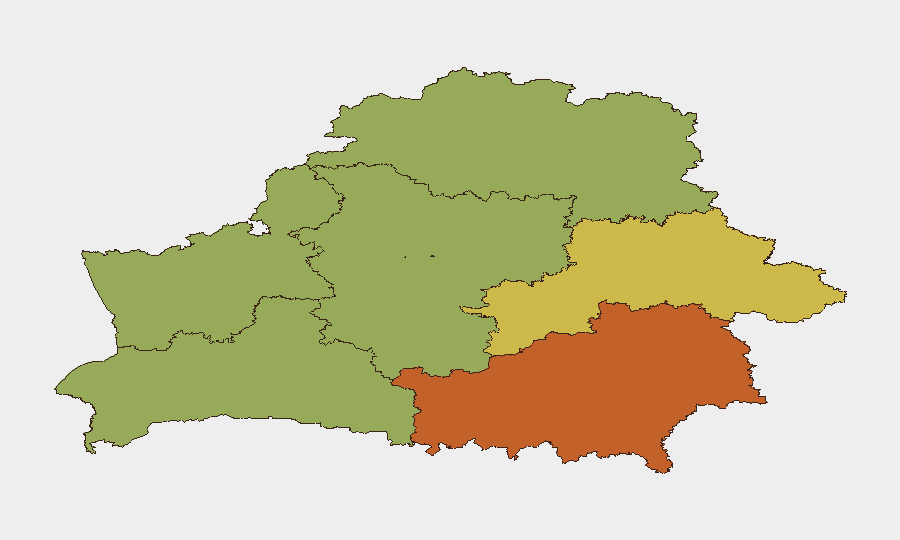
Homyel Region (risk 75) and Minsk (risk 68) remain the highest-risk areas, with Homyel's elevated score likely reflecting its position in the eastern border zone and historical sensitivity to Russian-aligned security dynamics. Mahilyow Region (62) and Brest Region (55) follow, suggesting risk clustering along or near the Russian and Ukrainian borders. The concentration of risk in border regions and the capital reflects hybrid-security pressures—migration flows, information warfare, and cyber operations—rather than domestic instability; peripheral regions (Vitsebsk, Minsk Region) score notably lower, indicating geographically contained risk exposure.
How GeoBit Would Assist
Security teams should deploy AOI Monitoring & Early Warning on Homyel and Minsk regions, combined with border & disputed-territory search to track migration and hybrid-pressure dynamics in real time. Multi-language OSINT fusion (X/Twitter, Telegram, government statements) enables rapid corroboration of border incidents and official security claims, reducing false-alarm risk. Cyber and regime-stability search capabilities support monitoring of the ongoing Chinese–Belarusian information-security cooperation and any shifts in command-and-control vulnerability that could affect operations or personnel in-country.
7-Day Outlook
Border-migration pressure is expected to persist as part of the broader EU–Russia hybrid campaign; no immediate escalation to armed conflict or large-scale domestic unrest is signaled. Cyber and military cooperation with China will likely continue through the stated 25 July window, with potential expansion into broader information-warfare or critical-infrastructure-resilience frameworks. Personnel and assets in Homyel and Minsk should maintain heightened situational awareness and contingency protocols, while operations in peripheral regions remain lower-risk in the near term.
Highest-Risk Areas — Ranked
| # | State / Region | Risk |
|---|---|---|
| 1 | Homyel Region | 75 |
| 2 | Minsk | 68 |
| 3 | Mahilyow Region | 62 |
| 4 | Brest Region | 55 |
| 5 | Hrodna Region | 52 |
| 6 | Minsk Region | 48 |
| 7 | Vitsebsk Region | 45 |
Sources
Previous Daily Briefs
A new Belarus brief is written every day — each with its own risk map and downloadable CSV. Here's the last week; use the calendar to go further back.
📅 Browse every day by calendar →
Highlighted days have a brief. Tap a day for that day's map & analysis, or “csv” for that day's dataset ($5).
Atlas — our AI intelligence desk — emails them this snapshot personally. Nothing else, no list.