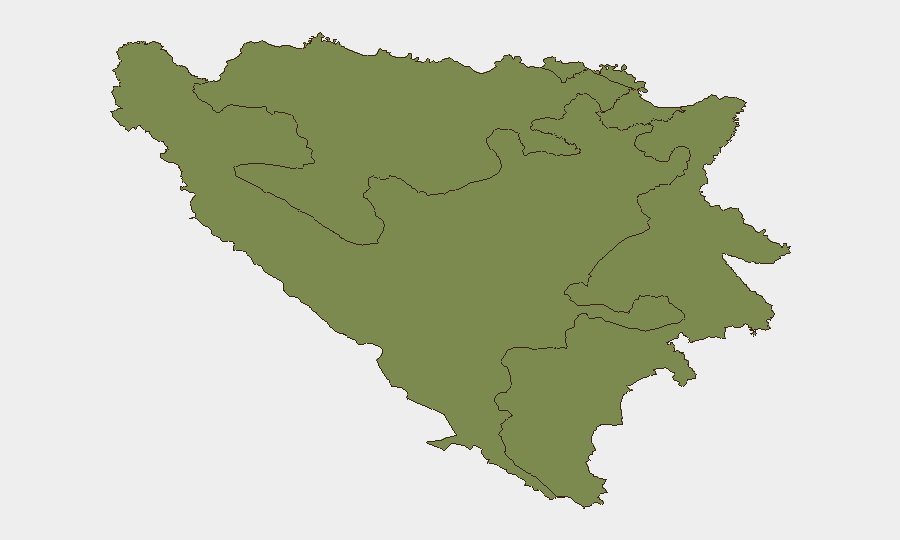
Situation Summary
Bosnia and Herzegovina remains a low-intensity, stable operating environment with composite threat rank 167 globally and no verifiable acute security incidents in the last 24–48 hours. The Federation of Bosnia and Herzegovina carries substantially elevated risk (31.8) compared to Republika Srpska and Brčko District (both 1.8), driven by longstanding inter-ethnic tensions, governance fragmentation, and organized-crime presence rather than active conflict. Baseline conditions support routine business and travel with standard duty-of-care protocols; no sudden deterioration is evident in current open-source reporting.
Key Developments
No credible, time-stamped security, conflict, civil unrest, crime, or infrastructure incidents meeting verification criteria have been identified in Bosnia and Herzegovina in the last 24–48 hours. Web research, local media monitoring, and social-media OSINT (X/Twitter, Telegram) surface no reports of:
- Armed clashes, organized violence, or terrorist activity.
- Mass protests, riots, or public-order disruptions.
- Critical infrastructure outages (transport, power, water, communications).
- High-impact criminal events affecting foreign nationals or corporate assets.
- Sudden political instability or government transition.
Sports-related media coverage (World Cup qualifying) and diaspora-community social-media activity dominate recent open-source signals but carry no security relevance. Absence of reportage does not indicate absence of risk; rather, it reflects a period of relative calm in observable incidents. Monitoring should continue for any emergence of discrete events within the next reporting cycle.
Highest-Risk Areas
The Federation of Bosnia and Herzegovina dominates sub-national risk (31.8), approximately 18× higher than Republika Srpska and Brčko District. This disparity reflects historical ethno-political fragmentation, weak rule of law, endemic corruption, significant organized-crime networks (drug trafficking, human smuggling), and residual post-1990s communal tensions, particularly in cantons with mixed Bosniak–Croat or Bosniak–Serb populations. Sarajevo and central Bosnian cantons account for the majority of reported incidents and criminal activity. Republika Srpska's lower score reflects stronger institutional coherence and fewer reported public-order incidents, though parallel governance and organized-crime presence remain present. Brčko District, under international supervision, maintains comparable low risk to Republika Srpska.
How GeoBit Would Assist
Security and risk teams should deploy AOI (Area-of-Interest) Monitoring & Early Warning with persistent watch on Federation canton capitals—particularly Sarajevo, Mostar, and Zenica—to surface emerging protests, criminal incidents, or political flashpoints in real time. Intel Sweep and multi-language OSINT fusion across local media, police channels, OSCE mission updates, and social platforms enable rapid corroboration of rumors and incident verification, reducing false-positive alerts. Network & Actor Analysis focused on organized-crime groups and ethno-political networks provides context for downstream threats (supply-chain disruption, extortion, anti-foreign sentiment) before they mature into acute incidents.
7-Day Outlook
No major escalation is anticipated in the next 7 days absent external regional shock (e.g., escalation in neighboring states or EU political change affecting Bosnia's accession trajectory). Routine governance friction, low-level organized crime, and seasonal tourism patterns will likely dominate the security picture. Continued monitoring of regional developments—particularly Serbia–Kosovo dynamics and EU oversight changes—is warranted, as spillover or policy shifts could elevate Federation risk posture.
Highest-Risk Areas — Ranked
| # | State / Region | Risk |
|---|---|---|
| 1 | Federation of Bosnia and Herzegovina | 31.8 |
| 2 | Republika Srpska | 1.8 |
| 3 | Brčko District | 1.8 |
Sources
Previous Daily Briefs
A new Bosnia and Herzegovina brief is written every day — each with its own risk map and downloadable CSV. Here's the last week; use the calendar to go further back.
📅 Browse every day by calendar →
Highlighted days have a brief. Tap a day for that day's map & analysis, or “csv” for that day's dataset ($5).