Situation Summary
Brazil remains elevated on the global threat index (#33 globally, composite score 79) driven primarily by active criminal-insurgency dynamics and 1,040 tracked security events. Over the past 24–48 hours, a significant diplomatic escalation has emerged following the U.S. State Department's designation of major Brazilian criminal organizations (PCC and Comando Vermelho) as terrorist entities, prompting Brazil's Foreign Ministry to formally warn Congress of potential U.S. military intervention on Brazilian soil. The combination of entrenched organized crime, institutional stress signals, and now elevated geopolitical friction has created a compounding risk environment, particularly in high-insurgency states.
Key Developments
- Brasília – Foreign Ministry terrorist-designation escalation (July 10, 2026)
Brazil's Ministry of Foreign Affairs issued an official letter to Congress warning of "risk of use of U.S. military force" on Brazilian territory following Washington's designation of PCC and Comando Vermelho as terrorist organizations. The warning explicitly flagged concern that such designations could provide legal cover for extraterritorial U.S. operations targeting Brazilian institutions and criminal networks.
- Multi-agency institutional responses (July 11, 2026)
Concurrent with the diplomatic alert, signals show investigation activity across Brazilian government entities (MINIST, GOVERNMENT vs BRAZIL protocols active), senatorial disapproval, and legal rejection statements from chancellery and bar association figures, indicating institutional friction and competing positions on the U.S. designation and potential response.
- Prison and detention events (July 11, 2026)
Arrest/detention activity logged in prison system, potentially linked to ongoing organized-crime enforcement or response to the terrorist designation controversy.
- Hospital and service-demand activity (July 11, 2026)
Demand activity reported at hospital facilities; context unclear but may reflect strain on public services or response to security incidents.
- Government statement and media engagement (July 10–11, 2026)
Official government public statements and media activity indicate active messaging and narrative management around the designation crisis.
Highest-Risk Areas
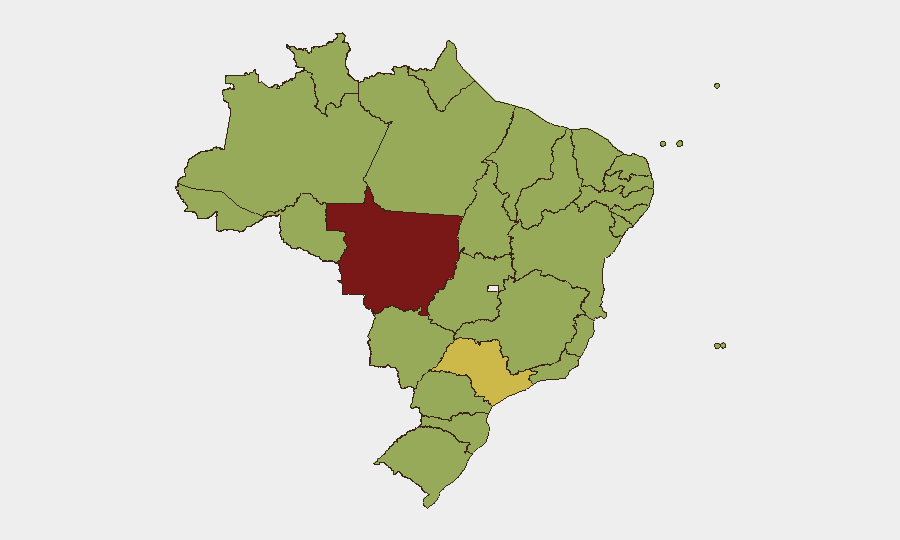
Mato Grosso (85) and São Paulo (67.6) remain the primary drivers of overall Brazil risk, with Mato Grosso's elevated score reflecting intense criminal-territorial and insurgency activity, particularly related to organized crime control of border regions and drug-trafficking routes. São Paulo—home to major PCC operations and the country's largest urban density—carries sustained risk from gang violence, prison system instability, and now heightened pressure from both U.S. designations and federal enforcement responses. Rio de Janeiro (59.9), Santa Catarina (59.2), and Amazonas (57.3) follow, with risk distributed across urban gang conflict, narcotics production/trafficking zones, and remote frontier lawlessness. The top-ranked states cluster around either major metropolitan zones (São Paulo, Rio de Janeiro) or strategic narcotics/border corridors (Mato Grosso, Amazonas, Pará).
How GeoBit Would Assist
Security and duty-of-care teams should leverage Intel Sweep and multi-language OSINT fusion to track real-time government statements, political positioning, and criminal-organization responses to the U.S. designation. AOI Monitoring & Early Warning on high-risk state capitals and border zones (Mato Grosso, São Paulo) will provide persistent threat alerting. Network & Actor Analysis applied to PCC, Comando Vermelho, and government institutions will clarify allegiances, splinter risk, and enforcement escalation patterns. Conflict & Military capabilities, combined with Routing & Network Analysis, help identify safe transit corridors and alternative logistics if U.S.–Brazil tensions affect normal operations or security postures.
7-Day Outlook
Expect continued institutional debate and U.S.–Brazil diplomatic communication over the designation and enforcement scope. Criminal organizations may accelerate territorial consolidation or shift operational patterns in anticipation of increased enforcement. Organizations with personnel or logistics in Mato Grosso, São Paulo, or Rio de Janeiro should review contingency protocols and validate communications channels given elevated geopolitical and law-enforcement risk.
Highest-Risk Areas — Ranked
| # | State / Region | Risk |
|---|---|---|
| 1 | Mato Grosso | 85 |
| 2 | São Paulo | 67.6 |
| 3 | Rio de Janeiro | 59.9 |
| 4 | Santa Catarina | 59.2 |
| 5 | Amazonas | 57.3 |
| 6 | Rio Grande do Sul | 57.1 |
| 7 | Bahia | 56.5 |
| 8 | Pará | 56.2 |
| 9 | Minas Gerais | 56.2 |
| 10 | Pernambuco | 55.8 |
| 11 | Rondônia | 55.5 |
| 12 | Espírito Santo | 55.5 |
Sources
Previous Daily Briefs
A new Brazil brief is written every day — each with its own risk map and downloadable CSV. Here's the last week; use the calendar to go further back.
📅 Browse every day by calendar →
Highlighted days have a brief. Tap a day for that day's map & analysis, or “csv” for that day's dataset ($5).
Atlas — our AI intelligence desk — emails them this snapshot personally. Nothing else, no list.