Situation Summary
Canada faces an acute security incident in Ontario and elevated cross-border tensions with the United States as of June 18, 2026. A Toronto Police Service officer was killed during an armed manhunt in North York on June 18, with one suspect arrested and a second armed suspect remaining at large and linked to a series of shootings including the March 2026 U.S. Consulate incident. Concurrently, U.S. Homeland Security leadership has publicly characterized the Canada–U.S. security relationship as "fracturing," signaling systemic law-enforcement and criminal-enterprise concerns that could affect bilateral coordination on migration, trafficking, and organized crime. Ontario's composite risk score (32.1) reflects both the immediate incident and underlying vulnerability to cross-border criminal activity.
Key Developments
- Toronto, Ontario – June 18, 2026 (morning, local time). Toronto Police Service officer shot and killed during Emergency Task Force operation at North York high-rise building; operation linked to investigations into a series of shootings including the March 10, 2026 U.S. Consulate incident. One 19-year-old suspect arrested; second 19-year-old suspect declared armed and dangerous and subject to active manhunt.
- Toronto, Ontario – June 18, 2026 (ongoing). Toronto police launched large-scale manhunt warning public that at-large suspect is armed, dangerous, and linked to prior consulate-related gunfire. Residents in affected areas advised to shelter and report sightings.
- Washington, D.C. – June 17, 2026. U.S. Homeland Security Secretary Markwayne Mullin publicly stated that Canada–U.S. relationship is "fracturing" and must be repaired to protect both countries from criminal enterprises; statement reflects cross-border security and law-enforcement concerns affecting coordination on migration, trafficking, and organized crime.
- Canada–U.S. border operations – June 17–18, 2026. U.S. Customs and Border Protection reported recent border incident under investigation by Homeland Security Investigations; CBP confirmed active HSI probe involving Canada–U.S. traffic but full details not yet released.
- Canada government security posture – June 17–18, 2026. Government of Canada official communications emphasized current national-security and public-safety concerns, including cyber and cross-border threats, reflecting elevated policy focus on security cooperation and infrastructure protection in response to U.S. counterpart concerns.
Highest-Risk Areas
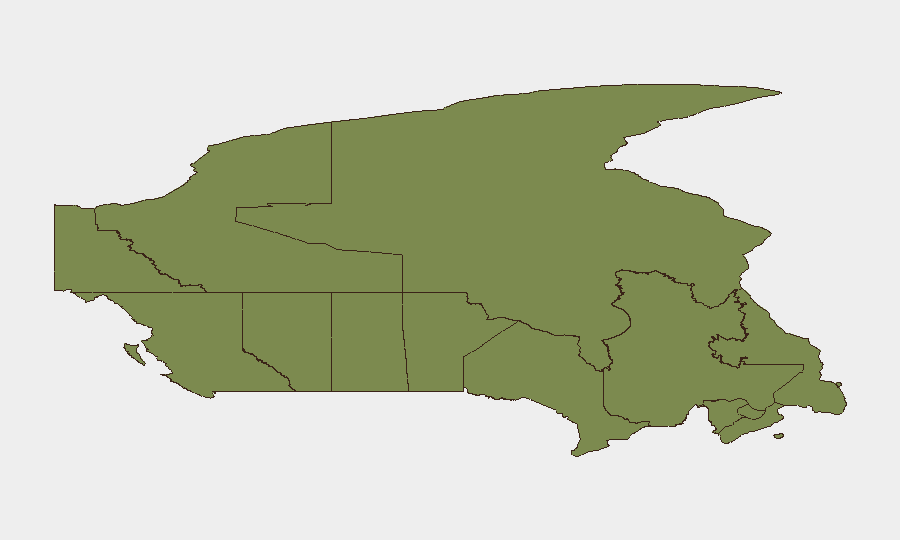
Ontario dominates the sub-national risk ranking (32.1) due to the active armed manhunt, officer fatality, and ongoing investigation into transnational shooting incidents linked to the U.S. Consulate. British Columbia (16.6) and Nunavut (14.5) follow; BC's elevated score reflects cross-border criminal networks and trafficking vulnerabilities, while Nunavut's remote geography and limited law-enforcement capacity create enforcement and monitoring gaps. Quebec (8.6) and Manitoba (5.2) carry moderate risk tied to organized crime and border-zone activity. All high-risk provinces require heightened duty-of-care attention on employee movements, asset security, and cross-border supply-chain continuity.
How GeoBit Would Assist
Corporate and risk teams should deploy AOI Monitoring & Early Warning on high-risk provincial centers (Toronto, Vancouver, Montreal) to track emerging armed-conflict or law-enforcement incidents in real time. Network & Actor Analysis and OSINT fusion (X/Twitter, Telegram, YouTube intelligence, multi-language search) will identify suspected actors, motive signals, and organized-crime network activity tied to the consulate shooting and current manhunt. Routing & Network Analysis can support contingency planning for personnel and supply routes around active incident zones and cross-border chokepoints during the high-alert period.
7-Day Outlook
The Toronto manhunt is expected to dominate operational security in Ontario for the next 5–7 days; TPS operations and tactical activity will remain elevated, and public movement restrictions in North York and surrounding areas are probable. U.S.–Canada bilateral security dialogue will intensify, potentially affecting cross-border clearance times and law-enforcement coordination; organizations with cross-border personnel or supply chains should monitor official travel advisories and border-crossing advisories from both governments. Risk of secondary incidents (retaliatory activity, copycat shootings, or related consulate-linked investigations) remains material through the end of June.
Highest-Risk Areas — Ranked
| # | State / Region | Risk |
|---|---|---|
| 1 | Ontario | 32.1 |
| 2 | British Columbia | 16.6 |
| 3 | Nunavut | 14.5 |
| 4 | Quebec | 8.6 |
| 5 | Manitoba | 5.2 |
| 6 | Alberta | 3.6 |
| 7 | Saskatchewan | 3 |
| 8 | Prince Edward Island | 2.7 |
| 9 | New Brunswick | 2.5 |
| 10 | Nova Scotia | 2.4 |
| 11 | Yukon | 2.2 |
| 12 | Northwest Territories | 2.2 |
Sources
Previous Daily Briefs
A new Canada brief is written every day — each with its own risk map and downloadable CSV. Here's the last week; use the calendar to go further back.
📅 Browse every day by calendar →
Highlighted days have a brief. Tap a day for that day's map & analysis, or “csv” for that day's dataset ($5).