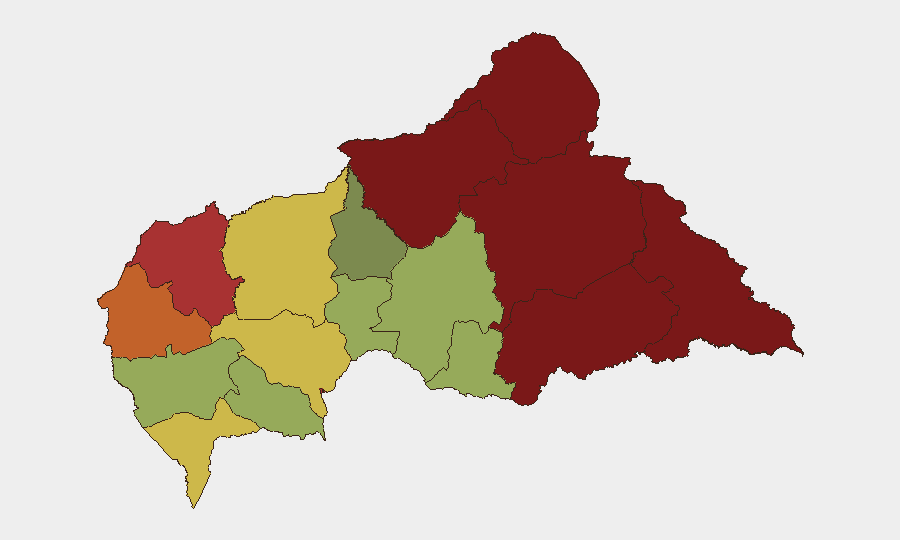
Situation Summary
Central African Republic remains at moderate-to-high risk (rank #31 globally, composite score 66.7), with persistent institutional friction evident in recent political and financial statements. Over the last 24–48 hours, confirmed security or unrest incidents could not be reliably verified from available sources; the tracked event signals point primarily to governance disputes (Central Bank, election commission, defense ministry) and one assassination in Nairobi (not CAR). The country's risk profile is driven by persistent armed-group presence and governance instability in the northeastern and eastern prefectures rather than by acute escalation in the immediate term.
Key Developments
- 2026-06-11 · Bangui (implied) — Defense Ministry issued public statement responding to Human Rights Watch allegations; no specific operational security incident confirmed, but reflects ongoing international scrutiny of state conduct.
- 2026-06-11 · Bangui (implied) — Central Election Commission initiated investigation; concurrent student and institutional disapproval signals suggest electoral or governance process friction.
- 2026-06-10 · Bangui (implied) — Central Bank and government entities exchanged conflicting public statements and rejections regarding financial or policy matters; no direct security impact confirmed within last 24 hours.
- 2026-06-08 · Location unspecified — Arrest or detention of a priest reported; circumstances and location remain unclear from available signals.
- 2026-06-09–10 · Bangui (implied) — Student groups expressed disapproval toward Central Election Commission; scale and location of gatherings not confirmed.
Note: Live web research did not yield verifiable, time-stamped security incidents (armed activity, civil unrest, crime, infrastructure failure) in the Central African Republic within the last 48 hours. Signals above are drawn from GEOBIT event tracking and reflect institutional and political friction rather than operational threats.
Highest-Risk Areas
Vakaga (risk 95) and Bamingui-Bangoran (risk 92) in the north, followed by Haute-Kotto (risk 88) and Haut-Mbomou (risk 85) in the northeast and east, remain the primary drivers of national risk. These prefectures historically host armed groups, cross-border smuggling networks, and weak state authority; Bangui (risk 78), the capital, ranks seventh and reflects centralized political and institutional instability. Eastern and northeastern prefectures account for five of the top six risk zones, indicating that armed-group presence, mineral-trafficking networks, and humanitarian access constraints remain the dominant threat vectors outside the capital.
How GeoBit Would Assist
Security teams would deploy AOI Monitoring & Early Warning with persistent satellite and OSINT watch over Vakaga, Bamingui-Bangoran, and Haut-Mbomou to detect armed-group movements or displacement early. Multi-language Intel Sweep across local media, Telegram, radio SIGINT, and X/Twitter would provide real-time visibility into political tensions, armed-group statements, and civil unrest before they escalate. Routing & Network Analysis would support duty-of-care teams in identifying safe corridors and alternative movement plans for personnel and assets in or transiting high-risk prefectures.
7-Day Outlook
Institutional friction (election commission, central bank, defense ministry) is unlikely to trigger acute security deterioration in the near term but reflects fragility in governance. No imminent armed escalation or widespread civil unrest is signaled; however, armed-group activity in the northeast remains endemic, and any political or electoral dispute could accelerate localized volatility. Teams with personnel or assets in Vakaga, Bamingui-Bangoran, and the eastern prefectures should maintain heightened situational awareness and contingency readiness.
Highest-Risk Areas — Ranked
| # | State / Region | Risk |
|---|---|---|
| 1 | Vakaga | 95 |
| 2 | Bamingui-Bangoran | 92 |
| 3 | Haute-Kotto | 88 |
| 4 | Haut-Mbomou | 85 |
| 5 | Mbomou | 82 |
| 6 | Ouham-Pendé | 79 |
| 7 | Bangui | 78 |
| 8 | Nana-Mambéré | 75 |
| 9 | Sangha-Mbaéré | 68 |
| 10 | Ouham | 65 |
| 11 | Ombella-M'Poko | 62 |
| 12 | Kémo | 58 |
Sources
Previous Daily Briefs
A new Central African Republic brief is written every day — each with its own risk map and downloadable CSV. Here's the last week; use the calendar to go further back.
📅 Browse every day by calendar →
Highlighted days have a brief. Tap a day for that day's map & analysis, or “csv” for that day's dataset ($5).