Situation Summary
Croatia remains a stable, NATO-allied nation with a composite threat score of 4 (rank 171 globally) and no corroborated security incidents reported in the past 24–48 hours across open-source channels. Risk is heavily concentrated in Karlovac County (composite score 31.4), which accounts for the majority of tracked event activity; Zagreb presents secondary risk (score 12), while most other counties register minimal exposure (1.4 each). The overall security environment has not materially deteriorated in the immediate reporting window.
Key Developments
No significant security, civil-unrest, terrorism, major crime, infrastructure disruption, or political-instability incidents have been corroborated in Croatia during the 24–48-hour window ending 2026-07-05. Open-source monitoring (news, social media, local reporting) confirms no material events affecting corporate or traveler safety in that timeframe. Background note: GEOBIT event signals from 2026-07-02 to 2026-07-04 reference investigations into military matters, NATO-related detentions, and paramilitary force mentions, as well as Portugal–Croatia diplomatic exchanges; however, these have not been independently verified as active security threats or public incidents affecting day-to-day operations or travel within Croatia proper.
Highest-Risk Areas
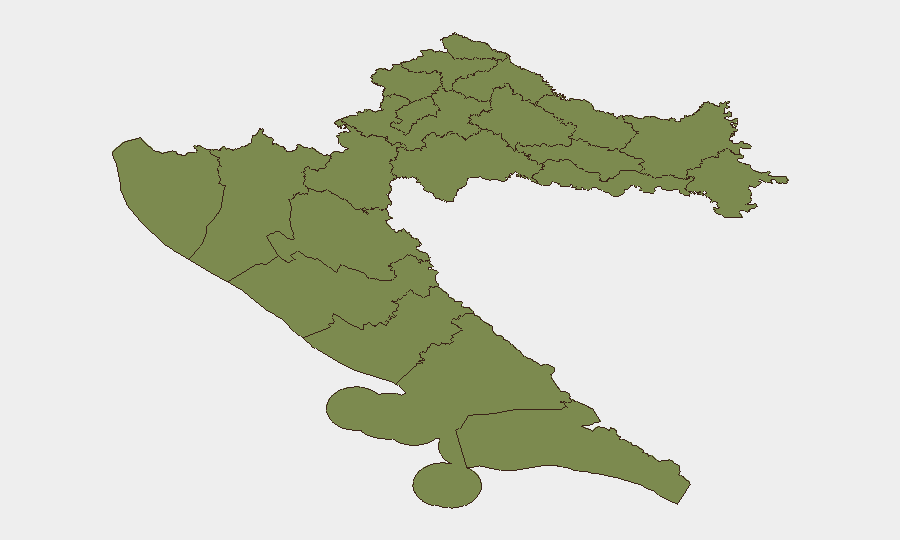
Karlovac County dominates the sub-national risk profile, with a composite score of 31.4—roughly 22 times higher than Zagreb and more than 20 times higher than any other region. This concentration suggests ongoing military, paramilitary, or defense-sector activity linked to the county's proximity to historically sensitive border and post-conflict zones. Zagreb (score 12) reflects capital-city-level exposure to organized activity, political events, and international scrutiny. All other counties register uniformly low risk (1.4 each), indicating that Croatia's security challenge, to the extent one exists, is highly localized to the Karlovac corridor and Zagreb; the broader coastal and northern regions show no comparative threat indicators in the dataset.
How GeoBit Would Assist
Corporate security teams with personnel or assets in Karlovac County or Zagreb should deploy persistent area-of-interest (AOI) monitoring & early-warning watches on those jurisdictions to flag emerging incidents, civil unrest, or infrastructure disruptions in near-real time. Multi-language OSINT fusion, local social-media monitoring, and sentiment analysis of Croatian-language sources would detect micro-level incidents (protests, arrests, road closures, police activity) before they escalate or affect operations. For duty-of-care teams planning travel or logistics, alternative routing and network analysis capabilities can identify safe, verified pathways around flagged zones and provide dynamic rerouting if conditions shift.
7-Day Outlook
The security environment in Croatia is expected to remain stable over the next seven days, with no indicators of imminent escalation in the broader national picture. Teams in Karlovac County should maintain heightened situational awareness and sustained AOI monitoring, as the elevated risk profile in that region may reflect ongoing security operations or border management that could generate localized disruptions. No changes to duty-of-care posture are recommended at the national level; however, personnel transiting or based in Karlovac should confirm local conditions and alternative routes with security teams before travel.
Highest-Risk Areas — Ranked
| # | State / Region | Risk |
|---|---|---|
| 1 | Karlovac County | 31.4 |
| 2 | City of Zagreb | 12 |
| 3 | Krapina-Zagorje County | 1.4 |
| 4 | Međimurje County | 1.4 |
| 5 | Varaždin County | 1.4 |
| 6 | Koprivnica-Križevci County | 1.4 |
| 7 | Zagreb County | 1.4 |
| 8 | Sisak-Moslavina County | 1.4 |
| 9 | Istria | 1.4 |
| 10 | Primorje-Gorski Kotar County | 1.4 |
| 11 | Lika-Senj County | 1.4 |
| 12 | Zadar County | 1.4 |
Sources
Previous Daily Briefs
A new Croatia brief is written every day — each with its own risk map and downloadable CSV. Here's the last week; use the calendar to go further back.
📅 Browse every day by calendar →
Highlighted days have a brief. Tap a day for that day's map & analysis, or “csv” for that day's dataset ($5).
Atlas — our AI intelligence desk — emails them this snapshot personally. Nothing else, no list.