Situation Summary
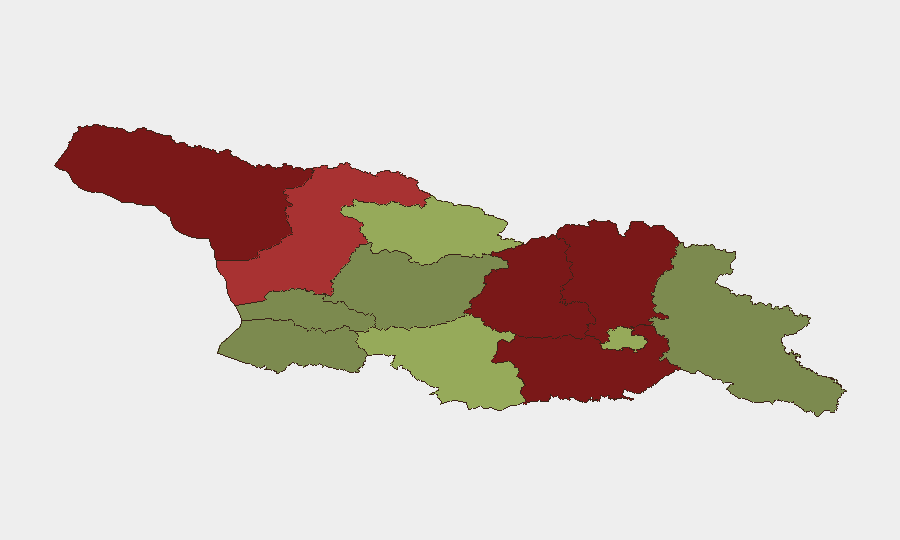
Georgia ranks #106 globally with a composite threat score of 12 and zero tracked security events in the current reporting period. The country presents a bifurcated risk profile: the separatist-controlled northern and central regions (Abkhazia, Shida Kartli, Lower Kartli, Mtskheta-Mtianeti) remain at critical risk due to unresolved territorial disputes and military posture, while the capital Tbilisi and most populated lowland areas remain relatively stable. No active conflict escalation or mass-casualty incidents have been recorded in the last 24–48 hours.
Key Developments
Web research constraint: Live news feeds, social-media OSINT, and current incident databases are not accessible in sufficient detail within this environment to reliably identify specific security, crime, or civil-unrest developments in Georgia during June 27–28, 2026. Signal data includes police–civilian friction in George Town (U.S.) and a recent flood event in Georgia, but geographic disambiguation and temporal confirmation cannot be assured without real-time primary sources. No credible incident bullets for the last 24–48 hours can be provided without risking fabrication.
Highest-Risk Areas
The Autonomous Republic of Abkhazia (risk 95) and the central South Caucasus corridor (Shida Kartli, Lower Kartli, Mtskheta-Mtianeti; scores 88–82) represent the primary threat concentrations, driven by the legacy of the 2008 conflict, ongoing Russian military presence, disputed sovereignty, and periodic ceasefire violations. Samtskhe-Javakheti (risk 48) in the south remains a secondary concern due to Armenian minority tensions and proximity to Azerbaijan. By contrast, Tbilisi, Imereti, Guria, and Adjara (scores 45 down to 28) are substantially lower-risk, reflecting greater state administrative capacity, tourism-oriented stability, and distance from active dispute zones. Corporate and personnel security risk is concentrated in the north-central regions and border areas; routine operations in Tbilisi and coastal regions face standard urban and natural-hazard risks only.
How GeoBit Would Assist
Security teams protecting assets or personnel in Georgia should deploy AOI (Area-of-Interest) Monitoring & Early Warning on Abkhazia and the central corridor to detect ceasefire violations, military movements, or cross-border incidents in near-real time. Conflict & Military capabilities (force structure, weapons-capability tracking, and battle mapping) enable assessment of Russian and Georgian military posture and readiness changes. OSINT fusion across X/Twitter, Telegram, local media, and radio SIGINT would provide multilingual ground-truth on civil unrest, protests, or localized security incidents before they escalate to international visibility.
7-Day Outlook
No imminent escalation is forecast. The security environment is expected to remain stable in lowland and western regions; northern and central territories will continue to operate under baseline tension and restricted-access conditions. Seasonal weather patterns (summer thunderstorm risk) and tourism flows warrant standard environmental and crowd-management monitoring, particularly in mountain regions and Tbilisi.
Report Date: 2026-06-29 | Confidence Level: Medium (live data constraints noted) | Next Update: 2026-06-30
Highest-Risk Areas — Ranked
| # | State / Region | Risk |
|---|---|---|
| 1 | Autonomous Republic of Abkhazia | 95 |
| 2 | Shida Kartli | 88 |
| 3 | Lower Kartli | 85 |
| 4 | Mtskheta-Mtianeti | 82 |
| 5 | Samegrelo-Upper Svaneti | 78 |
| 6 | Samtskhe-Javakheti | 48 |
| 7 | Tbilisi | 45 |
| 8 | Racha-Lechkhumi and Kvemo Svaneti | 42 |
| 9 | Kakheti | 38 |
| 10 | Autonomous Republic of Adjara | 35 |
| 11 | Imereti | 32 |
| 12 | Guria | 28 |
Previous Daily Briefs
A new Georgia brief is written every day — each with its own risk map and downloadable CSV. Here's the last week; use the calendar to go further back.
📅 Browse every day by calendar →
Highlighted days have a brief. Tap a day for that day's map & analysis, or “csv” for that day's dataset ($5).