Situation Summary
Greece remains a moderate-risk country (rank #64 globally, composite score 18) with 135 tracked events, but acute security pressures have emerged in the past 48 hours centered on political violence and critical infrastructure failure in major urban centers. Coordinated firebomb attacks targeting ruling-party figures in Thessaloniki on July 1 signal a resumption of organized political violence, while simultaneous building collapse in Athens and ongoing irregular migration flows indicate compounding infrastructure and border-management strains. The concentration of incidents in Central Greece and Attica—the two highest-risk sub-national regions—underscores localized but significant threats to personal safety, business continuity, and law-enforcement capacity.
Key Developments
- Thessaloniki firebombings (July 1, 0400–0445 hrs): Three coordinated incendiary attacks on apartment buildings housing New Democracy party members and a parliamentary candidate; five hospitalized, including candidate with severe burns and mother in intensive care; vehicles destroyed; police launched anti-terror investigation into politically motivated targeting.
- PM Mitsotakis public response (July 1): Prime Minister publicly condemned attacks as "cowardly, terrorist and murderous," pledged prosecution of perpetrators, and initiated formal anti-terror investigation, signaling political escalation and state security mobilization.
- Athens building collapse – Petralona (July 1): Four-story residential apartment building collapsed; emergency search-and-rescue teams deployed; outcome and casualty numbers still being assessed, indicating potential for cascading urban-safety incidents and strain on emergency services.
- Kalamata maritime interceptions (July 1–2): Greek coast guard intercepted 115 irregular migrants in three separate incidents south of Kalamata within hours, confirming active and densely packed irregular migration routes and ongoing maritime law-enforcement operations.
- Crete migrant arrival (June 30): Social media reports of 47 additional irregular migrants arriving on Crete's unspecified coastal location, consistent with sustained cross-Mediterranean migration pressure on Greek borders.
Highest-Risk Areas
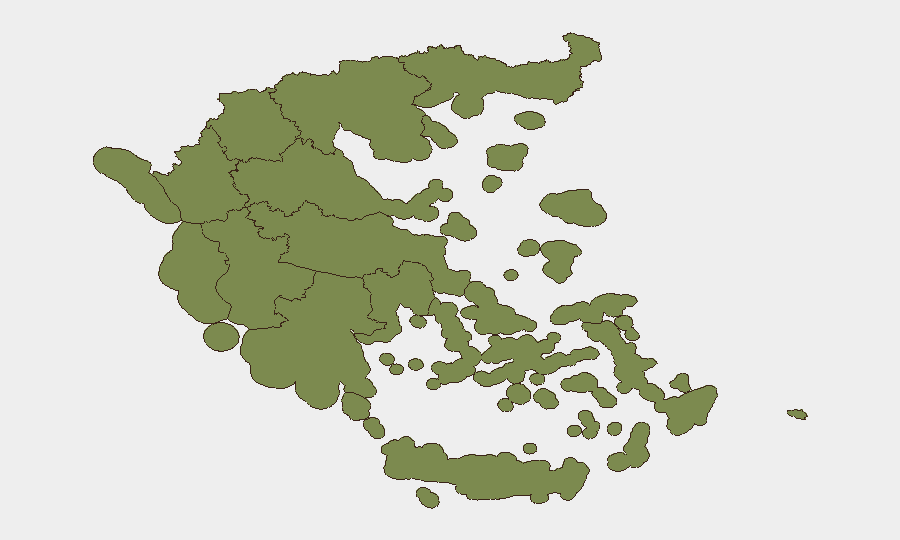
Central Greece dominates the sub-national risk profile (31.5), driven by the Thessaloniki firebombings and their political implications, which signal active extremist or opposition-linked attack capability in Greece's second-largest city and major economic hub. Attica (21.0)—encompassing Athens—ranks second due to the building collapse, ongoing protest activity, and concentration of state/corporate infrastructure; together these two regions account for the vast majority of tracked national risk. Central Macedonia and Eastern Macedonia and Thrace show significantly lower scores (6.4 and 4.9), suggesting the violence is not yet nationally dispersed but remains geographically concentrated in the north and capital. Remaining regions score below 2.0, indicating peripheral risk at present.
How GeoBit Would Assist
A security team protecting personnel or assets in Greece should deploy AOI Monitoring & Early Warning on Thessaloniki and Athens to detect follow-on attack signals, protest activity, or law-enforcement escalation in real time. Network & Actor Analysis and multi-language OSINT (X/Twitter, Telegram, local forums) would identify responsible groups, track tactical intent, and monitor for claims of responsibility or related messaging. Routing & Network Analysis would support duty-of-care teams in identifying safe transit corridors and alternative work/residence locations in affected cities during the current operational tempo.
7-Day Outlook
Political violence in Greece is likely to remain elevated over the next week as the anti-terror investigation unfolds, opposition movements respond to the attacks, and state security measures intensify. Building-collapse investigations in Athens may trigger broader infrastructure safety audits and temporary area closures, further disrupting business continuity. Border and maritime migration flows are expected to remain stable but high-volume, requiring continued law-enforcement presence and creating secondary safety risks in coastal regions.
Highest-Risk Areas — Ranked
| # | State / Region | Risk |
|---|---|---|
| 1 | Central Greece | 31.5 |
| 2 | Attica | 21 |
| 3 | Central Macedonia | 6.4 |
| 4 | Eastern Macedonia and Thrace | 4.9 |
| 5 | Thessaly | 2 |
| 6 | South Aegean | 1.9 |
| 7 | Western Greece | 1.7 |
| 8 | Western Macedonia | 1.5 |
| 9 | Peloponnese Region | 1.5 |
| 10 | Autonomous Monastic State of the Holy Mountain | 1.5 |
| 11 | Northern Aegean | 1.5 |
| 12 | Crete | 1.5 |
Sources
Previous Daily Briefs
A new Greece brief is written every day — each with its own risk map and downloadable CSV. Here's the last week; use the calendar to go further back.
📅 Browse every day by calendar →
Highlighted days have a brief. Tap a day for that day's map & analysis, or “csv” for that day's dataset ($5).