Situation Summary
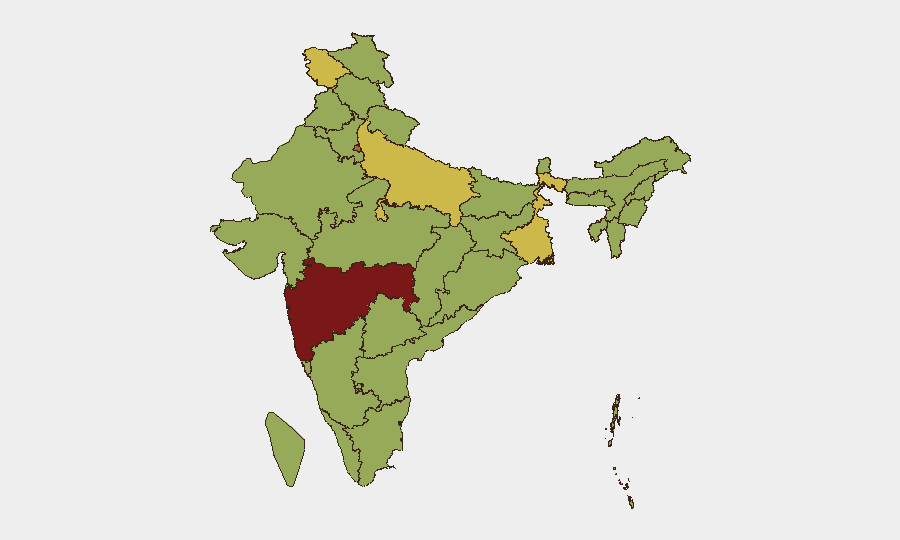
India remains at composite threat level 77 (rank #17 globally), with 1,618 tracked events reflecting persistent civil-unrest, political tension, and localized security incidents. Signal-level activity over the past 72 hours indicates community demands, legislative scrutiny, and scattered armed incidents, though independent verification of specific incidents within the last 24–48 hours remains incomplete. Maharashtra, Delhi, and Uttar Pradesh continue to drive overall risk elevation. The threat trajectory is stable with episodic volatility in high-risk urban centers.
Key Developments
- 2026-06-20 · Armed Incident at School (Location Unconfirmed): Small-arms combat reported at an educational facility; police investigation ongoing. Severity and casualty status require confirmation.
- 2026-06-20 · Legislative & Law-Enforcement Investigations: Police and state legislator-level inquiries launched, likely connected to recent civil unrest or governance disputes. Scope and timeline not yet clarified.
- 2026-06-18–19 · Community & Senate-Level Demands: Community-initiated demand activity reported, followed by senator-level engagement on 2026-06-19. Underlying grievance categories not specified in available signals.
- 2026-06-18 · Political-Governance Tension (New Delhi): Disapproval signals recorded between New Delhi and state/national government; content and affected constituencies unclear.
- 2026-06-18 · Media–Government & Media–Sena Friction: Two separate public-statement events indicate tension between media and government entities, and between Shiv Sena (or regional sena actor) and media. Likely tied to political or civil-order narratives.
- 2026-06-18 · Rebellion-Threat Signal: A threat-level signal mentioning rebellion was recorded; specific actor, geography, and credibility assessment pending verification.
Status Note: GeoBit signals from 2026-06-18–20 are event-level indicators pending independent corroboration. No timestamped field incidents from the last 24–48 hours have been independently verified through secondary sources. Watch-list escalation warranted if verification occurs.
Highest-Risk Areas
Maharashtra (risk 84) and Delhi (risk 74.1) remain the primary threat drivers, driven by political contestation, commercial-scale crime, and civil-unrest frequency in metro zones. Uttar Pradesh (64.8) and West Bengal (61.9) contribute through communal-tension and governance-instability signals. Jammu & Kashmir (60.3) reflects persistent border-stability and insurgency-linked risk; Punjab (58.3) shows Khalistani-linked activity and inter-community friction. Together, these six regions account for the majority of India's tracked 1,618 events and are where corporate and diplomatic presence faces the highest incident probability.
How GeoBit Would Assist
Security teams should deploy AOI Monitoring & Early Warning on Maharashtra, Delhi, and UP headquarters and key facilities, paired with Intel Sweep (X/Twitter, Telegram, YouTube OSINT) to track emerging civil-unrest narratives and factional statements in real time. Entity extraction and sentiment analysis applied to regional media and government channels will surface governance disputes and community-demand escalation 24–48 hours before street-level mobilization. Routing & Network Analysis ensures duty-of-care teams can identify alternative transit corridors during localized unrest; conflict and regime-stability search provides structured briefings on factional alliances and flashpoint geography.
7-Day Outlook
Signal intensity is likely to remain elevated in Maharashtra and Delhi through a political or legislative cycle event; community demands may escalate to peaceful protest or intermittent traffic disruption by 2026-06-25. No indicators suggest imminent nationwide instability, but episodic armed clashes in schools or public spaces remain possible in Bihar, UP, and West Bengal. Continued monitoring of media–government rhetoric and police investigations is warranted to assess whether 2026-06-18–20 signals represent isolated incidents or a broader factional mobilization.
Highest-Risk Areas — Ranked
| # | State / Region | Risk |
|---|---|---|
| 1 | Maharashtra | 84 |
| 2 | Delhi | 74.1 |
| 3 | Uttar Pradesh | 64.8 |
| 4 | West Bengal | 61.9 |
| 5 | Jammu and Kashmir | 60.3 |
| 6 | Rajasthan | 59.6 |
| 7 | Punjab | 58.3 |
| 8 | Bihar | 58.1 |
| 9 | Haryana | 57.8 |
| 10 | Karnataka | 57.1 |
| 11 | Madhya Pradesh | 56.9 |
| 12 | Tamil Nadu | 56.8 |
Sources
Previous Daily Briefs
A new India brief is written every day — each with its own risk map and downloadable CSV. Here's the last week; use the calendar to go further back.
📅 Browse every day by calendar →
Highlighted days have a brief. Tap a day for that day's map & analysis, or “csv” for that day's dataset ($5).