Situation Summary
Kazakhstan remains a low-threat environment (global rank #128, composite score 6/100) with no confirmed violence, civil unrest, or targeted political attacks in the past 48 hours. Recent activity is dominated by infrastructure and environmental incidents—forest fires, industrial accidents, and border-administration delays—rather than security escalation. The threat trajectory remains stable and low-intensity, though administrative friction at border crossings warrants continued monitoring.
Key Developments
- Akmola Region, East Kazakhstan Region, and Bayanaul National Park (Pavlodar Region) – 18 July 2026
Ministry of Ecology reported new forest fire outbreaks on state forest lands, causing localized air-quality degradation and fire-safety risks for nearby communities and transportation corridors.
- Almaty city, Rozybakyeva Street 249/1 – 18 July 2026
Warehouse fire involving lithium-ion batteries and rental electric scooters triggered fire-service response; localized industrial hazard with short-term disruption in the immediate vicinity.
- Kazakhstan–Russia border zone (Kostanay / North Kazakhstan Region) – 18 July 2026
Minor earthquake detected; no damage, casualties, or follow-on security implications reported.
- Russian–Kazakh and Kazakhstan–Kyrgyzstan border crossing points – 18 July 2026
Tightened fuel-smuggling controls continue to cause administrative delays for passenger and cargo traffic; no clashes or violence observed in the 16–18 July window.
- Nationwide (Kazakhstan) – 18–19 July 2026
Cross-platform security monitoring confirms no verified incidents of terrorism, large-scale protests, or major crime spikes; threat environment remains low-intensity and primarily administrative.
Highest-Risk Areas
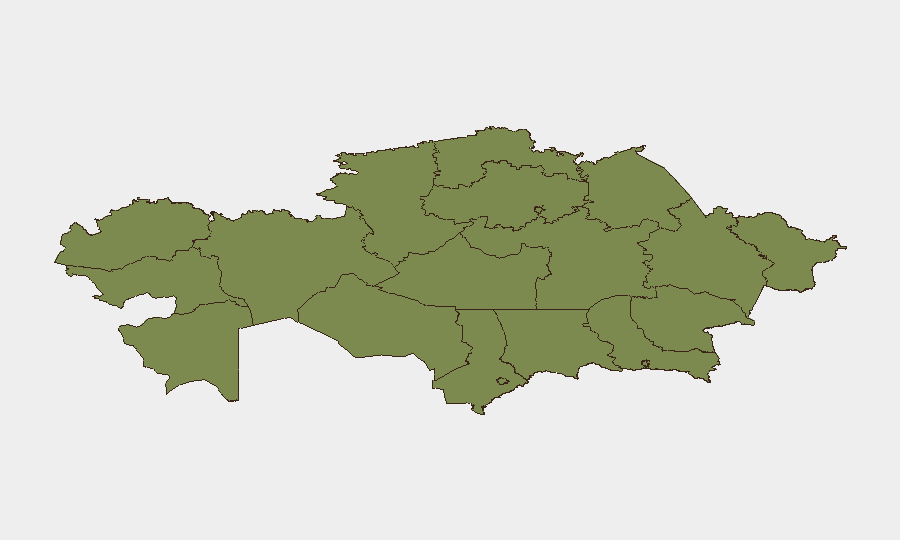
Ulytau Region significantly outranks all other sub-national areas (risk score 31.8 vs. Astana at 8.7), suggesting concentrated risk drivers—likely resource-extraction activity, border proximity, or localized instability not yet fully reflected in recent event data. The remaining 10 regions cluster at uniform baseline risk (1.8), indicating geographically dispersed, low-level threat patterns. Astana's elevated score relative to the national average warrants closer monitoring of political, administrative, or infrastructure vulnerabilities in the capital; Ulytau's anomaly suggests either acute emerging threat or data-concentration effects that require targeted geospatial and event-correlation analysis.
How GeoBit Would Assist
Corporate security and duty-of-care teams should employ AOI Monitoring & Early Warning with persistent watches on Ulytau Region and major border crossings to detect escalation in fuel-smuggling enforcement or resource-sector incidents before they affect operations. OSINT Fusion & Corroboration across social media, local news, and cross-border traffic data will clarify whether current border delays represent temporary administrative tightening or a shift in regional stability. Satellite & Imagery Analysis combined with GIS & Spatial Analysis can track forest-fire progression and impact on transport routes and asset locations in real time.
7-Day Outlook
The near-term security trajectory for Kazakhstan is expected to remain stable, with infrastructure and environmental incidents (fires, border delays) dominating the operational landscape rather than political or conflict-driven events. However, the unexplained risk spike in Ulytau Region warrants heightened attention; monitoring should intensify if cross-border activity, protest signals, or military movements emerge. Border-crossing delays may persist through late July pending clarification of smuggling-enforcement policy.
Highest-Risk Areas — Ranked
| # | State / Region | Risk |
|---|---|---|
| 1 | Ulytau Region | 31.8 |
| 2 | Astana | 8.7 |
| 3 | Turkistan Region | 1.8 |
| 4 | Almaty Region | 1.8 |
| 5 | East Kazakhstan Region | 1.8 |
| 6 | Abay Region | 1.8 |
| 7 | Jetisu Region | 1.8 |
| 8 | West Kazakhstan Region | 1.8 |
| 9 | Atyrau Region | 1.8 |
| 10 | Mangystau Region | 1.8 |
| 11 | Aqtöbe region | 1.8 |
| 12 | Pavlodar Region | 1.8 |
Sources
Previous Daily Briefs
A new Kazakhstan brief is written every day — each with its own risk map and downloadable CSV. Here's the last week; use the calendar to go further back.
📅 Browse every day by calendar →
Highlighted days have a brief. Tap a day for that day's map & analysis, or “csv” for that day's dataset ($5).
Atlas — our AI intelligence desk — emails them this snapshot personally. Nothing else, no list.