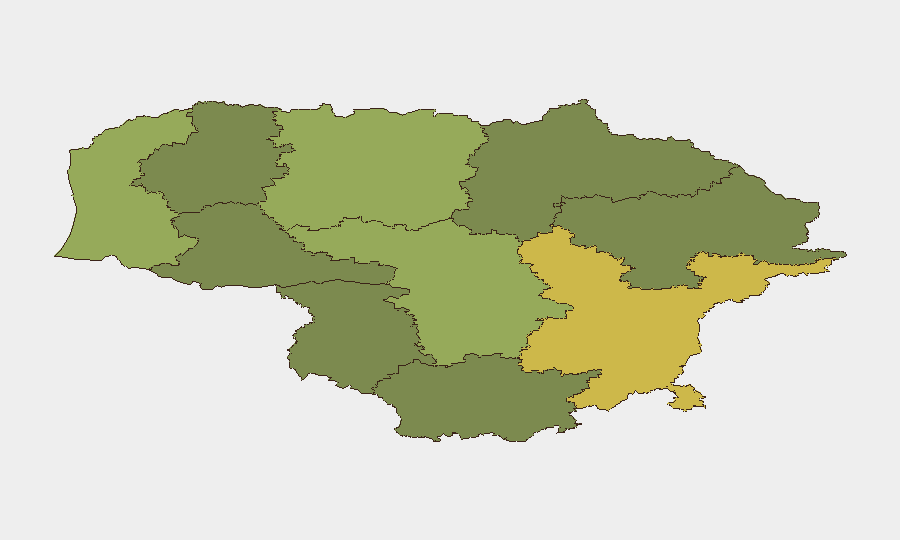
Situation Summary
Lithuania remains under sustained hybrid-pressure conditions from Belarus and Russia, characterized by irregular migration, cross-border smuggling, and intelligence-collection activity rather than direct military conflict or mass civil unrest. Over the last 48 hours, border and law-enforcement activity has remained routine, though several incidents—including a large-scale drone-smuggling intercept and an espionage investigation—underscore persistent vulnerabilities in counterintelligence and critical-infrastructure security. The threat environment is elevated but localized; no country-wide emergency has been declared.
Key Developments
- Vilnius, 28 July – The Vilnius Regional Prosecutor's Office opened a pre-trial espionage investigation into a Lithuanian citizen suspected of collecting and transmitting information on military facilities, airport movements, and defense-industry sites to Russia via Telegram, indicating active Russian intelligence operations targeting domestic infrastructure.
- Druskininkai area (Belarus border), 28–29 July – Lithuanian Border Service simultaneously intercepted four smuggling drones carrying approximately 5,000 packs of illicit cigarettes—described as the first incident of that scale at a single location—signaling escalation in hybrid-pressure smuggling tactics and potential vulnerabilities in aerial-border monitoring.
- Šakiai District (Southwest Lithuania), 29 July – Border guards detained a French citizen transporting 19 irregular migrants; the incident reflects ongoing people-smuggling networks exploiting the Belarus–Lithuania migration corridor.
- Lithuania–Belarus border (multiple points), 29 July – Border guards prevented 13 illegal crossing attempts in 24 hours, consistent with ongoing hybrid-pressure patterns but without associated mass breaches or civil disorder.
- Grigiškės (near Vilnius), 29 July – Police discovered the body of a man near a cemetery; a death investigation was opened with no indication of broader security or terror links at this stage.
- Port of Klaipėda and Curonian Spit, 28–29 July – Lithuanian Armed Forces conducted rapid-response infrastructure-protection drills involving Navy, Land Forces, Air Force, Military Police, and Public Security Service; localized movement restrictions or military presence may be visible to travelers and port users in the coming days.
Highest-Risk Areas
Vilnius County (risk 68) and Kaunas County (risk 58) dominate the sub-national ranking, reflecting the concentration of critical infrastructure, military facilities, government offices, and international transport hubs in these urban centers—precisely the targets of espionage and hybrid-pressure activity noted in recent events. Klaipėda County (risk 52) ranks third, driven by the strategic Port of Klaipėda and its role in NATO supply chains and energy infrastructure. Border counties (Tauragė, Utena, Alytus) register lower composite scores but remain under persistent migrant and smuggling pressure from Belarus, with potential for localized incidents. Corporate and personnel security should weight Vilnius and Kaunas highest for counterintelligence and access-control posture.
How GeoBit Would Assist
Security teams operating in Lithuania would benefit from AOI Monitoring & Early Warning on critical-infrastructure sites, borders, and transport nodes to detect reconnaissance, surveillance, or physical intrusion attempts. Network & Actor Analysis of espionage and smuggling networks—integrating Telegram OSINT, entity extraction, and actor-tracking—enables early detection of insider threats and intelligence operations. Routing & Network Analysis combined with border and maritime tracking supports personnel movement planning and supply-chain resilience across the Belarus and Russia exposure zones.
7-Day Outlook
Hybrid-pressure activity (migration, smuggling, intelligence collection) will likely persist at current levels; border-control incidents and minor law-enforcement actions should be expected. The espionage investigation and drone-smuggling escalation may trigger heightened internal-security posture and temporary military exercises, increasing localized disruptions around critical sites. No major political or military escalation is signaled in current open-source reporting.
Highest-Risk Areas — Ranked
| # | State / Region | Risk |
|---|---|---|
| 1 | Vilnius County | 68 |
| 2 | Kaunas County | 58 |
| 3 | Klaipeda County | 52 |
| 4 | Siauliai County | 42 |
| 5 | Panevezys County | 38 |
| 6 | Taurage County | 35 |
| 7 | Utena County | 33 |
| 8 | Alytus County | 32 |
| 9 | Telsiai County | 28 |
| 10 | Marijampole County | 25 |
Sources
Previous Daily Briefs
A new Lithuania brief is written every day — each with its own risk map and downloadable CSV. Here's the last week; use the calendar to go further back.
📅 Browse every day by calendar →
Highlighted days have a brief. Tap a day for that day's map & analysis, or “csv” for that day's dataset ($5).
Atlas — our AI intelligence desk — emails them this snapshot personally. Nothing else, no list.