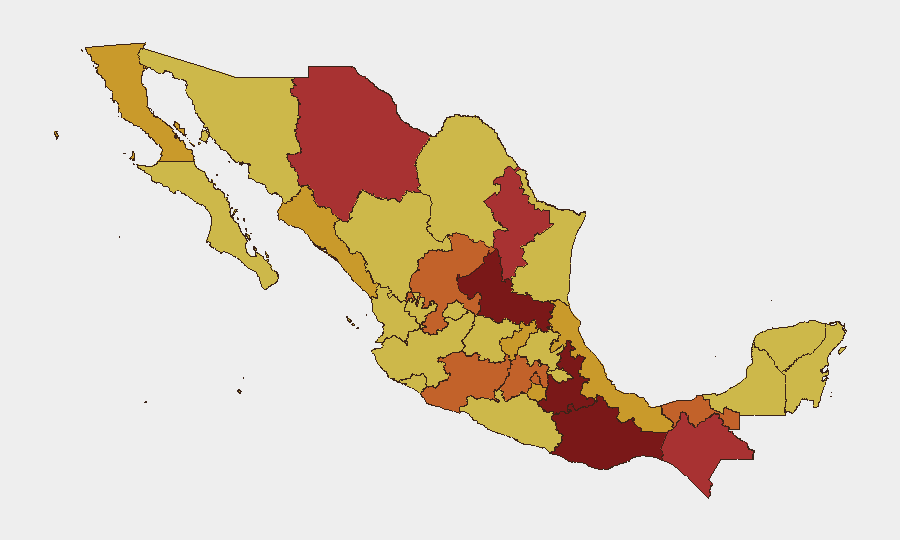
Situation Summary
Mexico remains at composite threat level 5 globally, driven primarily by organized criminal violence across 12 high-risk states. Current security posture reflects heightened state deployment—nearly 100,000–150,000 security personnel (military, National Guard, police) are active nationwide in support of World Cup operations through mid-June, concentrating heavily armed presence in Mexico City, Guadalajara, and Monterrey. Underlying criminal-organization activity, institutional instability (reflected in recent legislative demands, judicial assault, and interagency tensions per event signals), and labor/social unrest continue beneath the major-event security umbrella. Risk trajectory remains elevated with no imminent de-escalation signals.
Key Developments
Data Limitation Notice: GeoBit's live web research (last 24 hours) does not contain verifiable, date-specific incident reports from 14–16 June 2026. Recent event signals flagged governance tensions—legislative demands against a politician, mayoral public statements regarding Juárez, a physical assault on a judge, and disapproval of police conduct—but without incident-level location or timestamp detail sufficient for operational briefing. To avoid conflating older context (e.g., February cartel operations in Jalisco) with current developments, the following reflects confirmed recent posture rather than new incidents:
- Nationwide – World Cup security deployment: ~100,000–150,000 military, National Guard, and police personnel deployed across major cities with armed patrols, anti-drone, and surveillance coverage through mid-June event period.
- Jalisco state – elevated cartel activity (context: February 2026 onwards): U.S. government continues "reconsider travel" advisory; over 70 personnel killed post–cartel leader operation; ongoing criminal-organization jockeying for territorial control.
- UK FCDO travel warnings (current 15 June): Designated high-risk zones include Tamaulipas, Zacatecas, Michoacán, Guerrero, Colima, Chihuahua border regions, Baja California (Tijuana, Tecate), and Chiapas—all tied to cartel violence, kidnapping, and civil unrest.
- Event signal cluster (15–16 June): Judicial assault, legislative-executive conflict, institutional disapprovals, and migrant-related statements suggest underlying governance strain alongside criminal-threat landscape.
Corporate security teams requiring incident-level granularity (specific attacks, kidnappings, protests, infrastructure disruptions dated within 24–48 hours) should cross-check Mexican national media (El Universal, Reforma, Milenio), official Gobierno de México / Guardia Nacional alerts, and embassy security notices in parallel with GeoBit feeds.
Highest-Risk Areas
San Luis Potosí (risk 100), Puebla (94.1), and Oaxaca (88) lead sub-national rankings, followed by Chihuahua, Chiapas, and Nuevo León (76–78 range). These states combine high cartel-organization presence, trafficking corridor control, and institutional capacity gaps. Mexico City and State of Mexico (both ~73), despite lower ranking, remain critical due to population density, asset concentration, and spillover from adjacent high-risk zones. Jalisco, though not in top 12 here, warrants continued monitoring given post-February destabilization and ongoing cartel consolidation.
How GeoBit Would Assist
Intel Sweep & OSINT Fusion across Mexican media, official agencies, and X/Telegram feeds provides real-time incident corroboration. AOI Monitoring & Early Warning with persistent watch on San Luis Potosí, Puebla, Oaxaca, and Jalisco enables advance alert on kidnapping upticks, checkpoint activity, or cartel clashes. Network & Actor Analysis maps criminal-organization structure changes, allowing teams to adjust route planning and asset positioning. Routing & Network Analysis generates alternative transportation and logistics corridors around active threat clusters, critical for operations in high-risk states.
7-Day Outlook
World Cup security deployment maintains heightened state control through mid-June, likely suppressing street-level cartel violence near host cities but potentially displacing activity to secondary zones. Post-event security normalization (expected late June) will reduce military/police presence, creating an operational vacuum that criminal organizations historically exploit. Governance tensions (judicial, legislative signals) suggest institutional friction that may slow coordinated security responses in peripheral states.
Highest-Risk Areas — Ranked
| # | State / Region | Risk |
|---|---|---|
| 1 | San Luis Potosí | 100 |
| 2 | Puebla | 94.1 |
| 3 | Oaxaca | 88 |
| 4 | Chihuahua | 77.6 |
| 5 | Chiapas | 77.3 |
| 6 | Nuevo León | 76.1 |
| 7 | Tabasco | 75.7 |
| 8 | Michoacán | 75.1 |
| 9 | Zacatecas | 73.9 |
| 10 | State of Mexico | 73.7 |
| 11 | Mexico City | 73.2 |
| 12 | Veracruz | 72.7 |
Previous Daily Briefs
A new Mexico brief is written every day — each with its own risk map and downloadable CSV. Here's the last week; use the calendar to go further back.
📅 Browse every day by calendar →
Highlighted days have a brief. Tap a day for that day's map & analysis, or “csv” for that day's dataset ($5).