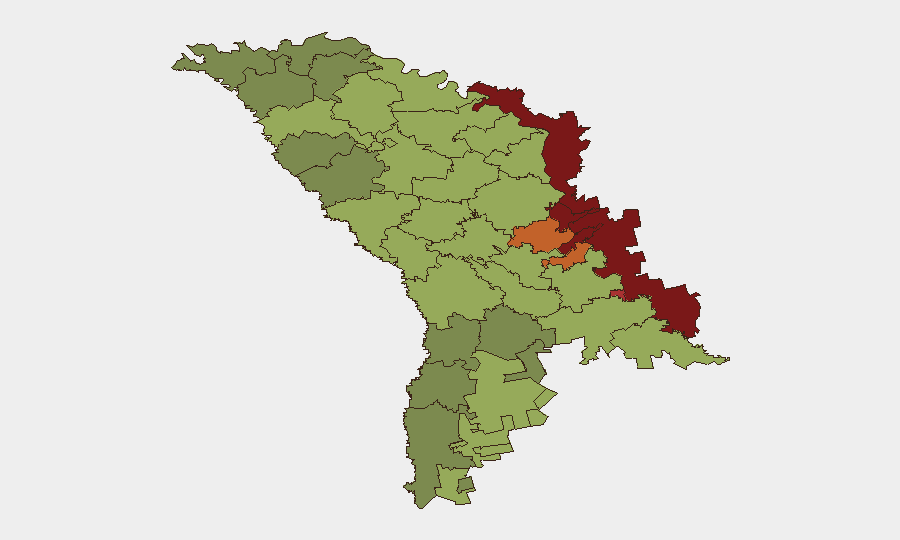
Situation Summary
Moldova faces a baseline composite threat score of 7 globally, with security conditions shaped by ongoing geopolitical friction with Russia, administrative divisions along the Dniester, and sporadic diplomatic incidents. No verified security or civil-unrest incidents have been documented in Moldova within the last 24–48 hours. The threat landscape remains characterized by chronic rather than acute risks: territorial fragmentation, Russian diplomatic friction, sanctions-evasion enforcement, and weather-related public safety demands.
Key Developments
- No verified security or civil-unrest incidents documented in Moldova during July 24–25, 2026. Open-source monitoring shows no confirmed protests, armed incidents, infrastructure sabotage, or travel disruptions in the last 24–48 hours.
- Russian–Moldovan diplomatic friction (mid-July, ongoing). Moldovan police detained Russian embassy staff at the Leuşeni border crossing and seized diplomatic license plates from a Russian embassy bus in Chişinău; Russia summoned the Moldovan ambassador on July 21 in protest. This reflects escalating police–diplomatic tension but does not constitute a fresh security incident within the reporting window.
- Dual-use export sanctions-evasion dismantled (recent, date unspecified). Moldova's Intelligence and Security Service and Prosecutor's Office disrupted an illegal export scheme supplying dual-use goods to Russian military-industrial entities under international sanctions. Incident date not precisely confirmed within 24–48 hours.
- Extreme heat response (July 24–25). Moldovan civil protection opened 14 assistance points across regions; three water-related deaths of minors reported in past 24 hours. This is public safety and emergency response, not conflict or civil unrest.
Highest-Risk Areas
The Left Bank Dniester administrative units (risk 85), Dubăsari (82), and Bender (79) dominate the sub-national ranking, reflecting the de facto separatist Transnistrian territory's chronic governance fragmentation, uncontrolled armed presence, and absence of state authority. Criuleni (75) and Rezina (58) follow, both bordering the disputed zone and vulnerable to spillover. Gagauzia (54), an autonomous region with Russian sympathies, and Taraclia (55) represent secondary concentrations of political tension and pro-Russian sentiment. Chişinău (49), despite being the capital, ranks 12th—a function of state security infrastructure and international diplomatic presence—but remains a focal point for political mobilization and Russian-aligned interference.
How GeoBit Would Assist
Corporate teams with personnel or assets in Moldova should employ AOI Monitoring & Early Warning on Dubăsari, Bender, and Left Bank Dniester units to detect sudden militia activity, checkpoint changes, or border control shifts affecting transit and logistics. Network & Actor Analysis combined with multi-language OSINT and Telegram/X monitoring would identify emerging pro-Russian or separatist coordination signals in real time. Alternative route and journey planning (Routing & Network Analysis) should be updated to account for Leuşeni and other border-crossing friction points, while regime-stability and election monitoring capabilities help contextualize Moldova's near-term political stability and Russian pressure vectors.
7-Day Outlook
No acute security escalation is forecast in the next seven days. Baseline risks remain: low-level diplomatic friction with Russia, chronic governance gaps in Transnistria, and routine border-control friction. Weather extremes (heat, potential flooding) will continue to drive public safety demands. Corporate duty-of-care teams should maintain standard situational awareness protocols and monitor diplomatic channels for any shift in Russian–Moldovan relations.
Highest-Risk Areas — Ranked
| # | State / Region | Risk |
|---|---|---|
| 1 | Administrative-Territorial Units of the Left Bank of the Dniester | 85 |
| 2 | Dubăsari | 82 |
| 3 | Bender | 79 |
| 4 | Criuleni | 75 |
| 5 | Rezina | 58 |
| 6 | Taraclia | 55 |
| 7 | Gagauzia | 54 |
| 8 | Căușeni | 53 |
| 9 | Soroca | 52 |
| 10 | Ștefan Vodă | 51 |
| 11 | Orhei | 50 |
| 12 | Chișinău | 49 |
Previous Daily Briefs
A new Moldova brief is written every day — each with its own risk map and downloadable CSV. Here's the last week; use the calendar to go further back.
📅 Browse every day by calendar →
Highlighted days have a brief. Tap a day for that day's map & analysis, or “csv” for that day's dataset ($5).
Atlas — our AI intelligence desk — emails them this snapshot personally. Nothing else, no list.